
You don’t have an SEO problem.
You’ve got a being invisible problem.
And Google doesn’t care how brilliant you are, how long you’ve been doing it, or how many mates say you’re “the best in Cheshire”. If you’re not showing up when someone searches, you may as well be trading out of a shed with the lights off.
So here it is. The no-bullsh*t guide to getting found on Google.
Not theory. Not “brand awareness”. Not 48 pages of fluff.
Just the stuff that actually moves the needle.
First, understand where “found” actually happens
Most small business owners think “getting found on Google” means “ranking #1”. That’s only one lane, and it’s not even the quickest one.
Here are the three places you need to win.
| Where you show up | What it looks like | What Google wants from you | What you should do about it |
|---|---|---|---|
| Google Maps (Local Pack) | The map + 3 businesses | You’re real, local, trusted | Nail your Google Business Profile and reviews |
| Organic results | The normal blue links | Relevance + authority + decent UX | Build proper service pages, get links, fix tech |
| AI answers (AI Overviews, ChatGPT-style search) | Summaries that quote sources | Clarity + structure + proof | Write answer-ready content with real evidence |
If you only take one thing from this post: Maps brings calls faster for local businesses. Organic builds a pipeline. AI visibility is the next knife fight.
If that last sentence sounded dramatic, good. It should.
Step zero: make sure Google can even see your site
Before you start “doing SEO”, check whether Google has actually indexed your pages.
Because if your site isn’t indexed, you can rewrite your homepage 400 times and it still won’t rank. That’s like putting up posters in your own living room and wondering why nobody turned up.
Do this:
- Set up Google Search Console (free).
- Use the URL Inspection tool.
- Check if your key pages are “Indexed”.
If you’re not showing up at all, it’s usually one of these:
| Symptom | Usual culprit | What to do |
|---|---|---|
| Site doesn’t appear for your brand name | Not indexed, or wrong canonical | Check Search Console indexing and canonicals |
| Pages “Discovered, currently not indexed” | Thin pages, duplicates, weak internal links | Improve content quality, add internal links |
| Pages “Excluded by ‘noindex’” | Someone ticked the wrong box (classic) | Remove noindex, resubmit |
| You changed URLs and traffic died | Redirect mess | Map old to new with clean 301s |
If you want the full breakdown (and the stuff that makes people swear at their web developer), read this: Why your website isn’t showing up on Google (and how to fix it).
Stop trying to rank for stupid keywords
If you’re a plumber in Crewe and your plan is to rank for “plumber”… I mean… come on.
That keyword is:
- Vague
- National
- Expensive (if you try to brute force it)
- Mostly useless for leads
The money is in buyer intent keywords. The ones typed by people who are already annoyed, already ready, and already looking for a solution.
Examples (you can steal this format):
- “emergency plumber Crewe”
- “boiler repair near Chester”
- “flat roof repair Nantwich”
- “wedding catering Cheshire prices”
Notice what’s happening?
- Service
- Location
- Sometimes urgency
- Sometimes cost
That’s how real customers search.
If you’re stuck, this framework is solid: SEO services, the 5 building blocks that drive leads.
Your website needs a spine (not a one-page brochure)
A shocking number of small business websites are basically:
- Home
- About
- Gallery
- Contact
Nice. But Google can’t rank vibes.
You need pages that scream:
- What you do
- Where you do it
- Why you’re the safe choice
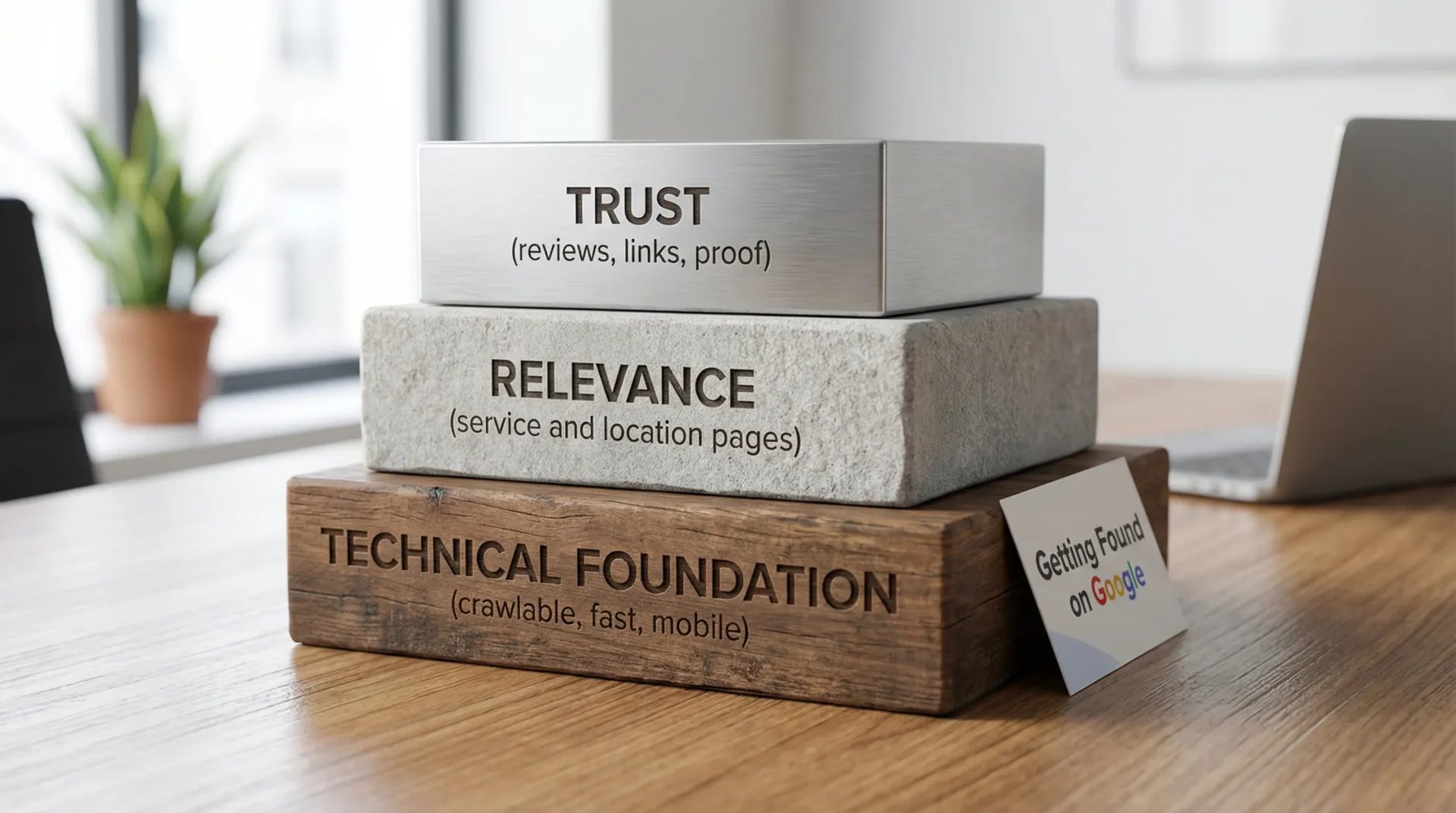
Here’s the minimum structure that works for most local service businesses:
- One page per core service (not everything crammed into one “Services” page)
- One page per key location (if you genuinely serve those towns)
- One “proof” page (case studies, results, before/after, testimonials)
- One proper contact page (clear CTA, phone, form, opening hours)
And yes, this means writing actual words. Not a paragraph and a stock photo of someone pointing at a laptop.
If you want a deeper guide on getting the page basics right, this is the one: On-page SEO: a guide to achieving SEO dominance.
Maps is the quickest win, and most people still mess it up
If you’re local, Google Maps can start bringing leads before your website rankings fully mature.
But your Google Business Profile (GBP) can’t be half-done.
The basics that matter (and yes, Google does notice):
- Correct primary category (don’t get cute)
- Services filled out (not just one line)
- Real photos (your work, your team, your vans, your shop)
- Regular updates (posts, offers, Q&A)
- Reviews that keep coming in
If you want the straight-up checklist, here you go: The one free tool every Cheshire business should be using.
And if you’re serious about getting more calls (not “more impressions” you can’t take to the bank), read: Local SEO services: how to get more calls in Cheshire.
Reviews: the only “hack” that still works
Want a real cheat code?
Get more reviews than your competitors, and don’t be weird about it.
Reviews do three jobs at once:
- They help Maps visibility
- They increase click-through rates (people choose the safest option)
- They convert enquiries (trust sells)
Here’s what actually works without feeling like you’re begging:
- Ask right after the win (job finished, customer smiling)
- Text the link (don’t say “leave a review on Google”, just send the link)
- Reply to every decent review (short, human, grateful)
- Reply to negative reviews calmly (future customers read that more than the rant)
And don’t buy fake reviews. That’s not rock and roll, it’s amateur hour.
Links: not 10,000 of them, just the right ones
Backlinks still matter. Anyone telling you they don’t is either clueless or selling something.
But you don’t need a thousand spam links from random sites in languages you can’t read.
You need local and relevant authority.
Good links (the kind that actually help):
- Local press mentions
- Sponsorships (local sports clubs, events)
- Supplier or partner pages
- Proper directories that humans use (not “SEO links 4 u dot biz”)
Bad links:
- Fiverr specials
- Link farms
- Anything that looks like a spreadsheet came to life
If you’ve ever paid for SEO and got a report full of “50 backlinks built” with no explanation, you’ll enjoy this: Your SEO agency is robbing you blind, here’s the proof.
Content that gets you found is not “blogging for the sake of it”
This is where most people waste months.
They publish posts like:
- “The History of Plumbing”
- “5 Reasons to Choose Us”
- “Why Quality Matters”
Nobody searches for that. Not even your mum.
Content that wins is painfully practical. It answers what people actually type when they’re ready to buy.
Think:
- Prices and ranges (with context)
- Timelines (how long it takes)
- Comparisons (option A vs option B)
- “Is it worth it?” questions
- “What happens if…” questions
This is exactly why niche guides work (plumbers, dentists, law firms, venues). They match real intent.
If you want a solid example, this one is built around high-intent local searches: How to get more plumbing customers from Google.
Your site speed and technical setup still matter (boring, but brutal)
You can have the best copy in Cheshire. If your site loads like it’s being delivered by pigeon, people bounce.
And when people bounce, Google notices.
You don’t need perfection. You need “not embarrassing”.
Start here:
- Mobile usability
- Core pages loading fast enough
- No broken links everywhere
- HTTPS (secure site)
- Clean navigation
If you want a punch list of the stuff people constantly miss, this is a good one: The 10 most commonly overlooked SEO issues.
And if your website is genuinely ancient, sometimes you don’t need “more SEO”, you need a proper rebuild. If you’re looking for an example of a team that bakes marketing into the build process, have a look at Sleek Web Designs and how they position web builds around launch speed and visibility.
AI search is here. If your content is messy, you won’t be mentioned
This is the bit most local businesses are ignoring, right up until their traffic graph looks like a ski slope.
AI-driven search (Google AI Overviews, conversational search tools) doesn’t reward waffle. It rewards:
- Clear answers
- Structured pages
- Consistent business info
- Proof (reviews, case studies, real-world detail)
If you want to show up in AI answers, your site needs to be easy to quote. That means:
- Descriptive headings
- Short, direct sections that answer one thing
- Service pages that state what you do, for who, where, and what it costs (if possible)
- Proper schema where relevant
If you’re playing catch-up, start here: How to optimise your business for ChatGPT, Gemini, and AI search.
And if you want the bigger picture on how this changes the game, this one lays it out: Why the new ChatGPT search engine changes everything for SEO.
“How long will it take?” depends on whether you actually do the work
Let’s kill the fantasy.
If you’ve got a half-finished site, no reviews, no service pages, and your GBP hasn’t been touched since 2021, you’re not ranking next week.
But you can see movement fast if you fix the foundations.
A realistic timeline for local SEO:
- Early signs: 4 to 8 weeks (maps visibility, impressions, some calls)
- Proper, defendable results: 6 to 12 months
That’s not pessimism. That’s reality.
Full breakdown here: How long does local SEO take to work.
Track leads, not ego metrics
Rankings are nice. Traffic is nice.
But you can’t pay your mortgage with “nice”.
Track what matters:
| What you want | What to track | Where |
|---|---|---|
| Calls | Click-to-call, phone clicks, call conversions | GA4 + GBP insights |
| Enquiries | Form submissions, email clicks | GA4 events |
| Local visibility | Map views, direction requests | GBP |
| Sales impact | Which pages lead to enquiries | GA4 + a half-decent CRM or spreadsheet |
If your SEO report doesn’t mention leads, it’s basically a bedtime story.
A one-week hit list (if you’re sick of being invisible)
Do these and you’ll be ahead of 80% of your competitors who are still “thinking about SEO”.
| Day | Do this | Result |
|---|---|---|
| 1 | Set up Search Console and check indexing | You stop guessing |
| 2 | Fix your homepage title and your main service page titles | Better relevance signals |
| 3 | Fully complete your Google Business Profile | Maps visibility improves |
| 4 | Ask 5 recent customers for reviews | Trust goes up, conversions improve |
| 5 | Create one proper service page (800 to 1,200 words, real detail) | You start ranking for something specific |
| 6 | Add internal links between related pages | Google crawls you better |
| 7 | Get one local link (partner, sponsor, press mention) | Authority starts building |
If you want a longer runway plan you can actually follow, this is solid: SEO for small businesses: a 12-week plan that works.
Proof that this isn’t just talk
SEO isn’t magic, it’s mechanics.
When you fix the mechanics, the results look boring on paper and insane in real life.
For example, SEO Bridge helped Crave Coffee hit +156% organic traffic and +94% conversion rate, plus top-5 rankings for 20+ keywords (without pretending a plugin did it): Crave Coffee case study.
That’s what “getting found” is supposed to do.
If you want someone to tell you what’s broken, do this
If you’ve read all this and thought, “Yep, my site is doing half of that, badly”… you’re normal.
Most business owners don’t need more SEO trivia. They need someone to look at their site and say:
- This is blocking you
- This is wasting your time
- This will get you leads first
If you want that kind of straight answer, start here: Shall we audit your website?
No fluff. No mystery retainer. Just clarity, then action.
