
I did the thing you’re not supposed to do.
I crawled through my competitors’ websites like a raccoon in a bin at 2am. Tabs everywhere. Notes. Screenshots. Mild despair.
And what I found was embarrassing.
Not for me. For them.
Because for all the noise in the SEO industry (the “award-winning” badges, the “bespoke growth frameworks”, the stock photos of people pointing at laptops), a shocking amount of competitors’ sites are held together with duct tape and wishful thinking.
If you’re a small business owner in Cheshire, here’s the good news: you don’t need to be a genius to beat most of your local competition online.
You just need to stop doing the obvious nonsense.
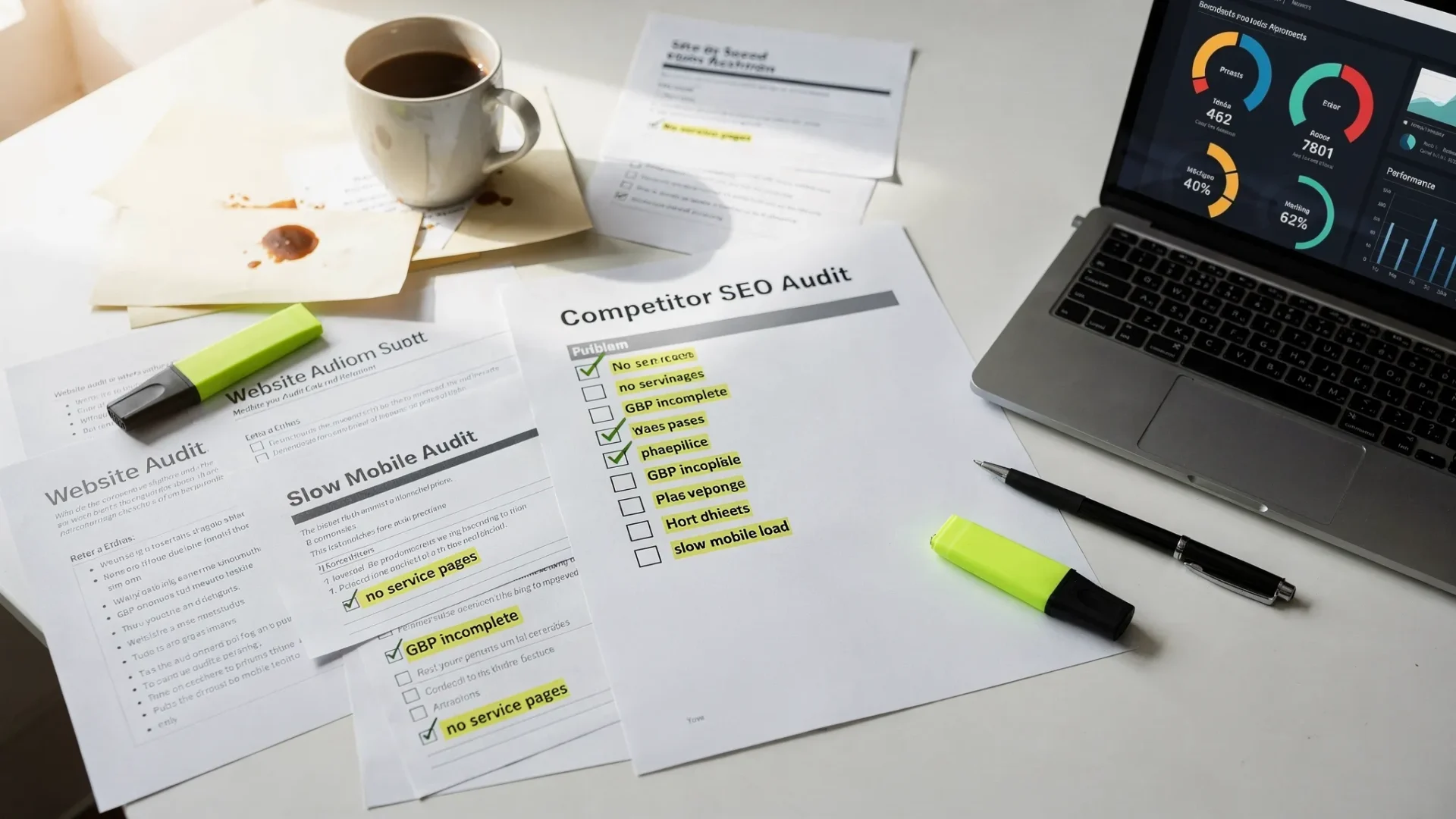
The competitor audit that ruined my evening
This wasn’t some fancy enterprise setup.
I looked at the same stuff Google (and now AI search tools) cares about:
- Can the site be crawled and indexed without tripping over its own shoelaces?
- Does it clearly say what the business does, where it does it, and why anyone should care?
- Is it fast and usable on mobile, or does it feel like a 2009 Nokia experience?
- Is there any proof the business is real and trusted (reviews, case studies, accreditations, actual human signals)?
- Is the content written for customers, or for a keyword spreadsheet?
- Does the site have structure that AI can quote without making things up?
If you’ve never had a proper audit done, start here: Shall We Audit Your Website?. It’ll save you months of “why isn’t this working?”
What I found (and why it matters to your bank account)
Here’s the pattern.
Most competitors don’t have one big catastrophic SEO problem.
They’ve got ten small, stupid ones. And they stack up like unpaid parking tickets.
1) Homepages trying to rank for everything (and succeeding at nothing)
I saw a lot of this:
- Homepage headline: “Welcome to [Business Name]”
- Next line: “We provide quality solutions”
- Then a paragraph of fluff that could describe a plumber, a yoga teacher, or an offshore oil rig
Google isn’t psychic. Neither is ChatGPT Search.
If your pages don’t clearly match what people search, you won’t rank when it counts.
You want leads? You need proper service pages that match actual intent.
If you want the non-fluffy breakdown of what “proper” looks like, read: SEO Services: The 5 Building Blocks That Drive Leads.
2) Technical SEO held together with “it seems fine on my phone”
This one’s a classic.
Sites that look acceptable… until you test them.
- Massive images slapped on with zero compression
- Sliders that nobody asked for
- Mobile menus that hide key pages
- Broken internal links (the silent killer)
Google has been banging on about page experience for years, and Core Web Vitals are still a basic yardstick. You don’t need to obsess, but you do need to avoid being awful.
If you want the straight checklist of common issues, this is gold: The 10 Most Commonly Overlooked SEO Issues.
Here’s the reality: a slow, clunky site doesn’t just lose rankings. It loses customers.
People don’t “bounce” because they’re rude. They bounce because your website feels like a punishment.
3) Local SEO that’s basically “we exist, please clap”
If you’re a local business, your Google Business Profile is not optional.
And yet I saw:
- Unclaimed profiles
- Wrong categories
- No photos
- No regular posts
- Reviews left to rot (or worse, replied to like a robot)
If you want a fast win, start here: The One Free Tool Every Cheshire Business Should Be Using.
And if you want the full local plan without the fairy tales: Local SEO Services: How to Get More Calls in Cheshire.
4) Content written for Google 2012
You can smell it a mile off.
The stiff, keyword-stuffed paragraphs that read like they were written by an exhausted intern who hates you.
That kind of content doesn’t just fail to rank, it actively makes people trust you less.
Modern SEO is people-first, but it’s also structure-first. Clear headings. Clear answers. Real proof. Stuff AI can quote without hallucinating.
If you’re trying to understand what actually matters now, read: SEO, AEO & GEO: What Actually Matters in the Age of AI Search.
5) Trust signals missing, or buried like a guilty secret
This is the one that made me laugh out loud.
Some competitor sites had:
- No case studies
- No testimonials
- No photos of real work
- No team info
- No “why choose us” that isn’t pure fluff
So they’re asking strangers to ring them, pay them, and trust them… based on vibes.
That’s not marketing. That’s wishful thinking.
Want to see what proper proof looks like? Here are a couple of real-world results pages:
- Booked Solid, Taking 2027 Enquiries in 2026 (Catering Case Study)
- From Invisible to Fully Booked (Dog Sitting Case Study)
Different industries, same lesson: proof beats promises.
And if you think this only applies to trades or services, it doesn’t. Even highly regulated niches win with trust-first structure. For example, look at this orthodontics clinic site built around credibility and clear patient outcomes. Credentials, before-and-after, process, booking, all laid out like they actually want someone to choose them. Revolutionary concept.
The “embarrassing” bit: most competitors are easy to outrank
Not because you’re smarter.
Because they’re sloppy.
Here’s a quick snapshot of what I checked, what I kept seeing, and what to do instead.
| What I checked | What competitors often do | What to do instead |
|---|---|---|
| Service targeting | One page trying to cover 12 services | One strong page per core service (plus supporting FAQs and examples) |
| Location relevance | “We cover Cheshire” shoved in the footer | Clear towns/areas in key pages, plus local proof (reviews, projects, directions) |
| Crawl/index basics | Broken links, messy redirects, orphan pages | Fix internal linking, tidy redirects, ensure key pages are indexable |
| Mobile UX | Tiny text, awkward forms, tap targets from hell | Make calls and enquiries stupidly easy on mobile |
| Trust | Generic claims with no evidence | Case studies, testimonials, photos, accreditations, real names |
| AI-readiness | Walls of text and vague claims | Structured pages with clear headings, concise answers, and consistent entity details |
If you’re thinking, “Cool, but where do I even start?”, this is a solid roadmap: SEO for Small Businesses: A 12-Week Plan That Works.
The stuff that actually moves the needle (without selling your soul)
Let’s turn this into something you can use.
Get your page-to-intent match sorted
Pick your money services. The ones that pay your mortgage.
Then build pages that match what people type:
- “emergency plumber chester” needs a different page than “boiler installation chester”
- “wedding venue in nantwich” needs different content than “corporate events venue”
You don’t need 200 pages. You need the right 10 to 30 pages, written like a competent adult.
Fix the boring technical stuff once, then stop bleeding traffic
Most small business sites don’t need “advanced technical SEO”.
They need:
- A site that loads quickly
- A site that works on mobile
- A site that doesn’t block Google accidentally
- A site that doesn’t confuse users
If you want a proper deep dive, this is the nerdy guide (in a good way): Mastering Technical SEO.
Stop treating your Google Business Profile like a dusty cupboard
If you’re local, your GBP is often your best lead source.
Treat it like a living sales asset.
Photos. Updates. Services. Q&A. Reviews.
And for the love of all that is holy, make sure your opening hours are correct.
Build authority like a grown-up (not with spammy links)
I still see agencies selling link packages like it’s 2010.
It’s not clever. It’s not “edgy”. It’s just a future headache.
If you’re worried you’re paying for nonsense, read this and get angry (useful angry): Your SEO Agency Is Robbing You Blind – Here’s The Proof.
Real authority in 2026 looks like:
- Mentions from relevant local sites
- Partnerships
- PR
- Reviews
- Case studies
- Consistent brand/entity signals that AI systems can trust
Make your site easy to quote by AI (without turning it into a textbook)
AI search is basically a lazy researcher.
It scans, summarises, and recommends.
So give it something clean to work with:
- Clear H2/H3 headings that match real questions
- Short answer blocks near the top of key pages
- Pricing guidance if you can (even “from” pricing)
- Proof and references (reviews, accreditations, outcomes)
If you’re behind on this, this one will light a fire: Your Competitors Are Already Optimising for AI Search. Are You?
“Alright then, what should I do this week?”
If you want a simple, non-magical plan you can actually execute, do this:
- Pick your top 3 money services and check you have one strong page for each
- Add clear location signals (towns you serve) where it makes sense, not stuffed into every sentence
- Audit your Google Business Profile and fix the obvious gaps
- Make your contact and enquiry journey painless on mobile
- Add proof: testimonials, photos, case studies, guarantees you can actually stand behind
- Fix broken links and obvious technical errors
- Write one genuinely helpful piece of content that answers a buyer question (not a fluff post)
If you want the “I’m on a tight budget but I still want results” version of this, you’ll like: SEO on a Budget?.
If your competitors are this messy, what does that mean for you?
It means you’re probably one solid audit and a few proper improvements away from stealing market share.
Not with gimmicks.
Not with a £99/month package that buys you two hours of someone pretending to care.
With the basics done properly.
If you want me to rip your site apart (politely) and tell you exactly what to fix first, start with a website audit. If you’ve been burned before, even better. You’ll appreciate the receipts.
