
SEO isn’t mysterious. It’s just annoyingly… earned.
If someone told you they could “do a bit of SEO” and you’d be top of Google by Friday, they’re either lying, clueless, or selling you the digital equivalent of magic beans.
Here’s the honest truth about SEO that nobody wants to say out loud, because it’s harder to sell the truth than it is to sell hope.
Truth #1: Google doesn’t rank websites. It ranks solutions.
Google’s job isn’t to reward your business for existing. It’s to shut the searcher up by giving them the best answer, the fastest.
So when you ask “why aren’t we ranking?”, what you’re really asking is:
- Are we the most relevant option for that search?
- Are we the most trustworthy option?
- Is the page actually usable on a phone, right now, in the real world?
Google literally tells you this in plain English in its own docs: build helpful, reliable, people-first content. That’s not motivational poster fluff, it’s the rulebook. See Google’s Search Essentials.
SEO is not a hack. It’s proving you deserve the click.
Truth #2: Your SEO plugin isn’t doing SEO. It’s colouring in.
Yoast. RankMath. Insert shiny WordPress plugin here.
They’re fine. They’re helpful. They are not your SEO strategy.
A plugin can:
- Remind you to add a title tag
- Help you noindex a page
- Generate basic schema
A plugin cannot:
- Decide which services actually make you money
- Write a page that makes someone call you
- Fix a messy site architecture
- Earn trust, links, reviews, or authority
If you want the straight comparison (and why people get distracted by nonsense settings), read Yoast SEO vs RankMath: Which WordPress SEO Plugin Is Actually Better?.
Truth #3: “On-page SEO” isn’t sprinkling keywords like salt
On-page SEO is not:
- repeating “plumber Chester” 47 times
- jamming the keyword into every heading
- writing like a robot with a concussion
Real on-page SEO is:
- one page, one job
- matching what the searcher wants (not what you want to say)
- making it obvious what you do, where you do it, and how to take the next step
If your service page doesn’t clearly answer:
- what you do
- who it’s for
- what it costs (or at least what affects cost)
- where you cover
- why someone should trust you
Then your “SEO” is basically a fancy business card.
If you want the proper breakdown without the fairy dust, here’s the full guide: On-Page SEO: A Guide to Achieving SEO Dominance.

Truth #4: Most small business websites are trying to rank for the wrong stuff
This one stings.
Loads of businesses chase big, broad keywords because they sound impressive.
“Electrician.”
“Accountant.”
“Builder.”
That’s like opening a pub and saying your target market is “humans who drink”. It’s not a strategy, it’s a cry for help.
You win leads by targeting intent, not ego.
- “emergency electrician in Crewe”
- “boiler repair Nantwich same day”
- “wedding catering Chester pricing”
The weirder and more specific the search, the hotter the lead.
We’ve seen this play out in the real world, not in SEO fantasy land. See the proof:
- Booked Solid, Taking 2027 Enquiries in 2026 (Catering case study)
- From Invisible to Fully Booked (Dog sitting case study)
Truth #5: Local SEO is boring. That’s why it works.
You want the sexy version of SEO. The version where you post a blog, add a keyword, and boom, leads raining from the sky.
Local SEO is the opposite. It’s repetitive. It’s admin. It’s consistency.
But it prints calls when done properly.
Local SEO is mostly:
- Google Business Profile done properly (categories, services, photos, posts, reviews)
- consistent business info across directories (citations)
- service pages that actually mention where you work
- reviews that don’t look fake
- local links that make sense
Start here if you want more calls, not more “traffic”: Local SEO Services: How to Get More Calls in Cheshire.
And if you still haven’t sorted your Google Business Profile, stop reading and fix that first. Seriously. Here’s why: The One Free Tool Every Cheshire Business Should Be Using.
Truth #6: Technical SEO isn’t optional, it’s the floor
You can have the best content in Cheshire. If your site is slow, broken, or blocked from indexing, you’re basically shouting into a pillow.
Technical SEO is the stuff nobody brags about on Instagram:
- page speed
- mobile usability
- crawlability and indexation
- redirects that don’t loop
- broken internal links
- duplicate pages
If you want the deep version (without pretending it’s “fun”), read Mastering Technical SEO.
Or if you suspect your site is doing something daft like noindexing key pages, this will save your sanity: Why Your Website Isn’t Showing Up on Google (And How to Fix It).
Truth #7: Links still matter. Just not the trash ones.
Yes, backlinks matter. No, you shouldn’t buy 500 of them from a bloke on Fiverr.
Think of links like reputation.
A few mentions from the right places beats a thousand mentions from absolute nowhere.
Local businesses win with:
- suppliers
- trade bodies
- local press
- event sponsorships
- partnerships
Want an easy mental model? Look at trades businesses in other markets who do the basics properly (clear services, trust, location signals). For example, backup power and electrical installations is a niche that lives and dies on trust, clarity, and proof. Same rules in Cheshire, just different accents.
If you’re tempted by dodgy tactics, read this before you wreck your site: Unveiling the Contrast: White Hat vs. Black Hat SEO Techniques.
Truth #8: SEO takes longer than you want, and less time than you fear
Here’s the timeline most people hate:
- Weeks 1 to 4: fixes, foundations, early movement
- Weeks 4 to 8: you start seeing signs of life
- Months 3 to 6: you can get meaningful traction if you’re doing it properly
- Months 6 to 12: defensible results, especially in competitive areas
If anyone promises “page one in 30 days”, ask them to put it in writing, then watch them vanish.
More detail here: How Long Does Local SEO Take To Work.
Truth #9: Cheap SEO is usually expensive SEO
£99 a month SEO packages are popular for the same reason microwave lasagne is popular.
It’s quick. It’s easy. It looks like food.
Then you realise it’s mostly filler and regret.
Real SEO costs time and thinking. Proper research, proper on-page SEO, proper technical fixes, proper content, proper authority building. That doesn’t fit into “an hour a month plus a report”.
If you’ve been eyeing one of those packages, read this first: Why Your £99/Month SEO Package Is Basically A Very Expensive Waste Of Time.
Truth #10: AI search didn’t kill SEO. It killed lazy SEO.
AI Overviews. Chat-style search. Answer engines.
Here’s what changed:
- You’ll get fewer clicks for basic “what is…” content.
- You’ll get more value from being the cited source.
- Structure, clarity, and trust signals matter more than ever.
If your website is a vague brochure with fluff headlines and no substance, AI will ignore it. If your pages are specific, well-structured, and proven, you’ve got a shot.
Start here:
- SEO, AEO & GEO: What Actually Matters in the Age of AI Search
- Why the New ChatGPT Search Engine Changes Everything for SEO
- Your Competitors Are Already Optimising for AI Search. Are You?
Here’s what actually moves the needle (and what’s mostly a distraction)
Let’s make this painfully clear.
| Thing people obsess over | Does it matter? | What matters more instead |
|---|---|---|
| “We need to rank #1 for our biggest keyword” | Sometimes | Ranking for high-intent searches that bring calls and enquiries |
| Changing a few meta descriptions and calling it a day | A bit | Proper on-page SEO: page intent, headings, copy, internal links, conversion |
| A “monthly SEO report” full of graphs | Not really | A change log and lead tracking (calls, forms, booked jobs) |
| Pumping out AI blogs daily with no plan | Rarely | Fewer pages, better pages, updated regularly, with proof and specificity |
| Buying cheap backlinks | No | Earning relevant mentions, local links, and real authority |
| Plugins and scores (“green lights”) | Meh | Site speed, indexation, content quality, trust, and usability |
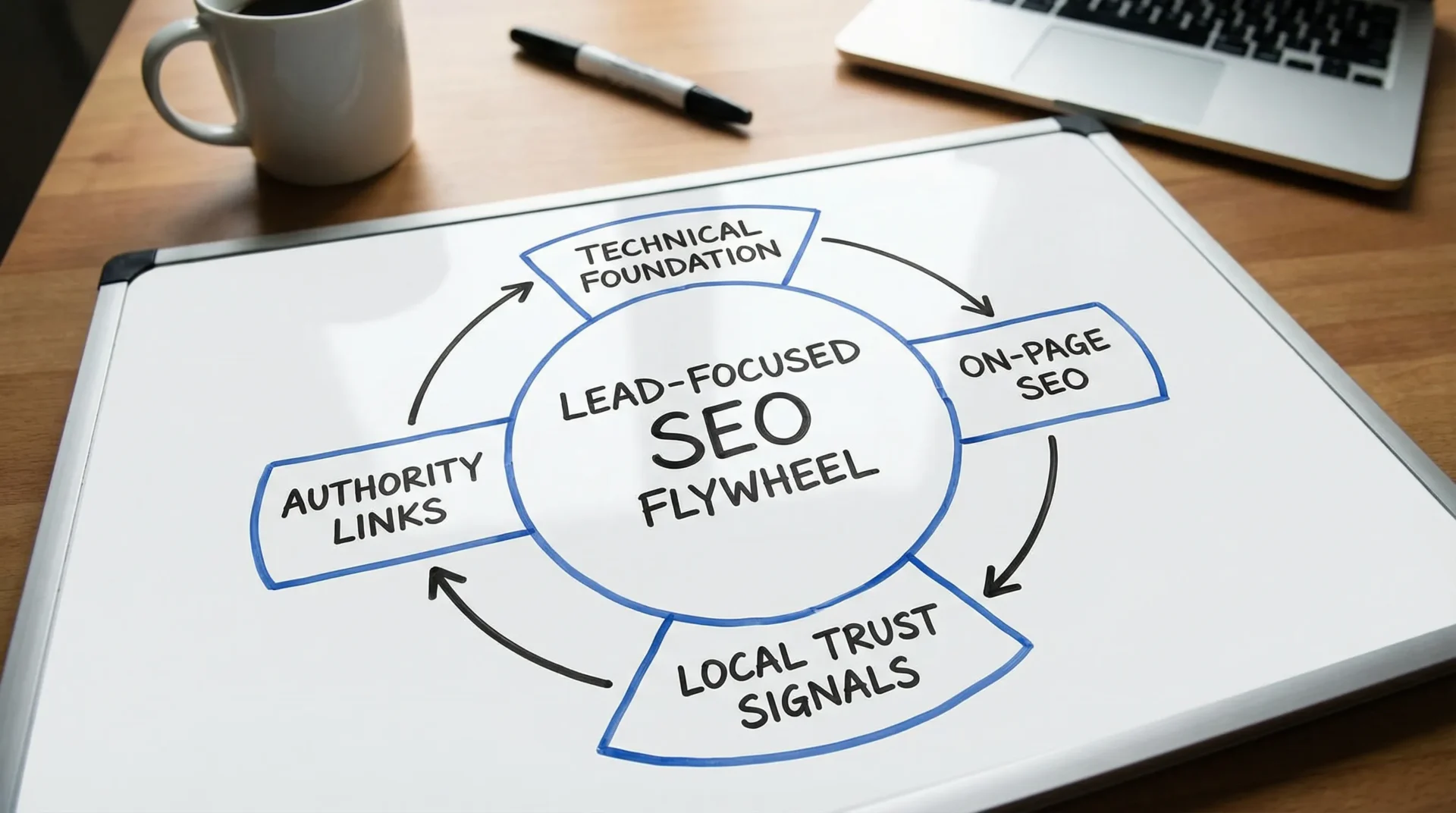
If you want the bigger framework (the stuff that actually drives leads), this lays it out cleanly: SEO Services: The 5 Building Blocks That Drive Leads.
A quick way to spot if an SEO agency is talking rubbish
You don’t need to be an SEO nerd to sniff out nonsense.
If your agency can’t clearly answer these, that’s a problem:
- What pages are we building or improving, and why?
- What search terms are those pages targeting, and what’s the intent?
- What technical issues did we fix this month?
- What changed on the site (literally, what changed)?
- What did we do to improve trust (reviews, links, authority, proof)?
- How are we tracking leads, not just rankings?
If your “SEO” feels like vibes and PDFs, you’re not buying SEO. You’re buying reassurance.
For the full checklist: How to Choose the Right SEO Marketing Agency in 2026 and What to Think About When Speaking to an SEO Consultant: Key Questions to Ask.
And if you suspect you’re being mugged off already, read: Your SEO Agency Is Robbing You Blind, Here’s The Proof.
The bottom line
SEO is not magic. It’s not a “set and forget”. It’s not a plugin.
It’s doing the fundamentals better than your competitors, for longer than they can be bothered.
If you want to keep guessing, crack on. If you want someone to tell you exactly what’s broken, what to fix first, and what will actually drive leads, start with an audit.
Have a look at Shall We Audit Your Website? or, if you’re not ready for ongoing work yet, Why a One-Off SEO Audit Might Be All You Need to Get Started.
