
£99 a month for SEO sounds like a bargain.
It’s also how a lot of small businesses end up paying for absolutely nothing, month after month, while someone in a different time zone “builds authority” (translation: does the SEO equivalent of chucking flyers into the bin).
If you’re reading this at 11pm, slightly raging, wondering why you’re still not ranking for “plumber Chester” after six months of paying the magical £99 package, here’s the uncomfortable truth:
At £99/month, there usually isn’t enough time, budget, or brainpower allocated to your business for SEO to make a meaningful dent.
Not because SEO is some dark art. Because basic maths exists.
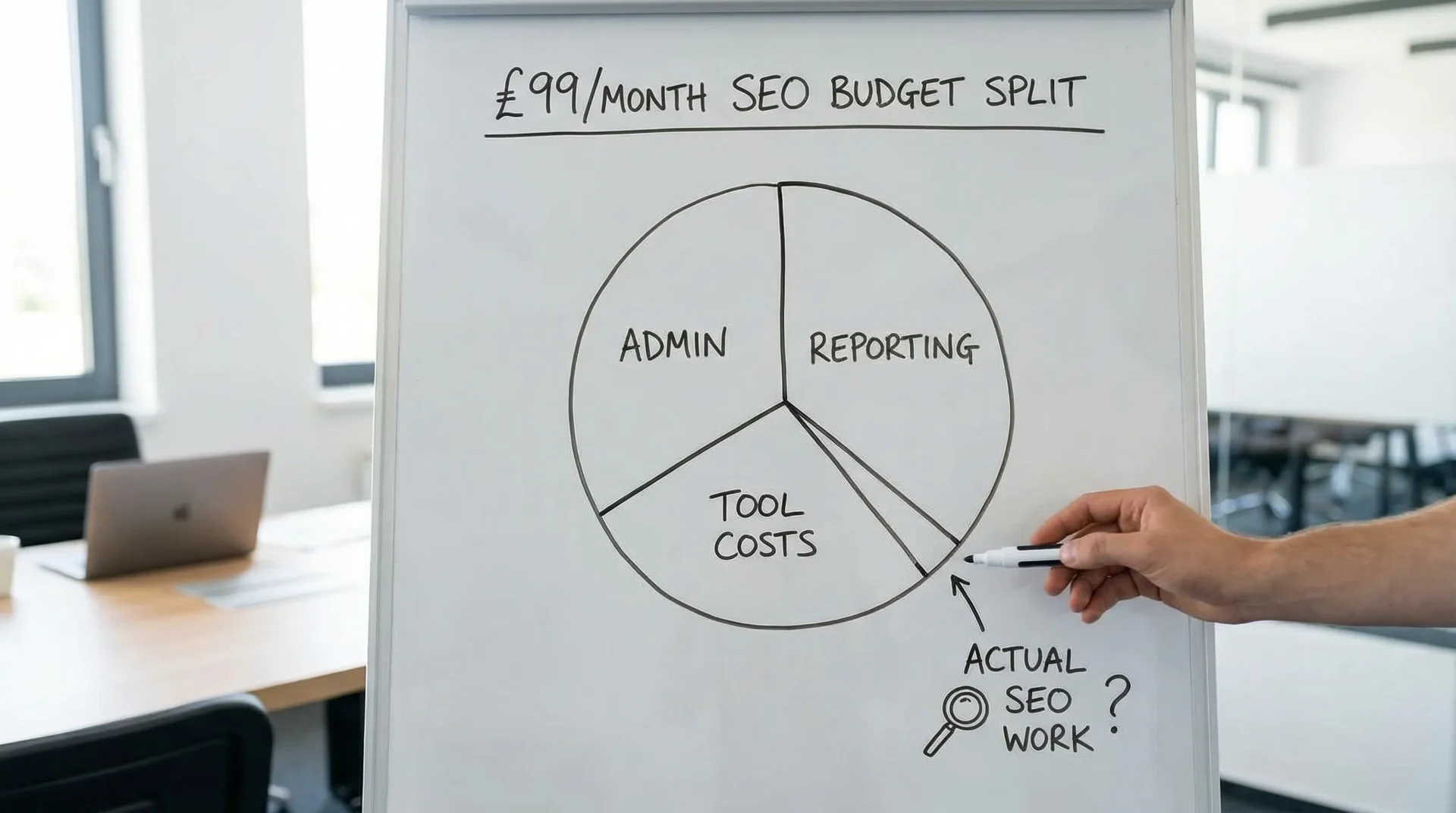
The brutal maths: what does £99/month actually buy?
Let’s pretend the agency is decent and paying a real human.
Even at a low-ish UK rate, say £50/hour, £99 gets you… basically two hours.
Two hours a month.
That’s not a strategy. That’s a chat.
And in those two hours, they still need to:
- look at your site
- look at competitors
- decide what to do
- do the work
- measure the impact
- report it
So what actually happens?
They cut corners. They automate. They template. They “set and forget”.
Which is hilarious, because Google doesn’t “set and forget”. Neither do your competitors.
If you want the longer version of the money breakdown (and what you’re really paying for when SEO is done properly), read: Understanding the real cost of SEO.
Why cheap SEO packages exist (and why they all feel the same)
Cheap SEO isn’t “affordable SEO”. It’s mass-produced SEO.
The business model only works if they stack loads of clients on the same workflow:
- same audit template
- same keyword dump
- same “optimised meta titles”
- same monthly report
- same dodgy link building
You’re not hiring a specialist. You’re joining a conveyor belt.
And to be fair, they’re not always evil. Sometimes it’s just naïve.
But the output usually lands in one of these buckets.
Bucket 1: “We changed some meta titles”
Meta titles matter, yeah. But if your site is slow, thin, confusing, and has no local trust signals, a new title tag is like putting a spoiler on a broken Ford Fiesta.
Bucket 2: “We built you backlinks”
If those links are garbage, they’re not authority. They’re a liability.
Google has been very clear for years that manipulative link schemes violate their spam policies. If you fancy a bedtime read, here’s Google’s own documentation: Link spam policies.
A £99 link budget often means one thing: volume. Not quality.
Bucket 3: “We’re doing blogs”
A couple of 500-word articles a month, written for nobody, with titles like “Why Choosing a Professional Service Matters”, is not content marketing.
It’s filler. And AI search engines can smell filler from space.
If you want content that actually pulls in leads, you need intent-led pages and proof. This breakdown is solid: SEO services, the 5 building blocks that drive leads.
The part nobody wants to hear: SEO is not cheap, or quick, or hands-off
If your SEO package promises any of these, you’re being sold a bedtime story:
- “Page 1 in 30 days”
- “Guaranteed rankings”
- “We submit your site to 1,000 search engines”
- “We do secret off-page work”
SEO is a grind. A smart one, but still a grind.
Especially in 2026, when Google’s results are full of AI Overviews, local packs, and zero-click answers.
If you want to understand how search is changing (without the usual fear-mongering), start here: SEO, AEO & GEO: what actually matters in the age of AI search.
What real SEO work looks like (the stuff £99 can’t cover)
Here’s the unsexy truth. SEO that generates leads normally involves:
1) Fixing what’s broken (technical and UX)
If Google can’t crawl it properly, or users bounce because it’s slow and messy, nothing else matters.
If you suspect your site has gremlins, this is a good starting point: Shall we audit your website?
2) Building pages that match how customers search
Not “home, about, services, contact”.
Actual service pages. Actual location relevance. Actual answers.
If you’re local, that usually means:
- a page per core service (written like a human, not a brochure)
- clear towns/areas you serve (without spammy location stuffing)
- proof, photos, reviews, case studies
If you’re still fuzzy on the basics, this guide is straight to the point: How to get your business on Google.
3) Sorting your local presence (Google Business Profile and citations)
For many Cheshire businesses, your Google Business Profile is doing more selling than your website.
Most £99 packages “set it up” once, then ignore it.
That’s like setting up a shop and never turning the lights on.
Start with this checklist: The one free tool every Cheshire business should be using.
Then go deeper: Local SEO services: how to get more calls in Cheshire.
4) Earning trust (links, mentions, reviews, proof)
Real authority is built from:
- local partnerships
- PR
- industry mentions
- legit directories
- customer reviews you actually respond to
Not a thousand blog comments from websites called “best-top-seo-linkz-dot-biz”.
“But I can’t afford more than £99/month” (fair, so do this instead)
I’m not here to mock budgets. I’m here to stop you burning money.
If £99/month is your ceiling, you’ve got two sensible options.
Option A: Stop paying for pretend SEO, do a tight DIY plan
You can make progress with limited cash if you spend your time well.
This is a decent starting point: SEO on a budget.
And if you want a structured plan that doesn’t waste your evenings, this is gold: SEO for small businesses, a 12-week plan that works.
Option B: Buy one proper audit, then implement over time
This is the most underrated move for small businesses.
A real audit tells you what’s broken, what matters, and what to ignore.
Read this if you’re sick of paying retainers for “activity” instead of outcomes: Why a one-off SEO audit might be all you need to get started.
How long should SEO take? Anyone who promises “fast” is guessing
Local SEO can show signs in weeks, but proper, defensible results take time.
If your £99 provider has been feeding you “just another month” for a year with no movement, that’s not patience. That’s a hostage situation.
Here’s a realistic timeline (with what should happen when): How long does local SEO take to work?
Red flags: how to spot a £99 SEO package pretending to be premium
If you hear any of these lines, your wallet should try to escape your pocket.
- “We can’t tell you what we do, it’s proprietary.”
- “Don’t worry about tracking calls or enquiries, rankings are the KPI.”
- “We’ll add you to 300 directories this month.”
- “We publish two blogs a month for SEO.” (but they can’t explain the keyword, intent, or goal)
- “We built 50 backlinks.” (but they won’t show you where from)
- “We did on-page optimisation.” (and that apparently means changing headings)
Want a proper buyer’s filter? Use this: How to choose the right SEO marketing agency in 2026.
What you should demand from an SEO marketing company (yes, even if you’re small)
You don’t need jargon. You need clarity.
Here’s a quick sniff test.
| What you ask | A good answer sounds like | A bad answer sounds like |
|---|---|---|
| “How will this get me more leads?” | “We’ll improve Maps visibility, build service pages for high-intent terms, track calls/forms, and iterate monthly.” | “We’ll improve your online presence.” |
| “What are you doing in month one?” | “Audit, fix crawl/indexing issues, GBP cleanup, competitor gap, prioritised roadmap.” | “We start link building immediately.” |
| “How do you report?” | “Rankings plus enquiries, GBP actions, Search Console clicks, and what we changed.” | “Here’s a PDF with green arrows.” |
| “Can I see examples?” | “Yes, here are case studies with numbers and what we did.” | “We can’t share that.” |
If you want a full list of the questions (and the ones that catch out the cowboys), this is worth saving: What to think about when speaking to an SEO consultant.
Proof beats promises: here’s what “real results” looks like
Any agency can talk.
What you want is evidence that the work turns into bookings, not “impressions”.
Have a nosey at these:
- From invisible to fully booked (dog sitting case study)
- Booked solid, taking 2027 enquiries in 2026 (catering case study)
- Crave Coffee case study
Notice what’s missing.
No “we submitted to 5,000 directories”. No “secret sauce”. Just work, done properly, with outcomes.
A weird but useful analogy: stop buying SEO like it’s a mystery box
If you ran a travel business and border rules changed every five minutes, you wouldn’t say:
“Who’s got the cheapest person to handle visas? I don’t care what they do, as long as it’s £99/month.”
You’d use a specialist, or a proper service with a track record, like SimpleVisa for handling the admin side of border crossing and eVisas.
Same principle.
When the stakes are real, you don’t buy the cheapest mystery box. You buy competence.
SEO is the same. It’s not “marketing”. It’s how you get found when someone is ready to buy.
So what should you do tomorrow morning?
If you’re on a £99/month SEO package right now, do this:
- Ask for a list of exact actions done in the last 30 days (not “ongoing optimisation”).
- Ask what they’re doing to improve Google Business Profile visibility if you’re local.
- Ask what pages they’re building or improving to target buyer-intent searches.
- Ask what they’re tracking that maps to money (calls, forms, bookings), not just rankings.
If the answers are vague, defensive, or weirdly offended, you’ve got your answer.
And if you want someone to tell you, plainly, whether your current SEO is helping or just making nice PDFs, start here: Shall we audit your website?
No fluff. No theatre. Just the truth, and a plan.
