You don’t need more traffic.
You need your website to stop acting like a shy bloke in the corner who could pull, but keeps saying “hello” and then immediately walks off.
Because here’s the painful truth: a lot of small business sites in Cheshire aren’t “bad at SEO”. They’re just bad at asking for the enquiry.
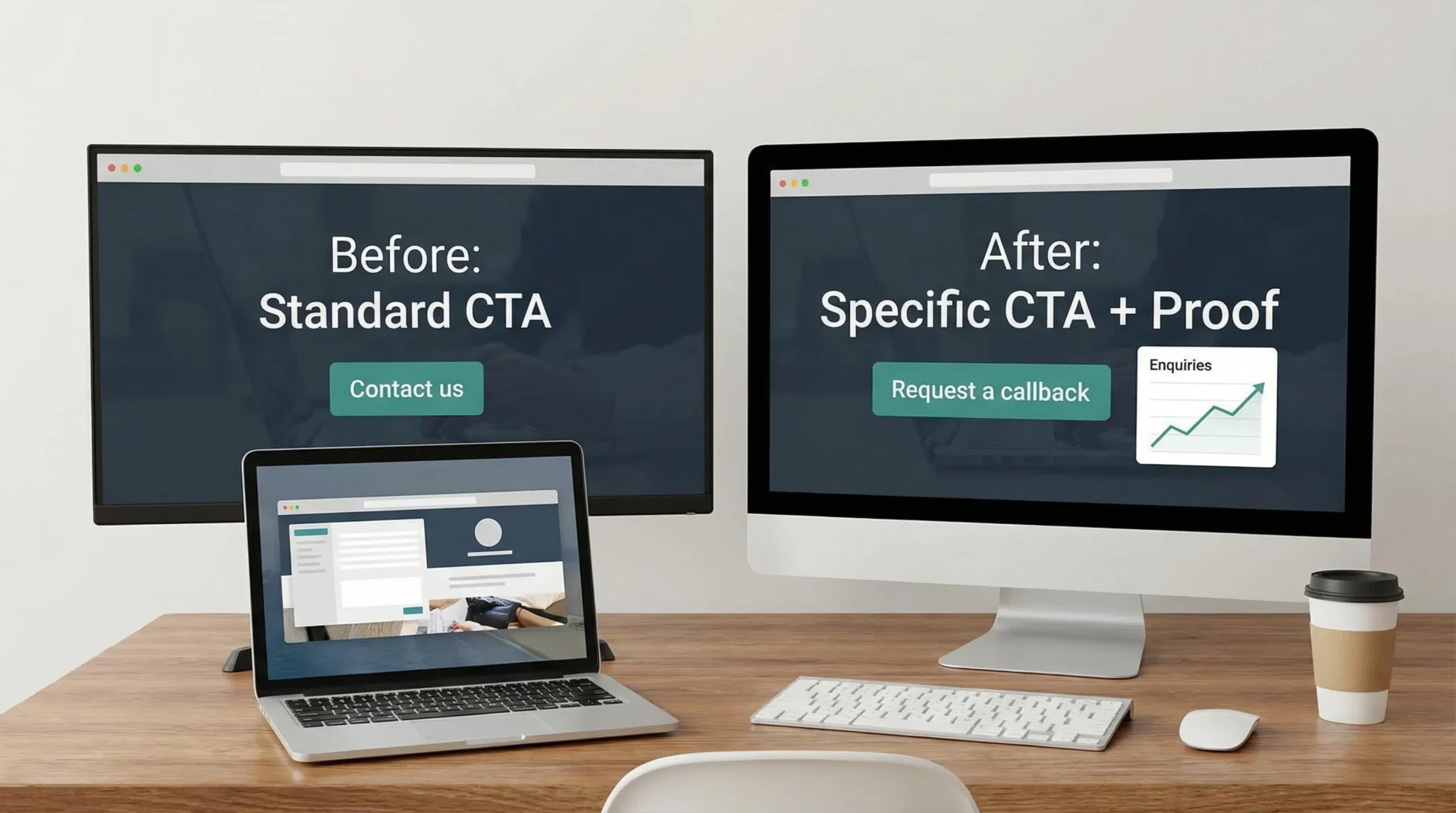
We changed three words on one client’s site and their enquiries doubled overnight.
Not after “months of algorithm magic”. Not after a 40-page SEO audit PDF nobody reads. Overnight.
The 3-word change?
“Request a callback.”
The button that was silently killing enquiries
Before the change, the main call-to-action on the site was the usual beige nonsense:
- “Contact us”
That’s it. Two words. Zero direction. Zero benefit. Zero urgency. It’s basically your website shrugging.
And “Contact us” sounds like effort.
It sounds like:
- filling a form
- waiting three days
- getting a reply that starts with “Dear Sir/Madam”
- being asked ten questions you’ve already answered
So people do what humans always do when they smell friction.
They bail.
Now, the client wasn’t short on traffic. They were getting visitors from Google, and from local searches, the whole lot. The problem was conversion.
So instead of chasing shiny new keywords, we fixed the leak.
We swapped “Contact us” for “Request a callback”.
Same page. Same traffic. Same offer.
Different outcome.
Why “Request a callback” works (and “Contact us” doesn’t)
This isn’t copywriting voodoo. It’s basic human behaviour.
1) It tells people exactly what happens next
“Contact us” is vague. It leaves people guessing.
“Request a callback” is a clear next step. There’s a sequence in it.
You request. They call. Sorted.
2) It lowers perceived effort
If someone thinks your contact form is going to be a whole thing, they won’t touch it.
A callback feels easy. Quick. Minimal typing.
And for a lot of local service businesses, the fastest path to money is still a phone conversation.
3) It matches what people actually want
Most people searching locally aren’t looking for a “relationship with your brand”. They want their problem gone.
They want a human. Today.
That’s why local SEO isn’t just rankings, it’s also what you do with the click.
If you want the full local lead-gen picture, this guide is solid: Local SEO services: how to get more calls in Cheshire.
“But we need more traffic” (no you don’t)
Nine times out of ten, when a small business owner says “We need more traffic,” what they mean is:
“We need more leads, and the current visitors aren’t turning into anything.”
Cool. Then piling more traffic onto a leaky website is just paying to lose.
Fix conversion first.
Then do the heavy lifting SEO.
If you want a no-fluff breakdown of what actually drives leads (not vanity rankings), read: SEO services: the 5 building blocks that drive leads.
The quick-and-dirty maths that makes this a no-brainer
Let’s keep it simple.
If a page gets 50 visitors a day and converts at 2%, that’s 1 enquiry a day.
If you bump that conversion rate to 4% (without changing traffic), that’s 2 enquiries a day.
That’s double.
Same traffic.
Same spend.
Just fewer people bouncing because your website stopped being awkward.
The “3-word change” framework you can steal tonight
You don’t need to use “Request a callback” specifically (although if you’re a service business, it’s a belter).
You need your CTA to do three jobs:
- Say what happens next
- Make it feel easy
- Make it feel worth it
Here are CTA styles that actually pull their weight:
| Business type / situation | Weak CTA (common) | Stronger CTA (clear, lower friction) |
|---|---|---|
| Local service business (calls matter) | Contact us | Request a callback |
| Quote-led service (people price-checking) | Get in touch | Get a fast quote |
| Booking-based business (calendar-driven) | Enquire now | Check availability |
| High-trust service (people nervous) | Learn more | Talk to a specialist |
Pick one. Put it everywhere it matters.
Header. Hero section. Service pages. Mobile sticky button if it makes sense.
And for the love of rankings, make sure it works properly on mobile. A shocking number of sites still treat mobile users like an afterthought.
If you suspect your site has bigger underlying issues (speed, indexing, broken stuff), start here: Shall we audit your website?
Where to put the magic words (so they actually do something)
The CTA copy matters, but placement matters too.
Most small business sites hide their CTA like it’s illegal.
Here’s where it should show up:
Above the fold on your main pages
When someone lands on your homepage or a service page, they should instantly know:
- what you do
- who it’s for
- what to do next
Not after a scroll. Not after reading your company history. Immediately.
On high-intent service pages
Your service pages should be your money pages.
If yours read like a GCSE essay and end with “If you have any questions, please don’t hesitate…”, you’re leaving leads on the table.
If you need an example of how we think about intent-led service pages, this is a good reference point: How to get more plumbing customers from Google.
Different industry, same psychology.
On Google Business Profile journeys
A lot of local leads come in via Maps.
People see you, click through, and then your website fumbles the bag.
If you haven’t properly sorted your Google Business Profile, do that next. This one’s basically free money: The one free tool every Cheshire business should be using.
“Overnight” only happens if you can already be found
Let’s be honest.
If your site gets basically no traffic today, a button change won’t do much because nobody’s seeing the button.
This tactic works when:
- you already rank for something
- you already get visitors
- those visitors should be converting, but aren’t
If you’re still invisible on Google, you’ve got a different problem.
Start with the basics here: Why your website isn’t showing up on Google (and how to fix it).
And if you’re playing the longer game (you should be), read this before you start expecting miracles in week two: How long does local SEO take to work.
Track it properly or you’re just guessing
This is where most businesses mess it up.
They change stuff, feel optimistic for a week, then decide SEO “doesn’t work”.
No, mate. You just didn’t measure anything.
At minimum, you should be tracking:
- form submissions (as events)
- click-to-call taps on mobile
- email clicks
- WhatsApp clicks (if you use it)
GA4 can do this. Google Tag Manager makes it easier. But you do need it set up correctly.
If your site is a bit more complex (custom builds, weird legacy code, messy templates), you might need dev help that actually understands performance and tracking, not just “make it look nice”. In that case, a proper team like PHP & React development experts at Wolf-Tech can be a lifesaver.
This isn’t just “conversion”. It helps SEO too.
Now for the bit that SEO nerds will nod at.
When your site converts better, it usually means:
- clearer pages
- stronger intent match
- better user engagement
- fewer pogo-sticks back to Google
Google doesn’t have a “conversion rate” ranking factor you can game. But it absolutely watches behaviour at scale.
So yes, better CTAs can indirectly support better performance.
And in 2026, with AI Overviews and answer engines pinching clicks, you need every click you do get to count.
If you want the “what the hell is happening to search” version of that story, this is worth your time: Why the new ChatGPT search engine changes everything for SEO.
Want me to tell you the 3 words your site needs?
If you’re getting traffic but the enquiries are dead, don’t throw more money at ads, “content”, or another monthly retainer that buys you a spreadsheet and a headache.
Fix the leak first.
If you want a straight answer on what to change (and what to ignore), start with a proper review: Why a one-off SEO audit might be all you need to get started.
And if you’re specifically looking for SEO Cheshire support that’s built around leads, not fluff, you know where we are.