
AI search is no longer a novelty. Your customers are already asking ChatGPT and Gemini questions like “Who’s the best [service] near me?”, “How much does [service] cost?”, and “Which company can handle this this week?”.
The big difference is this: AI tools don’t just rank pages, they try to recommend an answer. If your business is hard to verify (or your content is vague), you can get skipped even if your website looks “fine”.
Below is a straight-talking guide to help you become the kind of business AI search can confidently quote, summarise, and suggest.
How ChatGPT, Gemini, and AI search choose what to show
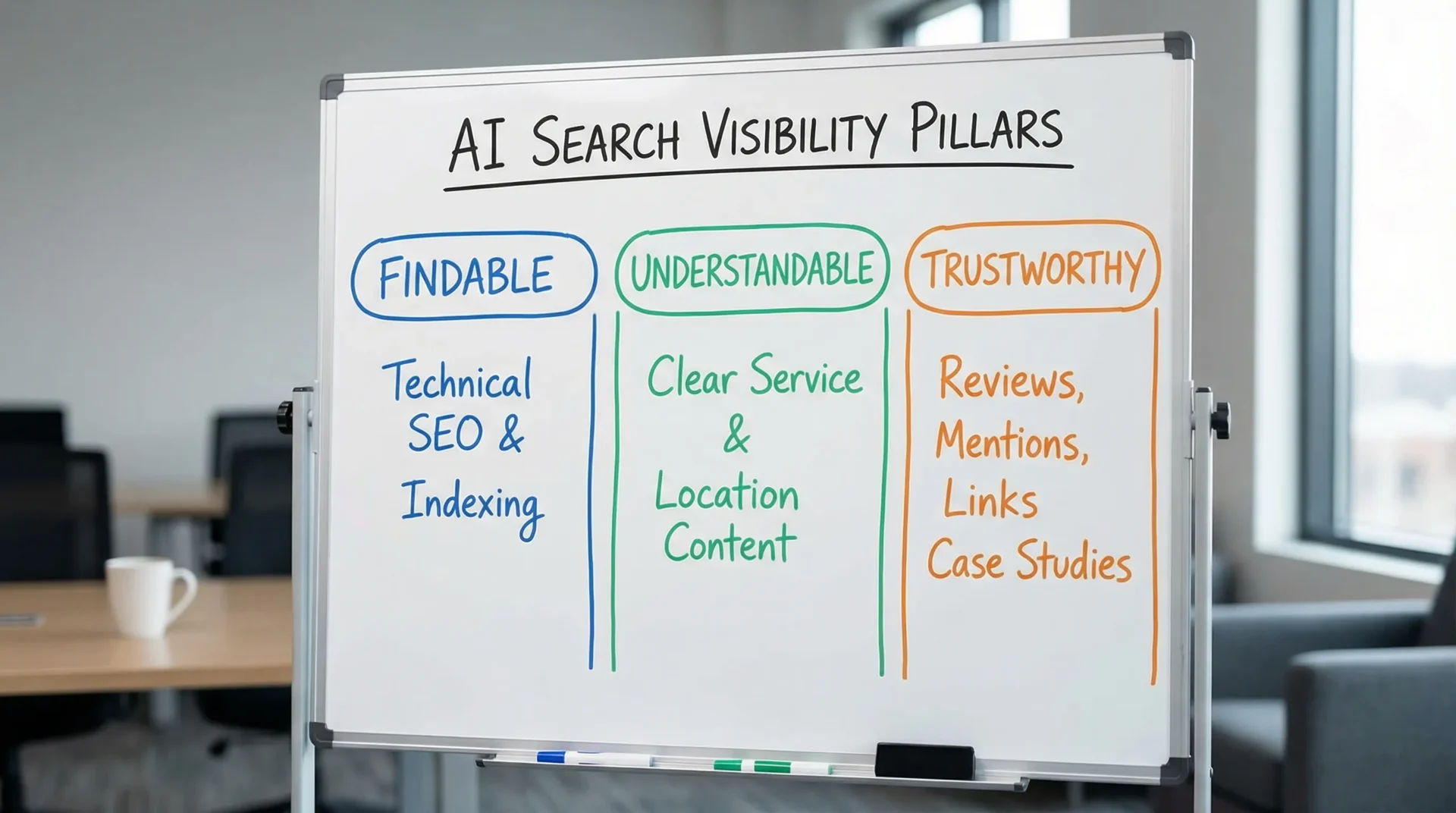
Different AI experiences work in slightly different ways, but they tend to rely on the same inputs:
- Crawlable web pages (the AI needs to access and understand the content)
- Clear entity signals (who you are, what you do, where you operate)
- Trusted corroboration (reviews, mentions, links, consistent business details)
- Answer-ready content (pages written in a way that’s easy to summarise and cite)
In our experience, most small business sites fall down on one of these four areas, and it’s usually fixable without a full rebuild.
Step 1: Make your business easy to verify (the “entity” problem)
Before an AI recommends you, it needs to feel sure you’re real and legitimate.
Tighten up your business basics across the web
Make sure these are consistent everywhere:
- Business name (use one format)
- Address (same formatting, including postcode)
- Phone number
- Website URL
- Opening hours
This matters because AI systems often cross-check multiple sources. If your details vary between your website, Google Business Profile, directories, and social pages, you look less reliable.
Build a proper “About” footprint (not just a paragraph)
At minimum, you want:
- A clear About page
- A named person behind the business (especially if you’re owner-led)
- Photos (real team, real premises if you have them)
- A simple “How we work” section
- Service areas and what you actually do day-to-day
If you’re in a trust-sensitive industry (health, legal, finance), this becomes even more important.
Add proof that other people trust you
AI search tends to favour businesses that are easy to corroborate. Practical examples:
- Reviews (Google, industry platforms)
- Case studies with specific outcomes
- Memberships, accreditations, awards
- Local sponsorships or community involvement
- Mentions on relevant sites (local news, trade bodies, partner sites)
Step 2: Fix the technical blockers that stop AI and search engines reading your site
This is not about chasing “perfect” scores, it’s about removing the common issues that prevent proper crawling, indexing, and interpretation.
Here’s a quick table of what typically matters most.
| Priority | What to check | Why it matters for AI search | Quick fix idea |
|---|---|---|---|
| High | Pages indexable (no accidental noindex, wrong canonicals) | If key pages aren’t indexable, they won’t be surfaced or cited | Check Google Search Console coverage and page-level meta robots |
| High | Clear site structure and internal links | AI and search engines need predictable pathways to your key pages | Link to your main services and locations from nav and relevant pages |
| High | Fast, stable mobile experience | Most AI-assisted journeys start on mobile, slow sites reduce engagement signals | Compress images, reduce heavy scripts, improve Core Web Vitals |
| Medium | Structured data (schema) | Helps machines understand what your business and pages represent | Add LocalBusiness, Organisation, Service, FAQ where appropriate |
| Medium | Clean duplicates and thin pages | Confusing duplication weakens clarity and authority | Consolidate overlapping pages and expand the ones that matter |
If you want a UK-specific breakdown of what we look at when optimising for AI discovery, this page explains the approach: AI search optimisation UK.
Step 3: Write “AI-citable” content (clear answers, not waffle)
AI tools love content that is:
- Specific
- Well-structured
- Easy to summarise
- Grounded in real-world detail
They struggle with content that’s vague, over-salesy, or written like it’s trying to impress Google rather than help a human.
Build pages that match real questions customers ask
For most service businesses, your high-value AI search questions fall into a few buckets:
- “Best” and comparison: “best accountant for contractors”, “best builder for extensions in [area]”
- Cost and pricing: “how much does X cost in the UK?”, “is Y worth it?”
- Process and timelines: “how long does it take to…?”, “what’s the process for…?”
- Suitability: “do I need X or Y?”, “is this right for my situation?”
If your site only has a generic service page and a contact form, you’re forcing both Google and AI to guess.
Use answer-first formatting
A simple approach that works well:
- Start sections with a direct answer (1 to 2 sentences)
- Follow with the detail and context
- Add examples (common scenarios, what customers typically do next)
- Finish with a clear next step (book a call, request a quote, checklist)
This increases the chance your content is quoted accurately, not reinterpreted.
Step 4: Use structured data so machines don’t have to guess
Structured data (schema markup) won’t magically get you featured, but it reduces ambiguity. That’s a big deal for AI.
Common schema types that are genuinely useful for small businesses include:
- Organisation
- LocalBusiness
- Service
- Article (for blog posts)
- BreadcrumbList
- FAQPage (only where the FAQs are visible on the page)
You can explore schema types at Schema.org, and Google’s own guidance is on Google Search Central.
If you’re not sure whether your schema is valid, Google provides the Rich Results Test.
Step 5: Build authority in places AI already trusts
A lot of AI “recommendations” are influenced by what the wider web says about you, not just what your website claims.
Get mentioned on relevant, credible sites
Think:
- Local directories that actually rank and get used
- Trade associations
- Local newspapers and community sites
- Suppliers and partner pages
- Industry blogs (legitimate ones, not spam)
A useful way to sanity-check this is to ask: “If my website disappeared tomorrow, could someone still confirm we exist and what we do?” If the answer is no, that’s a visibility risk.
Create content other sites want to reference
The easiest linkable assets for most small businesses are:
- A practical guide that answers a common buying question
- A simple pricing explainer (even if it’s ranges and drivers, not exact fees)
- A proper case study with clear before/after outcomes
As an example of the kind of clear, comparison-led experience that tends to work well in answer engines, platforms that let users quickly compare options and make a decision are often easy for AI to summarise. Something like compare insurance online (in this case for UAE insurance) shows how structured, decision-friendly pages can support AI-driven discovery.
Step 6: Don’t ignore Google Business Profile (AI still uses local signals)
Even when the user is in ChatGPT or Gemini, local trust signals still matter.
Make sure your Google Business Profile is not an afterthought:
- Correct primary category
- Services listed properly
- Regular new photos
- Real reviews, responded to
- Q&A filled with genuine questions and answers
If you’re a Cheshire business (Nantwich, Crewe, Chester, Sandbach, Congleton, Northwich, Macclesfield, Knutsford, Wilmslow), these local signals can be the difference between being “recommended” and being invisible.
Step 7: Measure what’s happening (without obsessing over vanity metrics)
AI search can reduce clicks in some cases, but it can still drive high-intent enquiries.
What we typically track with clients:
- Changes in branded searches (more people searching your business name)
- Enquiry quality (are leads more informed?)
- Landing pages that assist conversions (not just the homepage)
- Mentions and links earned over time
- Google Search Console queries shifting towards problem-led intent
Also, keep a simple habit: once a month, search the questions you want to be recommended for and note who gets mentioned and why. It quickly reveals gaps in your content and trust signals.
Common mistakes we see when businesses try to “optimise for AI”
Most issues come down to these:
- Publishing lots of AI-generated blog posts with no real expertise or local detail
- Thin service pages that don’t answer buying questions
- Inconsistent NAP details across the web
- No reviews, no case studies, no proof
- A site that’s technically messy (duplicate pages, broken internal links, indexing issues)
AI visibility is not a hack. It’s the outcome of being easy to understand and easy to trust.
Where AI content fits (and where it doesn’t)
I’m not anti-AI content (far from it), but AI content needs a human strategy behind it.
Used properly, it can help you:
- Cover the questions your customers ask at scale
- Keep your site fresh
- Build topical authority around your services
Used badly, it creates fluff that doesn’t rank, doesn’t convert, and can even dilute your credibility.
If you want a hands-off way to publish content that’s built around real search demand (and edited to make sense for real customers), take a look at our AI SEO blog content service.
Frequently Asked Questions
Do I need to “submit” my website to ChatGPT or Gemini? You can’t submit your site in the same way you submit to a directory. In practice, you improve visibility by being crawlable, indexable, and well-referenced online, and by publishing content AI can confidently quote.
Is this different from normal SEO? It’s mostly an extension of good SEO. The foundations still matter, technical health, relevance, and authority. The difference is you’re also optimising for being summarised and recommended, not just ranked.
Will optimising for AI search reduce my website traffic? In some searches, yes, because users can get answers without clicking. But many businesses still benefit through higher-intent visitors, more branded searches, and better-qualified leads.
What type of content works best for AI search? Clear service pages, cost explainers, comparison pages, FAQs, and practical guides that answer specific questions. Content that includes proof (examples, case studies, credentials) tends to perform better.
Do reviews really impact AI recommendations? They can. Reviews help validate that your business is real, active, and trusted. They also reinforce what you’re known for, which supports both local SEO and AI-driven discovery.
How long does it take to see results? It varies by competition, your starting point, and how quickly changes are implemented. In most cases you can see early signs within weeks (better indexing, clearer visibility), with stronger outcomes building over a few months as trust signals grow.
Want to know if your business is ready for AI search?
If you’d like a second pair of eyes on your site, I’m Matt Warren, founder of SEO Bridge in Nantwich. I can take a look at your website, your local signals, and your content structure, then tell you what’s most likely to help improve your visibility in Google and AI search.
Get in touch via SEO Bridge for a free, no-pressure SEO chat and a clear plan of action.
