
SEO automation gets talked about like it’s a magic button. Press it, watch the rankings roll in, job done.
In reality, automation is just a way to do the boring, repeatable bits of SEO consistently, so you (or your team) can spend your limited time on the things that actually move the needle: understanding customers, improving pages, earning trust, and turning traffic into enquiries.
I’m Matt Warren, founder of SEO Bridge in Nantwich, and most of the small businesses I speak to across Cheshire have the same problem: they know SEO matters, but they don’t have the hours to keep on top of it every week. That’s exactly where smart automation helps.
What “SEO automation” actually means (and what it doesn’t)
SEO automation is using tools and processes to:
- Monitor your website’s health without manually checking everything.
- Speed up content production, updates, and internal linking.
- Standardise reporting so you’re tracking the right numbers every month.
- Create repeatable workflows so tasks don’t fall through the cracks.
It does not mean:
- Spinning 100 low-quality articles and hoping Google doesn’t notice.
- Buying automated backlinks.
- “Set and forget” SEO (which usually becomes “set and drop”).
Google has been crystal clear for years that it rewards helpful, people-first content, not content made purely to manipulate rankings. If you want the official line, it’s worth skimming Google’s Search Essentials to understand where the guardrails are.
Why automation is especially useful for small businesses in 2026
Between AI Overviews, zero-click results, and more competitive local search, the businesses that win are the ones that are consistent.
Automation helps you be consistent even when:
- You’re busy quoting, fitting, delivering, or running the day-to-day.
- Your blog has gone quiet for months.
- Your site speed has slipped after a few plugin updates.
- You never quite get round to updating old pages.
For local businesses in places like Nantwich, Crewe, Chester and the surrounding areas, that consistency is often the difference between “we get the odd website enquiry” and “we get steady leads and calls”.
If you’re focusing on local growth, we’ve got a simple overview of how we approach it here: SEO in Cheshire.
The best automated SEO tool is the one that fits your workflow
A quick warning before we get into tactics: there isn’t one universally “best automated seo tool”. There’s the best tool (or combination of tools) for:
- Your platform (WordPress, Shopify, Squarespace, custom build)
- Your budget
- Your ability to review and publish content
- How competitive your market is
Most small businesses do better with a lean, reliable setup than a fancy stack that never gets used.
What you should automate vs what you should keep human
Here’s the easiest way to think about it.
| SEO task | Automate? | Why | What still needs a human |
|---|---|---|---|
| Site monitoring (uptime, indexing, errors) | Yes | You want alerts, not surprises | Prioritising fixes based on impact |
| Rank tracking (lightweight) | Mostly | Trend spotting is useful | Deciding what to change and why |
| Technical checks (speed, Core Web Vitals) | Yes | Fast feedback loop | Implementing fixes properly |
| Content briefs and outlines | Yes | Saves time and keeps structure | Adding real experience and local detail |
| Drafting blog content | Yes, with review | Speed and consistency | Accuracy, tone, proof, editing |
| Internal linking suggestions | Yes | Easy wins at scale | Choosing natural, relevant links |
| Backlink building | No (not fully) | Automation often leads to spam | Relationship-led links and PR |
| Conversion improvements | No (not fully) | Needs context and testing | Copy, offers, UX decisions |
If there’s one theme you’ll see throughout this article, it’s this: automate the “system”, not the “strategy”.
Start with two free automation checks (they catch the biggest leaks)
Before you add any new tools, do these two quick checks. They’re free, and they usually highlight issues that hold back everything else.
1) Check if your blog has quietly stopped pulling its weight
A dead or neglected blog is one of the most common problems I see on small business sites. It can hurt crawl frequency, it can signal stagnation to customers, and it’s a missed opportunity for AI search visibility.
Use our free checker here: Is Your Blog Dead?
If your last post was 9 months ago, don’t panic. You can recover, but you need a simple plan for consistent publishing and updates.
2) Run a speed test (because slow sites bleed leads)
Speed isn’t just “technical SEO”. It’s also a conversion issue. If someone in a hurry is looking for a roofer, a solicitor, or an emergency plumber, a slow site is an easy reason to click back to Google.
Run a quick test here: Website Speed Checker
If you’re not already using it, make sure your site is connected to Google Search Console so you can see indexing issues, query data, and performance trends over time.
A simple SEO automation loop that works for most small businesses
Most SEO automation should feed into one repeatable loop.
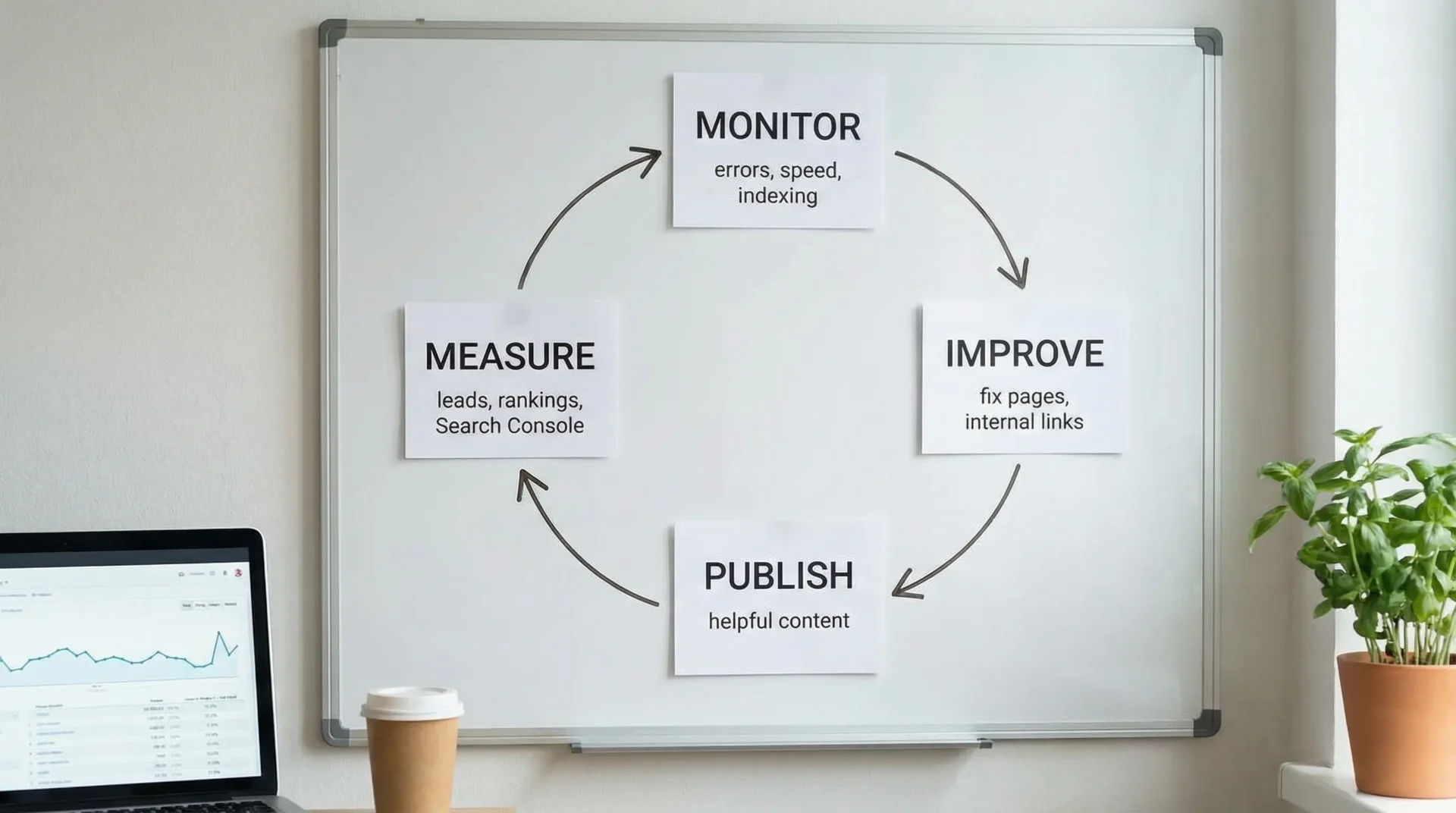
Monitor: set alerts and weekly checks
Automate the “what changed?” part.
Examples of what to monitor:
- Indexing drops (pages falling out of Google)
- Sudden traffic declines on key pages
- Broken pages (404s) and redirect chains
- Speed regressions after theme/plugin changes
This is where small, automated checks save you hours of detective work later.
Improve: update what already exists before you write more
For most SMEs, updating existing pages is the fastest route to better results.
A practical automated habit is: every new blog post triggers an internal link check.
That means:
- Add links from the new post to your key service pages.
- Add links from older, relevant posts to the new post.
- Refresh titles/meta descriptions if the intent has shifted.
Publish: use automation to stay consistent (with human review)
Consistent publishing is hard when you’re running a business. This is the part where AI and automation help most, as long as you’re not pushing unedited content live.
If you want an example of a done-for-you approach, we offer automated publishing here: AI SEO Blog Content.
The important bit is not “AI wrote it”. It’s:
- Topics are aligned to what customers actually search
- Posts are structured to be easy to quote in AI answers (AEO/GEO)
- Internal links and local relevance are handled sensibly
- Everything is reviewed for accuracy and brand tone
Measure: track leads, not vanity metrics
Automation makes reporting easier, but you still need to measure the right outcomes.
At minimum, track:
- Form submissions
- Phone clicks (especially mobile)
- Email clicks
- Quote or booking requests
Rankings and traffic are useful, but they’re not the end goal.
Where AI blog automation fits (and how to do it safely)
AI can be brilliant for speed, but it can also create a lot of “samey” content that doesn’t earn trust.
Here are the safeguards I recommend for small businesses.
Add real-world proof to every piece
AI can write a decent explanation. It cannot prove you’re a real business with real experience.
Build these into your publishing process:
- Short case notes (what you did, what changed, what customers asked)
- Local examples (areas you serve, common local problems)
- Photos of your work, your team, your premises (where appropriate)
- Clear next steps and contact routes
Use a consistent structure that AI engines can understand
In 2026, “being readable” is not just for humans. It’s also for AI summaries.
A simple structure that performs well:
- Clear H2s that match questions people ask
- Short paragraphs
- A table that summarises options, costs, or comparisons (where relevant)
- A simple conclusion that states what to do next
Avoid automating anything that looks like manipulation
If someone offers:
- Automated link blasts
- Automated forum comments
- Bulk guest posts at scale
That’s the stuff that tends to cause problems, not growth.
A lean tool stack for SEO automation (without going overboard)
Here’s a sensible starting point for most small businesses.
| Goal | What to use | Why it’s worth it |
|---|---|---|
| Indexing and search performance | Google Search Console | Direct data from Google |
| Speed and Core Web Vitals checks | SEO Bridge speed checker | Quick diagnostics you can act on |
| Blog activity check | SEO Bridge blog check | Fast way to spot a content consistency issue |
| Consistent SEO content publishing | AI blog automation service | Keeps your site active and builds topical coverage |
If you want to explore a dedicated blog automation tool, have a look at BlogSEO. (That link is a referral link, so we may earn a commission if you sign up, at no extra cost to you.)
What about automating task management and reporting?
This is the unglamorous part, but it’s where most SEO plans fall down.
Small businesses often don’t fail at SEO because they chose the wrong keywords. They fail because:
- Nobody knows what’s been done
- Nobody knows what’s next
- The same issues keep reappearing
A good task system fixes that. Oddly enough, some of the clearest examples of structured, privacy-first task tracking come from outside marketing entirely. If you want to see what “assign tasks, track behaviours, summarise progress” looks like in a tight product, have a look at this privacy-first task tracking app. Different use case, same principle: structure beats chaos.
A realistic weekly routine (that automation makes easy)
If you’re time-poor, aim for a routine you can actually keep.
Weekly (30 to 60 minutes)
- Check Search Console for spikes or drops
- Run a quick speed check after any site changes
- Publish one helpful piece (or update an existing one)
- Add internal links from the new content to your money pages
Monthly (60 to 90 minutes)
- Review the pages that drive leads and improve them
- Refresh your top 3 to 5 blog posts (titles, sections, links)
- Decide next month’s topics based on real enquiries and objections
Automation helps because the checks are quick, the publishing is consistent, and you’re not reinventing the wheel every time.
The bottom line: automate the routine, keep the judgement
SEO automation is best when it does two things:
- It protects you (alerts, monitoring, early warnings)
- It compounds (consistent publishing, consistent improvements)
If you want a hand putting a simple, affordable automation setup in place, take a look at our AI SEO Blog Content service and run the two free checks first: Is Your Blog Dead? and the Website Speed Checker.
If you’d rather talk it through, feel free to get in touch with me via SEO Bridge for a free, straight-talking SEO review. No hard sell, just a clear plan you can act on.
