
Most solicitors still grow through referrals, but the reality in 2026 is that a large share of first enquiries start with a Google search. The opportunity is obvious: if you can show up when someone nearby searches for “conveyancing solicitor”, “family law solicitor”, “wills and probate”, or “personal injury solicitor”, you can win cases before prospects ever ask friends for recommendations.
This guide is a practical, UK-focused approach to get your law firm on Google consistently, even if you are a smaller practice competing with national brands.
How do clients find a solicitor online today?
Most prospective clients follow a predictable journey:
- They search a service plus a location (for example, “conveyancing solicitor Chester” or “divorce solicitor Crewe”).
- They compare options fast, often from the Google Map results, reviews, and a quick scan of service pages.
- They shortlist 2 to 4 firms, then call or submit an enquiry form.
For high-intent areas like conveyancing, family law, wills and probate, and personal injury, visibility tends to be won in three places:
- Google Maps (the local pack) via your Google Business Profile.
- Organic results via practice area pages and location relevance.
- Trust signals (reviews, local mentions, directories, and clear credentials).
If your goal is how to get more legal clients online, the best strategy is to strengthen all three, in that order.
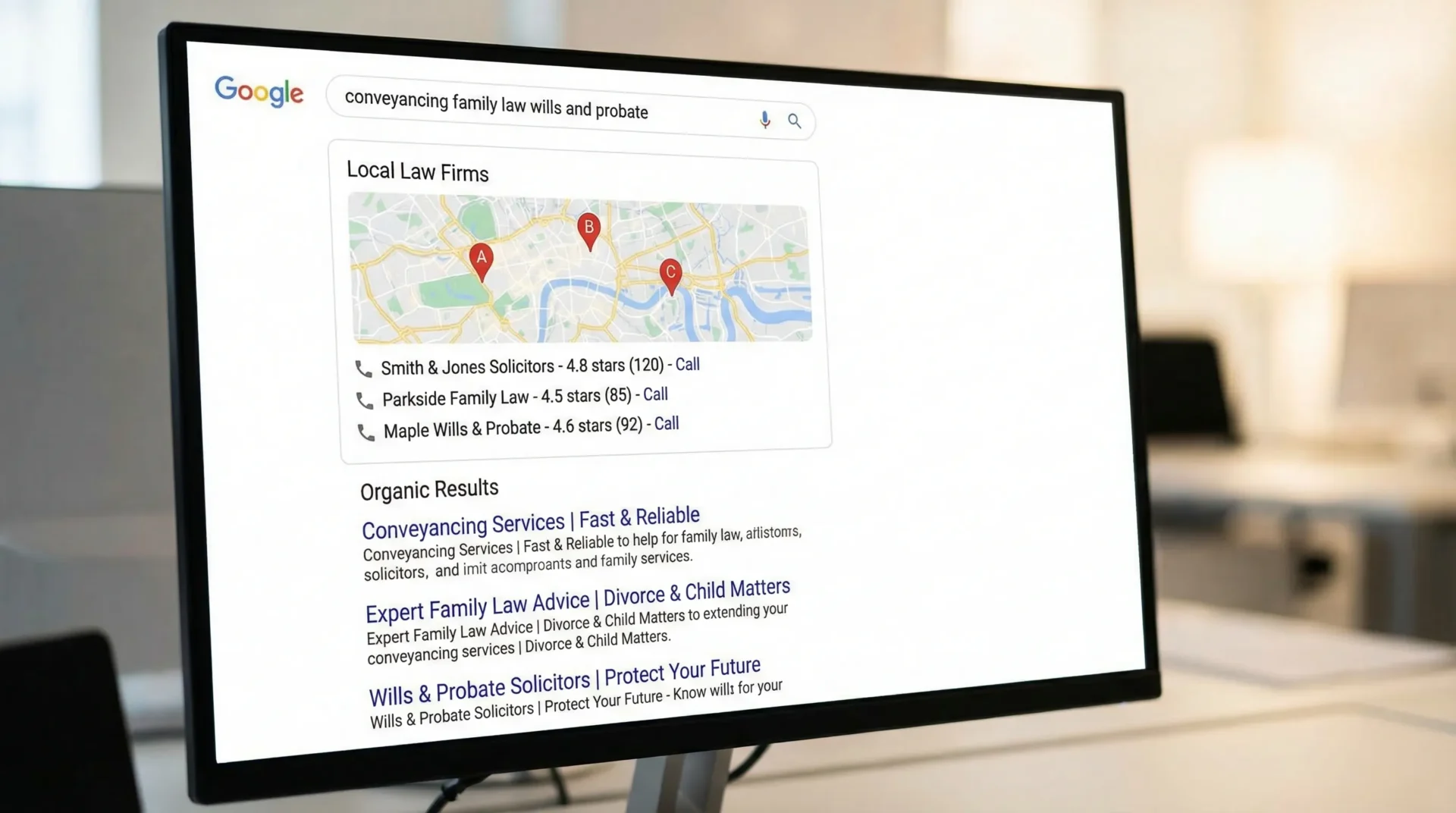
“My law firm website is not showing on Google”: diagnose the real problem first
When a firm says “we are not on Google”, it is usually one of these issues:
- You are not showing in Maps for local queries.
- You are indexed, but not ranking for valuable practice area searches.
- You rank, but the site does not convert (so it feels like SEO “does not work”).
Here is a quick diagnostic table you can use before changing anything.
| Symptom | What it usually means | Fastest next step |
|---|---|---|
| You do not appear in Google Maps at all | Google Business Profile (GBP) not set up, suspended, or mismatched details | Claim and verify GBP, check NAP consistency |
| You appear on Maps for your firm name only | You have brand visibility, but weak relevance for practice areas | Add services, categories, content, reviews, local links |
Your pages are not found with site:yourdomain.co.uk |
Indexing or crawlability issue | Check Google Search Console coverage and “noindex” |
| You rank for generic terms but not local (“solicitor UK”) | You are competing with huge sites, with low local signals | Build location relevance and local authority |
| Traffic looks OK but enquiries are low | Conversion and trust issues | Improve page structure, CTAs, proof, and tracking |
If you want a deeper checklist for technical and indexing problems, this related guide is worth reading: Why your website isn’t showing up on Google (and how to fix it).
Step 1: Win Google Maps first (local SEO for solicitors)
For most small and mid-sized practices, Google Maps is the quickest route to more enquiries, particularly for conveyancing and family law.
Set up (or rebuild) your Google Business Profile properly
Your Google Business Profile is not a “directory listing”. It is a ranking asset.
Key points that move the needle for local SEO for solicitors:
- Primary category: choose the closest match to your core service (avoid diluting it with too many categories).
- Services: add each practice area you actually want leads for (conveyancing, divorce, child arrangements, wills, probate, PI), with short descriptions.
- Service areas: use realistic coverage (for example, Chester, Ellesmere Port, Warrington, Northwich, Crewe, Nantwich, Wilmslow), rather than the whole UK.
- Photos: office exterior, reception, team photos (trust matters in legal services).
- Evidence of legitimacy: consistent business name, address, phone, website, and the same details across the web.
Review strategy (this is where smaller firms can beat big brands)
In competitive towns, reviews are often the deciding factor. Not just quantity, but quality and relevance.
Practical review improvements:
- Ask for reviews at the moment of success (completion for conveyancing, a milestone for family cases, probate closure).
- Encourage specificity (for example, “conveyancing in Chester” rather than “great service”).
- Respond to every review professionally (it is both a conversion signal and a local trust signal).
Google provides guidance on review policies and what can get reviews removed, so keep requests compliant.
Step 2: Build practice-area pages that match how people search
One of the biggest mistakes in solicitor marketing UK is trying to rank a single “Services” page for everything.
If you want Google to send you the right enquiries, you typically need dedicated pages for each high-value area, written for real client intent.
Examples of intent-led pages:
- Conveyancing Solicitor (with local variations if you serve multiple towns)
- Family Law Solicitor (divorce, finances, children)
- Wills Solicitor
- Probate Solicitor
- Personal Injury Solicitor
What should a high-performing legal service page include?
Google’s systems increasingly reward content that demonstrates real experience and trust. For solicitors, that means clarity and proof, not marketing fluff.
A strong page usually includes:
- Who the service is for (plain English, common scenarios)
- Your process (simple steps, timelines where appropriate)
- Fees approach (even if you cannot provide exact prices, explain how costs are calculated)
- Credentials and oversight (SRA details where relevant, team experience, accreditations)
- Evidence (case studies where permitted, testimonials, review snippets)
- A clear “next step” (call, enquiry form, consultation request)
Add location relevance without spam
If you are based in Cheshire and surrounding counties, do not “stuff” town names into paragraphs. Instead, create a sensible structure:
- One strong core practice page (for example, /conveyancing/)
- Location-focused pages where there is genuine demand and competition (for example, “Conveyancing Solicitor in Chester”, “Family Solicitor in Crewe”)
This is how smaller firms can compete with national brands: you become the most relevant option in a specific area, rather than trying to outrank massive websites nationally.
Step 3: Fix the on-site fundamentals that stop rankings (and enquiries)
You can have great content and still struggle if the site is technically weak or unclear.
The non-negotiables for getting a law firm on Google
- Indexability: your key pages must be crawlable and indexable.
- Mobile usability: most legal searches happen on phones.
- Speed and UX: slow pages lose both rankings and leads.
- Internal linking: help Google understand what your key services are.
If you want a structured baseline, SEO Bridge has a useful overview of what a proper audit covers in Shall we audit your website?.
Title tags that match high-intent searches
Solicitors often leave titles as the firm name only. That wastes the most important on-page SEO element.
A better pattern (examples):
- Conveyancing Solicitor in Chester | [Firm Name]
- Family Law Solicitors in Crewe | Divorce and Child Arrangements | [Firm Name]
- Wills and Probate Solicitors in Northwich | [Firm Name]
Keep titles accurate, readable, and aligned to the page’s actual content.
Step 4: Strengthen authority signals (so Google trusts you locally)
Google needs confidence that your firm is legitimate, established, and a good result for searchers.
In practical terms, authority for a local law firm comes from:
- Consistent citations (same name, address, phone across directories)
- Local mentions and links (Chambers of Commerce, local sponsorships, charities, community sites)
- Relevant legal directory profiles (done carefully and consistently)
- Press and local news where you can earn coverage
A common pitfall is chasing lots of low-quality links. For law, one strong local mention can be more valuable than dozens of weak links.
Step 5: Improve conversion (because rankings alone do not pay the bills)
A law firm website can rank and still underperform if it does not feel trustworthy or easy to contact.
Conversion improvements that typically increase enquiries:
- Make your phone number click-to-call on mobile
- Put a clear CTA above the fold on practice pages
- Add proof near the CTA (review snippet, client outcomes where compliant, accreditations)
- Use short forms (name, contact, brief details)
- Add “what happens next” so people know what to expect after they enquire
Train your intake team to convert more of the leads you already get
Many firms lose ROI at the last step: the call or first response. If your reception or intake team struggles with objection handling, urgency, or explaining next steps, your marketing cost per case rises fast.
Some practices use scenario-based training to improve enquiry handling consistency. For example, AI roleplay training for client intake and objection handling can help teams practise common conversations in a safe environment and tighten up conversion from calls to consultations.
Step 6: Track what actually drives new matters (not vanity metrics)
Solicitors are rightly results-driven. Rankings are useful, but they are not the KPI that matters.
The goal is to connect visibility to enquiries and signed clients.
Here is a simple measurement framework that works well for marketing for small law firms UK.
| Area | What to track | Why it matters |
|---|---|---|
| Google Business Profile | Calls, website clicks, direction requests, messages | Direct indicator of local demand |
| Organic search | Enquiries by landing page and practice area | Shows which services are producing leads |
| Lead quality | Matter type, location, value band (your internal classification) | Prevents chasing low-value traffic |
| Sales process | Call answer rate, time to respond, booked consultations | Improves ROI without more traffic |
| Visibility | Map pack presence and top organic positions in target towns | Confirms growth in the right areas |
If you do not have tracking set up, start simple. Even basic call tracking and form conversion tracking can reveal which practice areas are worth prioritising.
A realistic 30-day plan to get more legal clients online
You do not need to do everything at once. You need the right sequence.
| Week | Focus | Outcome |
|---|---|---|
| 1 | Google Business Profile rebuild, citation cleanup, review request process | Stronger Maps visibility foundation |
| 2 | Create or upgrade your top 2 practice pages (for example, conveyancing and family) | Better relevance for high-intent searches |
| 3 | Add location targeting where it is commercially justified | Increased reach across nearby towns |
| 4 | Authority and conversion upgrades (local links, proof, CTAs, tracking) | More enquiries from the traffic you already get |
If you are Cheshire-based, this pairs well with broader local strategy outlined in Local SEO services: how to get more calls in Cheshire.
What about AI search and “zero-click” results?
AI Overviews and conversational search are changing how people get answers, but for local services like solicitors, Google still relies heavily on local data, reviews, authority, and clear service pages.
In practice, the firms most likely to be recommended by both Google and AI tools tend to have:
- Clear, structured pages that answer real client questions
- Strong local entity signals (GBP, citations, consistent NAP)
- Trust and proof (reviews, credible mentions)
If you want a non-hype explanation of what matters, SEO Bridge’s guide on SEO, AEO and GEO in the age of AI search is a good companion read.
When it makes sense to get specialist help
DIY improvements can take you far, but if any of the below are true, you will usually grow faster with support:
- You have multiple practice areas and do not know which pages to prioritise.
- You are not showing in Google Maps in key towns (or you are stuck outside the top 3).
- Your firm competes with large national brands, and organic rankings are not moving.
- You are getting traffic but not enough conveyancing enquiries, family law clients, or higher-quality PI leads.
For a solicitor-specific approach, SEO Bridge has a dedicated page on SEO for solicitors UK that explains the process and what to focus on first: SEO for solicitors and law firms in the UK.
If you are aiming to generate more local leads around Cheshire (and nearby areas like Warrington, Greater Manchester, Merseyside, Staffordshire, and North Wales), a tailored local plan is usually the most efficient route: win Maps, then expand practice-area coverage, then build authority steadily.
