
Yes, your About page can help your Google rankings, but not by magically ranking for every service you sell. Done properly, about page seo proves who you are, where you operate, why you’re credible and how your site connects to the rest of your content. It supports trust, relevance and conversions.
Most business owners ignore their About page because they think it’s just a polite little corner of the website where you say, “We’re passionate about customer service” and bore everyone senseless. That’s a waste. Your About page is one of the few places where you can explain the business behind the services.
Google is not going to rank your plumber, solicitor, accountant or roofing business just because you’ve written a tear-jerking origin story. But it does need to understand your business clearly. That is where About page SEO earns its keep: it helps join the dots between your people, your services, your location and your credibility.
What your About page actually does for SEO
Your About page is usually not your main ranking page. Your service pages, product pages and location pages normally do the heavy lifting. If you want to rank for “emergency plumber in Chester”, your About page is not the first place I’d start.
What it can do is support the pages that matter. It gives Google and potential customers context. It answers questions like who runs the business, how long you’ve been doing the work, where you’re based, what you specialise in and why anyone should trust you with their money.
That matters because thin, faceless websites look weak. They might have service pages, but there’s no proof behind them. No owner. No story. No real experience. Just bland claims floating about like a leaflet in a puddle.
For small businesses, good About page SEO is less about chasing one keyword and more about strengthening the whole site. It helps your website look like it belongs to a real business, not a lead-gen shell knocked together over a long lunch.
Why Google cares about who is behind the business
Google’s systems are built to reward useful, trustworthy pages. That doesn’t mean your About page has a secret “trust button” that fires you to page one. Sorry. If that existed, every SEO agency would have ruined it by Tuesday.
But Google’s own guidance on creating helpful, reliable content repeatedly pushes site owners to show experience, expertise and clarity about who created the content. That’s especially important for businesses giving advice, handling money, working on homes or dealing with health, legal or financial topics.
Your About page is one of the cleanest places to show that. You can name the people involved, explain qualifications, include trade memberships, mention real experience and show the business has a genuine footprint.
About page SEO also helps users make a decision. If someone lands on your site after comparing three local companies, your About page might be the thing that stops them choosing the cheapest cowboy with a shiny logo. People buy from businesses they believe are real, competent and reachable.
What About page SEO needs to prove
A decent About page should prove a few simple things. Not with waffle. With evidence. If your page only says you’re “dedicated to excellence”, it proves you own a keyboard and possibly a thesaurus. That’s about it.
You need to show the substance behind the business. That might include your founder’s background, how long the company has traded, what areas you cover, what kind of customers you help and what makes your work different from the next firm in the results.
Use specific details. “We’ve fitted kitchens across Cheshire since 2014” is better than “we bring dreams to life”. “Our team includes Gas Safe registered engineers” is better than “we take pride in quality”. Specifics help customers trust you and help search engines understand what the business actually is.
Here’s the rough difference:
| About page element | What it helps prove | Weak version |
|---|---|---|
| Founder or team details | Real people are behind the business | “Our friendly team is here to help” |
| Location and service area | Local relevance | “We serve customers nationwide” when you clearly don’t |
| Experience and history | Credibility | “Many years of experience” with no dates or detail |
| Credentials and memberships | Trust | Logos dumped on a page with no explanation |
| Internal links to services | Site structure and relevance | A dead-end page with no useful next step |
The local SEO value of a proper About page
For a local business, your About page can reinforce the geography of your business without turning into spam. There is a big difference between naturally explaining where you work and stuffing every nearby town into a paragraph like you’re trying to summon Google with a spell.
A strong local About page should mention your real base, the areas you genuinely cover and your connection to the local community if it’s relevant. If you’re based in Cheshire and serve Nantwich, Chester, Crewe, Knutsford or Warrington, say so naturally. Don’t create a ridiculous sentence that reads like a bus timetable.
This is where About page SEO supports local signals. It can back up your contact page, Google Business Profile, location pages and service pages. If all of those tell a consistent story, Google has less work to do when deciding where your business fits.
If your local visibility is poor, your About page will not fix everything on its own. Your listings, reviews, service pages and technical setup still matter. But if you’re investing in local SEO, the About page should not be left as a dusty afterthought from 2016.
How to optimise your About page without making it weird
The biggest mistake is trying to “SEO” the life out of the page. You don’t need to repeat your main keyword twenty-seven times. You don’t need a 3,000-word autobiography about your first paper round unless it somehow explains why you’re brilliant at fitting bathrooms.
Good About page SEO is clean, useful and readable. Start with the facts a customer actually cares about. Who are you? What do you do? Where do you work? Why should someone trust you? What should they do next?
Use headings that make the page easy to scan. Add internal links where they help. If you mention your main services, link to those service pages. If you talk about how you help local businesses get found online, link to the relevant page instead of leaving the reader stranded.
This is part of wider onsite optimisation. The About page should have a sensible title tag, a clear meta description, one main H1, useful headings, compressed images, readable copy and links to important areas of the site. None of that is glamorous. Most of SEO isn’t. It’s fixing the obvious stuff properly.
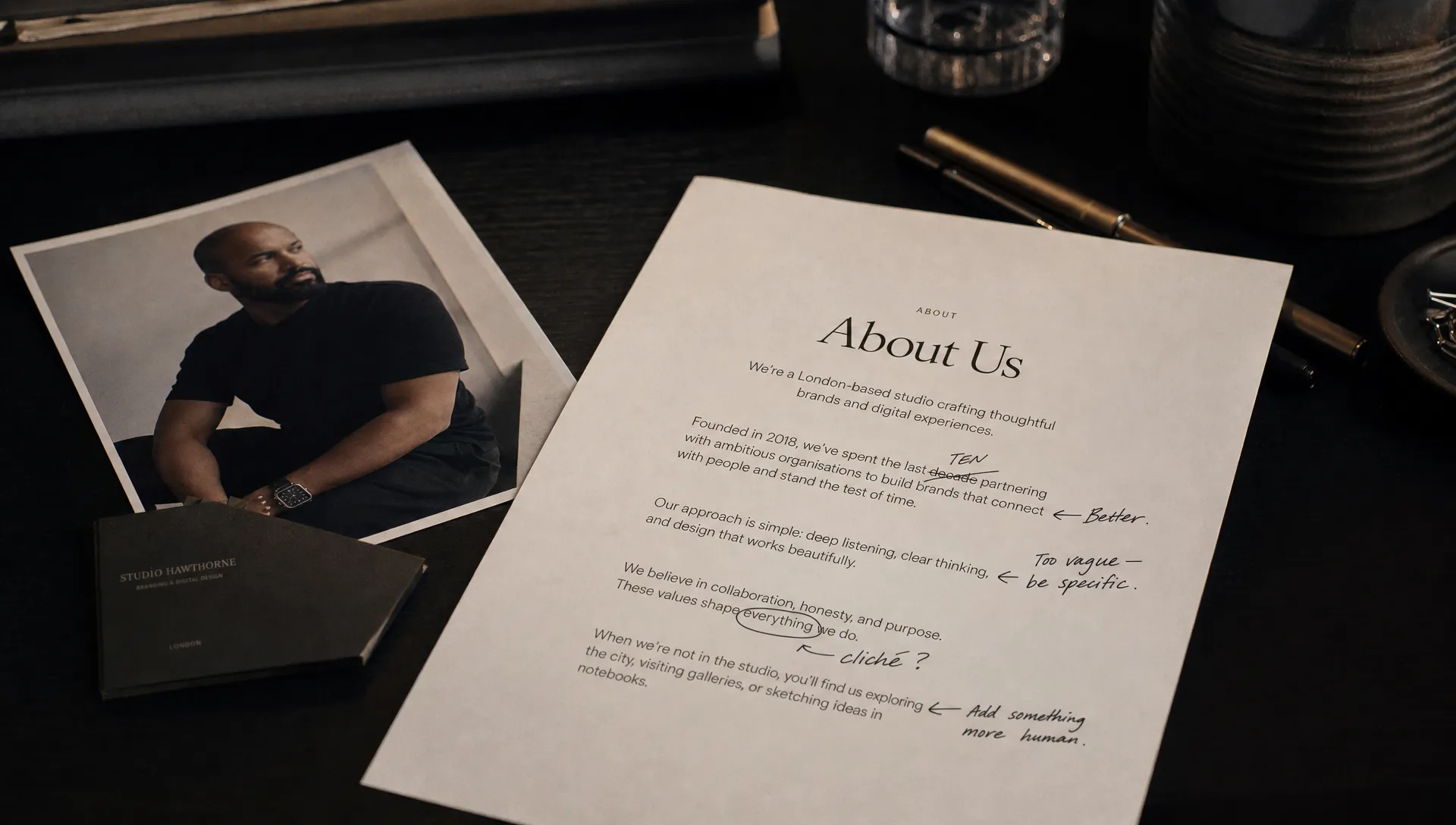
Internal links make your About page useful
An About page should not be a cul-de-sac. If someone reads it and likes what they see, give them a sensible next step. That might be a link to your services, your contact page, your case studies or a key guide that proves you know your stuff.
Internal links also help search engines understand which pages on your site matter. If your About page mentions your core services but doesn’t link to them, you’re missing an easy opportunity. It’s like telling someone you sell kitchens, then refusing to show them the showroom.
For example, SEO Bridge works with UK business owners who need practical, plain-English help rather than agency theatre. So a page explaining Matt’s background can naturally point readers towards affordable SEO for small businesses because that’s directly relevant to the audience.
About page SEO is not about throwing random links around. Link when it helps the reader. Use descriptive anchor text. Don’t use “click here” unless you enjoy making the internet worse. A few relevant internal links are better than a messy block of every page you’ve ever published.
Common About page mistakes that hurt trust
Most bad About pages fail because they are too vague. They sound like they could belong to any business in any town. “We’re a leading provider of bespoke solutions” is not an About page. It’s a cry for help.
Another common problem is hiding the people. I get why some business owners are cautious. Nobody wants their face plastered everywhere if they hate photos. But a completely anonymous business is harder to trust, especially if you’re asking people to invite you into their home, share sensitive details or spend serious money.
Watch out for these problems:
- No names, faces or identifiable people behind the business
- No mention of location, service area or trading history
- Generic claims with no proof, examples or specifics
- No internal links to important service or contact pages
- Outdated information, old team members or dead social links
- Keyword stuffing that makes the page read like it was written by a broken printer
About page SEO works best when the page feels human and credible. If your page could be copied onto a competitor’s site without changing much, it’s too bland.
A simple About page structure that works
You don’t need to be clever. Clever often gets in the way. A clear About page structure beats a “brand story” full of misty-eyed nonsense every time.
Start with a short summary of who you are and what you do. Then explain who you help and where you work. After that, add the background: when the business started, why it exists and what experience sits behind it. Include proof, such as accreditations, trade bodies, awards, case studies or review snippets where appropriate.
Then link to your main services and finish with a clear next step. That might be booking a call, requesting a quote or viewing your service pages. Don’t make people hunt around like they’re solving a murder mystery.
A practical order would be:
- Short introduction with your business name, location and main service
- Brief founder or company story with dates and relevant detail
- Explanation of who you help and what problems you solve
- Proof of credibility, such as qualifications, reviews or project examples
- Links to core services and a clear call to action
Used this way, About page SEO supports both search engines and real humans, which is the whole point.
What to include if you are a service business
Service businesses need to build confidence quickly. If you’re a builder, electrician, accountant, consultant, therapist, solicitor or SEO specialist, your About page should reduce risk in the customer’s mind.
People want to know whether you’re competent, whether you’re local, whether you understand their problem and whether you’re likely to disappear once the invoice is paid. Your About page can answer those concerns before they become objections.
Include details that matter to your buyers. For trades, this might be insurance, qualifications, years in business, areas covered and types of work handled. For professional services, it might be sector experience, specialist knowledge, client types, professional bodies and the way you work.
About page SEO for a service business should also connect clearly to the service pages that bring in leads. If your About page says you specialise in technical audits, for example, link to your technical SEO page. If you optimise Google listings for local clients, link to your Google Business Profile service page. Make the path obvious.
What to include if you sell products online
E-commerce businesses often treat the About page as filler. Big mistake. If you sell products online, customers may want reassurance before they buy, especially if they’ve never heard of you before.
Your About page can explain why the shop exists, who chooses the products, where items are sourced from, what standards you care about and what kind of customer you serve. This is especially useful for specialist products, premium items, ethical ranges or anything where buyers need confidence before spending.
It can also help Google understand the entity behind the shop. If your site sells handmade furniture, outdoor gear or skincare products, your About page can reinforce the expertise and focus behind the catalogue.
For online shops, About page SEO should not be stuffed with product keywords. Keep it natural. Mention your product category, explain your standards and link to important collections or buying guides where it makes sense. If the page reads like a proper business with a reason to exist, you’re already ahead of a lot of thin e-commerce sites.
Measuring whether your About page is helping
You probably won’t see your About page jump from nowhere to ranking for a massive commercial keyword. That is not the main job. The better question is whether it helps people trust you and move through the site.
Check Google Analytics or your reporting tool to see how many people visit the page, where they come from and what they do next. Do they go to service pages? Do they contact you? Do they leave immediately? A high exit rate is not always bad, but if people land there and vanish, the page might not be doing enough.
Look at Google Search Console too. You may see brand searches, founder names or local variations bringing people to the page. That can be useful, especially for established businesses where potential customers research before enquiring.
About page SEO should also be judged manually. Read the page out loud. Does it sound like you? Does it answer real buying concerns? Would you trust this business? If the honest answer is “not really”, fix the bloody thing.
When your About page is not the real problem
Sometimes business owners obsess over the About page because it feels easier than facing the bigger issue. If your service pages are weak, your site is slow, your Google Business Profile is half-empty and your content doesn’t match what customers search for, the About page is not the fire you put out first.
Your About page supports rankings. It does not replace proper service page optimisation, technical fixes, keyword research, local SEO or decent links. It is one part of the site, not the whole machine.
If you’ve recently paid for a new website and it looks lovely but brings in no leads, the problem is probably bigger than one page. Pretty websites can be useless if nobody planned the search structure. That’s where SEO Bridge usually starts: what needs to rank, what Google can understand, what users need and what is currently getting in the way.
About page SEO is worth doing because it’s simple, cheap and often neglected. Just don’t expect it to rescue a site that has no proper foundations.
Frequently Asked Questions
Can an About page rank on Google? Yes, an About page can rank on Google, especially for brand searches, founder names, company background queries and some local searches. It is unlikely to rank for highly competitive service keywords unless the search intent fits. Its main SEO value is usually supporting trust, relevance and internal linking across the site.
Is About page SEO a direct ranking factor? About page SEO is not a single direct ranking factor like a switch you turn on. It helps by improving clarity, trust signals, internal links and user confidence. Those things can support better site performance, especially when combined with strong service pages, good technical SEO and consistent local business information.
How long should an About page be? An About page should be as long as needed to explain who you are, what you do, where you work and why customers should trust you. For many small businesses, 600 to 1,200 words is enough. Avoid padding it with waffle just to hit a word count.
Should I include keywords on my About page? Yes, but keep it natural. Mention your main service, location and specialist areas where they genuinely fit. Do not repeat keywords awkwardly or turn the page into a list of towns and services. If a sentence sounds stupid when read out loud, it probably needs rewriting.
Should my About page link to service pages? Yes, your About page should link to important service pages when the link helps the reader. If you mention a core service, make it easy for visitors to learn more. This also helps Google understand the relationship between your business information and your commercial pages.
Do I need photos of myself or my team? You do not have to include photos, but real images can improve trust. For local businesses, trades and professional services, showing the people behind the company often helps. If you use photos, make sure they are decent quality, current and not awkward stock images pretending to be your team.
