You can’t “do SEO” with ChatGPT.
You can talk about SEO with ChatGPT. You can plan SEO with ChatGPT. You can even get it to write 17 blog posts about “why your business needs SEO” (please don’t).
But “do SEO”? As in, fix the broken tech, make the pages convert, build local trust, and win leads in Cheshire while Google changes the rules mid-week? Not a chance.
Still, I was curious (and mildly annoyed by the amount of people saying “I’ll just use AI for SEO now”). So we ran a simple test for a month.
We asked ChatGPT to run the playbook.
Here’s what happened.
The rules of the experiment (before the internet screams)
ChatGPT can’t log into your Google Search Console. It can’t crawl your site like Screaming Frog unless you feed it data. It can’t phone your web developer and force them to fix the redirect mess. It can’t ring your last 20 customers and ask for reviews.
So we did the only fair version of this test:
- ChatGPT told us what to do, and drafted the stuff that can be drafted.
- We did the human bits (because, newsflash, someone still has to press the buttons).
- We judged the output on one thing only: would this create a better, more findable, higher-converting SEO website?
And because it needs saying in 2026: Google doesn’t automatically punish AI content. It punishes rubbish content. Their guidance is basically “make it helpful, not spam” (yes, really) as per Google Search’s AI-generated content guidance.
The scoreboard: what ChatGPT was brilliant at vs what it faceplanted
Here’s the straight truth, not the “AI will replace you” LinkedIn fan fiction.
| SEO job | ChatGPT score (1 to 10) | What it did well | What it got wrong | Verdict |
|---|---|---|---|---|
| Keyword ideation | 7 | Fast list of service and question themes | Missed local modifiers, muddled intent, suggested irrelevant fluff | Useful starting point, not the finish |
| On-page copy drafts | 6 | Clean structure, decent headings | Generic, samey, not “you”, often too long | Needs editing, badly |
| SEO titles/meta ideas | 7 | Loads of options quickly | Often clickbaity or vague, sometimes repeats | Good for A/B ideas |
| Content briefs/outlines | 8 | Solid outlines, logical sections | Lacks real-world proof and local nuance | Great assistant |
| Technical SEO diagnosis | 3 | Can explain concepts clearly | Can’t see your actual issues without exports | Not a replacement for an audit |
| Link building | 2 | Can suggest types of links | Can’t earn links, suggests dodgy tactics if you push it | Human work, always |
| Local SEO (GBP, citations, reviews) | 4 | Knows what matters in theory | Can’t verify your listings or fix consistency | Needs hands-on work |
| Conversion improvements | 5 | Good general advice | Not specific to your offer, traffic, objections | Needs real testing |
That’s the headline: ChatGPT is a quality assistant. It is not an SEO manager.
If you treat it like a manager, you get a month of busywork and not much else.
Week 1: ChatGPT’s SEO plan was… fine. Then reality showed up.
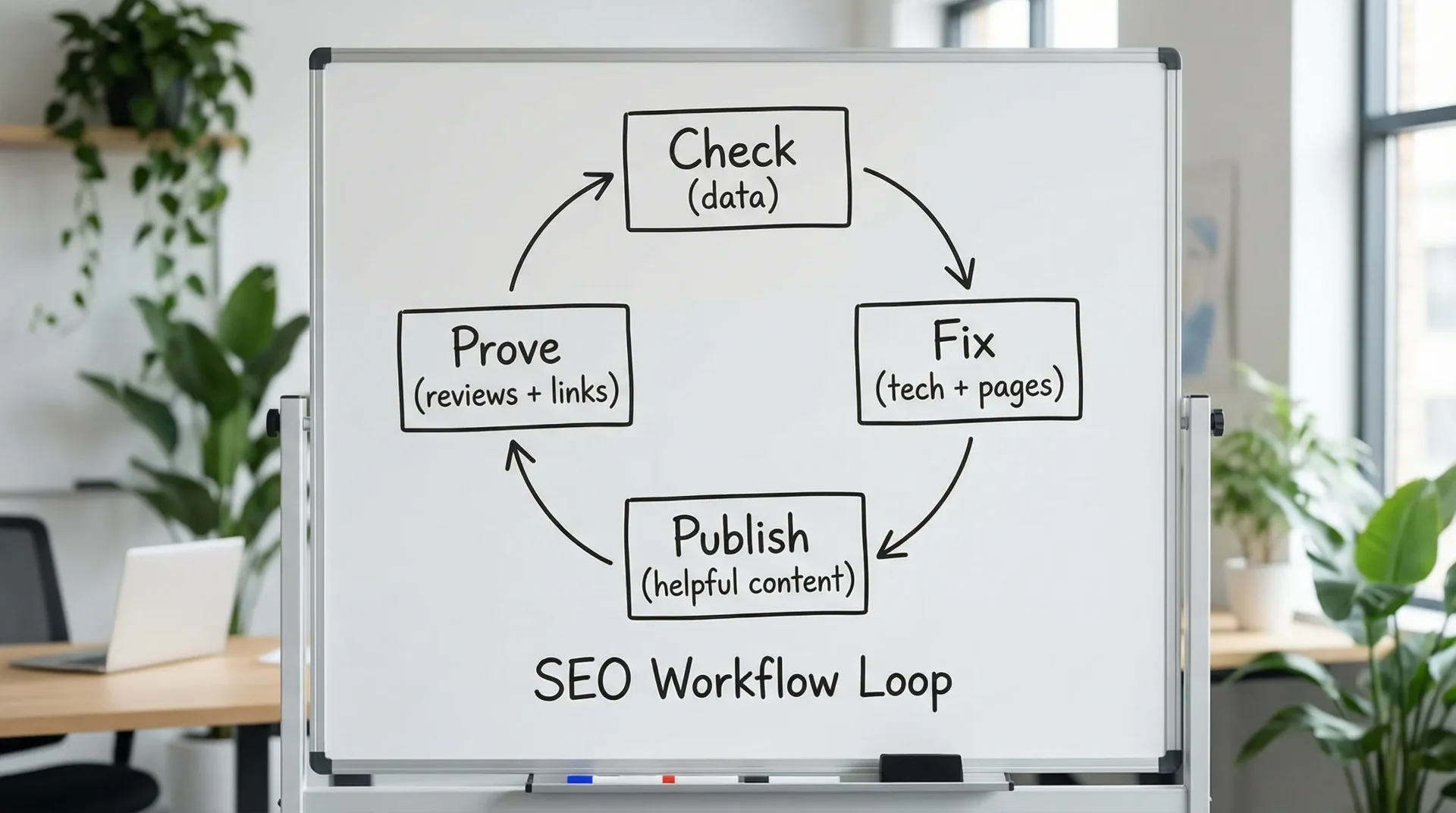
ChatGPT started strong. It gave us the standard setup:
- Pick a core service.
- Map keywords to pages.
- Fix technical issues.
- Publish helpful content.
- Build authority.
- Track results.
All true. All boring. All incomplete.
The problem is that “technical issues” can mean:
- A couple of missing meta descriptions.
- Or your entire site being half de-indexed because of canonicals.
ChatGPT can’t tell the difference unless you feed it the right exports.
So we did what any sane person should do first: we checked the site like grown-ups.
If you haven’t done this yet, stop reading and do it now:
- Check indexing in Google Search Console.
- Run a crawl.
- Check page speed.
- Check mobile.
If that list makes you want to lie down in a dark room, this is exactly why a proper audit exists. We’ve got a plain-English breakdown here: Shall we audit your website?
ChatGPT didn’t “find” the issues. It simply told us what issues might exist.
That’s not SEO. That’s horoscope.
Week 2: Content creation, where AI shines (and also embarrasses itself)
This is where ChatGPT starts looking like a hero.
Give it a service, a location, a customer type, and it will crank out drafts at speed.
And yes, content matters. A lot.
Ahrefs famously found 90.63% of pages get no organic traffic from Google in their large-scale study, mostly because they target nothing, answer nothing, or compete with everyone and their dog with the same bland page (source).
So we asked ChatGPT to draft:
- A service page rewrite
- A “money” blog post aimed at buyer intent
- A local supporting page
The drafts were… usable.
But they had three problems that show up every single time when business owners copy-paste AI into WordPress and call it a day.
1) It writes like it’s trying to win an award for “Most Words Used”
Real customers don’t want an essay.
They want:
- Are you local?
- Do you do the thing?
- How much does it cost?
- Can I trust you?
- What happens next?
ChatGPT loves padding. It will happily waffle for 400 words before saying anything concrete.
2) It’s terrified of specifics
Ask it to “add proof” and it will invent nonsense if you let it.
That’s not just cringe, it’s risky.
Google’s quality systems and human evaluators care about experience, expertise, and trust signals. If you want to see what “trust” actually looks like in Google’s world, read the Search Quality Rater Guidelines. It’s basically a 170-page document explaining why “vibes” don’t rank.
So we had to add the real stuff AI can’t:
- Real project examples
- Real constraints
- Real pricing ranges (when appropriate)
- Real photos
- Real policies
- Real testimonials
That’s the difference between a content site and an SEO website that generates leads.
3) It gets local tone wrong
If you’re a small business in Cheshire, you don’t want to sound like a Silicon Valley chatbot.
You want to sound like:
- a proper tradesperson
- a legit local service
- someone who will actually answer the phone
ChatGPT’s default tone is “polite corporate”. We had to beat it out of the copy with edits.
If your blog has gone stale and you’ve been relying on a couple of ancient posts from 2022, have a look at this (it’s savage, but fair): Is Your Blog Dead? Find Out Right Now.
Week 3: The bit everyone skips (then blames SEO when it doesn’t work)
Week 3 is where most DIY SEO collapses.
Because it’s not as fun as “writing content”. It’s the unsexy stuff:
- internal linking
- fixing cannibalisation
- improving service page layout
- adding proper calls to action
- cleaning up thin pages
- making the site faster
ChatGPT can suggest these things. It can even draft the snippets.
But it can’t do the hard part: making decisions.
ChatGPT suggested internal links. That was actually decent.
Internal linking is one of the cheapest wins in SEO, and most sites do it like they’re blindfolded.
We asked ChatGPT to propose internal links between related topics.
It gave sensible clusters like:
- technical checks and audits
- SEO building blocks
- AI search optimisation
- automation routines
If you want the “grown-up” version of how SEO is built (without the fairy dust), this is the backbone: SEO Services: The 5 Building Blocks That Drive Leads
And if you want the AI-era version, start here: How to Optimise Your Business for ChatGPT, Gemini, and AI Search
ChatGPT suggested conversion improvements. Half were great, half were pointless.
It recommended:
- clearer CTAs
- better page structure
- trust badges
- FAQs (we didn’t add them here)
All fine.
But it also recommended generic “add a newsletter pop-up” nonsense.
If you’re a local service business, you don’t need 3 pop-ups and a spinning wheel discount. You need one clear action.
Want a simple example of how small changes can hit hard? Here’s a real one: The 3-word change that doubled a client’s enquiries overnight
Week 4: Links, reputation, and why AI can’t do the job you actually need
This is the bit that separates “a website” from a business that shows up.
AI can’t build your reputation.
It can’t earn a local link from a supplier.
It can’t convince a real customer to leave a review.
It can’t undo the damage from the last agency that flogged you a £99/month package and sent 300 spam links from websites about casino bonuses.
(If that last sentence made your stomach drop, you’re not alone.)
The honest truth about link building
ChatGPT can give you a list of link ideas:
- local sponsorships
- partnerships
- directories
- guest posts
- PR
But it won’t tell you what matters most: quality and relevance.
It also won’t stop you from doing something stupid if you keep prompting it like “give me fast backlinks”.
This is why we bang on about transparency and proof. If you’ve ever suspected your provider is sending you pretty reports and doing nothing, read this: Your SEO Agency Is Robbing You Blind – Here’s The Proof
“But I make videos for my business, won’t that help?”
Yes, if you do it properly.
Not because “video ranks” (sometimes it does), but because video can:
- increase on-page engagement
- answer objections fast
- build brand memory
- give you assets for socials and outreach
And outreach is where links and mentions often come from.
If you’re churning out short promos or explainers, having decent creative assets speeds it up massively. One of the better resources we’ve seen for that is this bundle of video templates for everyday projects (one-time purchase, no subscription grief).
The real takeaway: ChatGPT didn’t do our SEO. It exposed our SEO process.
After a month, here’s the uncomfortable truth:
ChatGPT is great at making SEO look easy.
It’s less great at making SEO work.
Because SEO isn’t a list of tasks. It’s a chain. And the chain breaks where most people refuse to do the work.
What AI is genuinely good for (use it for this)
- Drafting outlines for service pages and blogs
- Turning messy notes into clean structure
- Generating alternate titles and intros (then you pick the non-terrible one)
- Summarising competitors (when you provide the pages)
- Creating content briefs your team can actually follow
What AI is absolutely not good for (stop pretending)
- Diagnosing technical SEO without data exports
- Choosing the right keyword targets for your margins and lead quality
- Understanding your local market like an actual Cheshire business
- Earning authority, links, reviews, and brand searches
- Knowing what will convert on your site without testing and context
If you’re a small business owner, here’s the move
If you want to use ChatGPT for SEO, do it. Seriously.
Just don’t do the classic thing where you use it to write 20 bland posts, ignore your Google Business Profile, leave your site slow, and then decide “SEO doesn’t work.”
SEO works.
But it rewards the boring stuff done consistently.
If you want someone to tell you, bluntly, what’s actually holding your SEO website back (and what to fix first), start here: get a proper website audit. No mysticism. No smoke. Just the stuff that moves the needle.