
If your “SEO report” looks like a horoscope, you’re not doing marketing. You’re funding someone’s new kitchen.
And before you email me saying “SEO is complicated”, yeah, it is. That’s why you hired seo experts. But complicated doesn’t mean mysterious. And it definitely doesn’t mean you should pay £500 to £2,000 a month for a PDF full of fluff and vibes.
This is the bit most agencies won’t say out loud:
A lot of SEO retainers are basically rent. You pay. They “do stuff”. You never really know what. Then you get told to “be patient” while your phone stays silent.
So let’s do something refreshing. Let’s talk proof.
The big lie: “Trust us, it’s happening”
SEO isn’t magic. It leaves fingerprints.
If an agency is doing real work, you can see:
- what changed on your site
- what improved (or got worse)
- what pages are earning impressions and clicks
- what leads and calls are being generated
- what they’re doing next, and why
If you can’t see any of that, you’re not buying SEO.
You’re buying reassurance.
And reassurance doesn’t pay wages.
“We built links.” Cool. Where are they then?
Here’s a classic.
“We built 30 backlinks this month.”
Brilliant. Show me.
Not “we can’t share because it’s proprietary”. Not “we don’t want competitors to copy”. That’s absolute nonsense.
At minimum, you should get a list with:
- the linking URL
- the page on your site it points to
- the type of link (mention, directory, guest post, PR, partner, etc.)
- why that site is relevant
And while we’re here: buying links on random sites with names like best-top-online-marketing-articles.biz is not “building authority”. It’s playing Russian roulette with your domain.
Google is very clear about link spam and manipulative link practices. If you want bedtime reading that actually matters, start with Google’s documentation on link spam.
The 9 red flags your SEO agency is rinsing you
Not “maybes”. Not “depends”. These are the signs you’re paying for noise.
1) Reports full of rankings, not outcomes
Rankings are cute. Cash is cuter.
If your report bangs on about “you moved from position 14 to 11 for ‘best electrician Cheshire’” but doesn’t mention enquiries, calls, form submissions, bookings, sales, you’re being distracted with shiny objects.
Good SEO reporting ties to business outcomes. Always.
2) They won’t give you access to your own accounts
If you don’t have admin access to:
- Google Search Console
- GA4 (Google Analytics)
- your Google Business Profile
…you don’t have an SEO provider, you have a gatekeeper.
You should own your data. Full stop.
3) “We did technical SEO” with no change log
Technical SEO is not a spiritual experience. Things get changed.
Ask for a simple list:
- what was fixed
- what pages were touched
- what the before/after was
- what’s still broken
No list, no work.
4) They publish blog posts nobody would ever search for
“We posted a new article: ‘Why Our Company Values Excellence’.”
Congratulations. You’ve just paid for a digital flyer.
Content should target:
- services people actually buy
- problems people actually have
- questions people actually ask before spending money
If it doesn’t map to real search intent, it’s just website padding.
5) Everything is “next month”
SEO takes time, yes.
But if every month is:
- “we’re still researching keywords”
- “we’re still auditing”
- “we’re still waiting for Google”
…then your campaign is stuck in a permanent pre-season friendly.
A proper project has momentum: foundations, pages, authority, conversion, iteration.
6) They avoid talking about conversion like it’s a dirty word
Traffic without conversion is just expensive entertainment.
If you’re getting visits but no leads, the problem might be:
- the page answers the wrong intent
- there’s no trust (reviews, proof, case studies)
- the call to action is weak
- the site is slow or confusing
If your agency doesn’t bring this up, they’re not doing growth. They’re doing “SEO theatre”.
7) They won’t talk about what they’re not doing
Good agencies have boundaries.
They’ll say:
- “we’re not doing PR this month, budget doesn’t cover it”
- “we’re prioritising service pages before content”
- “we’re not chasing 200 keywords, we’re chasing leads”
If everything is presented like it’s handled, but nothing ever changes, you’re being managed, not marketed.
8) They promise page-one like it’s a Domino’s delivery
Anyone guaranteeing rankings is either naive or lying.
Google doesn’t take promises. It takes signals.
9) The work doesn’t match the fee
Let’s be blunt.
If you’re paying a decent retainer and the only output is:
- one generic blog post
- a couple of directory submissions
- a monthly PDF
…you’re not investing, you’re being mugged off politely.
Here’s the proof you can check tonight in 20 minutes
You don’t need to be an SEO nerd. You just need three tabs open and a bit of scepticism.
Step 1: Google Search Console, the no-BS scoreboard
Open Search Console.
Check:
- Performance: are impressions and clicks trending up over 3 months, not 7 days?
- Queries: are you showing up for commercial searches, or random fluff?
- Pages: are the pages that make you money getting visibility?
If your top pages are “About” and “Blog”, but you sell kitchen fitting in Crewe, something’s off.
Step 2: Look for evidence of actual page work
Ask your agency for:
- a list of pages optimised this month
- what was changed (titles, headings, copy, internal links, schema)
- why those changes were chosen
If they can’t tell you which pages they touched, they didn’t touch any.
Step 3: Check if the leads are being tracked properly
If SEO is “working” but nobody can tell you:
- how many calls came from organic
- how many forms came from organic
- what pages those leads landed on
…then you’re driving blind.
You don’t need a fancy setup to start. Even a basic GA4 conversion event and a simple lead log beats guessing.
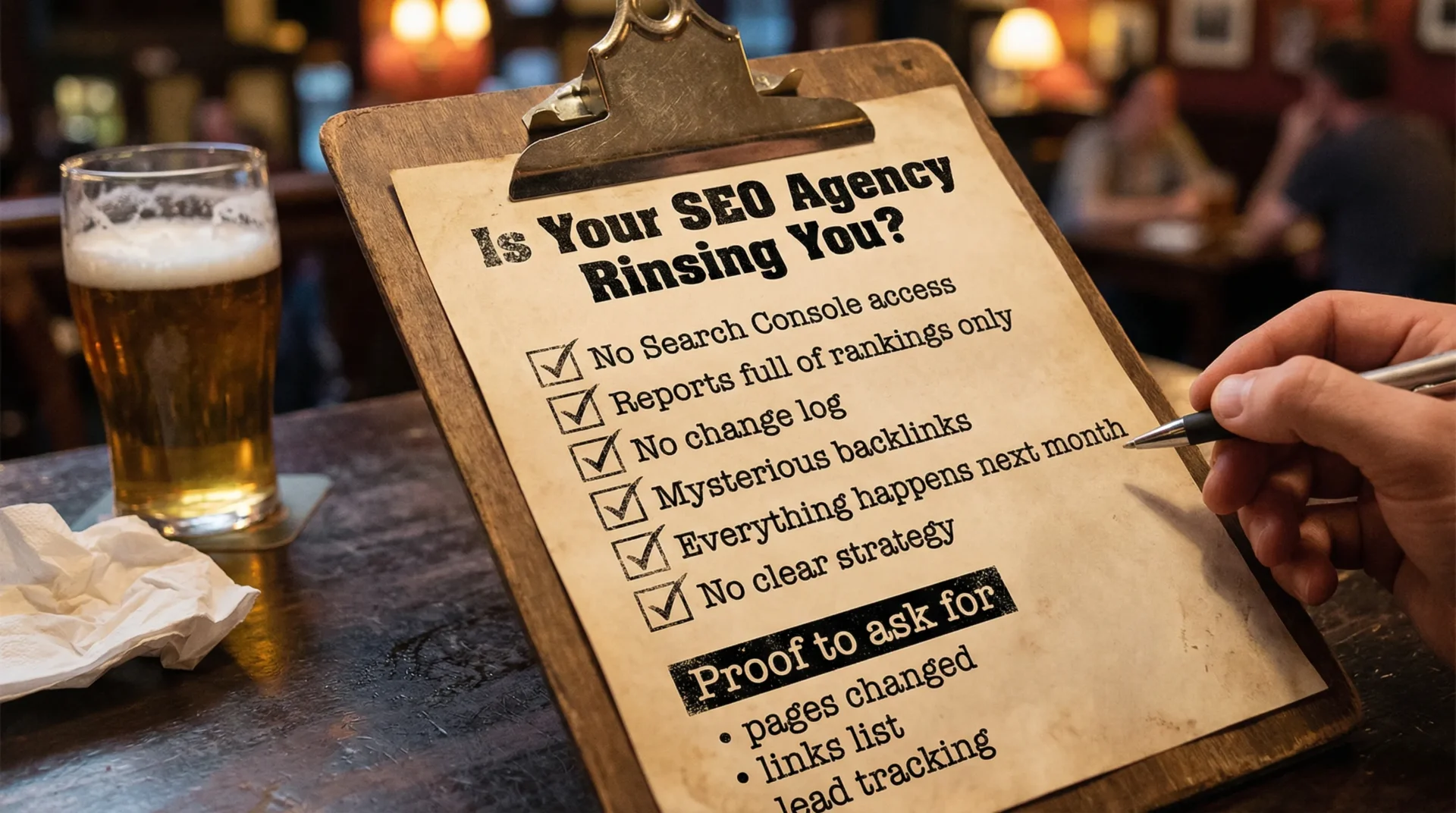
What good SEO looks like (so you don’t get fobbed off)
Good SEO is boring in the best way. It’s methodical. It’s measurable. It has a paper trail.
Here’s a simple “show me” table you can use when someone sends you a report full of smoke.
| What they claim | What you should receive | What it proves |
|---|---|---|
| “We did on-page SEO” | URLs changed + what changed (titles, H1s, copy, internal links) | Real work happened on real pages |
| “We improved technical SEO” | Audit items fixed + before/after checks (speed, indexation, errors) | Foundations are improving |
| “We built authority” | List of earned links/mentions + relevance explanation | Off-site trust is being built |
| “Traffic is up” | Search Console clicks + GA4 organic sessions + comparison period | It’s not bot noise |
| “SEO is working” | Leads from organic + landing pages + conversion rate trend | Visibility is turning into money |
If they can’t provide any of this, you’re basically paying for a story.
Real example: SEO is the same whether you’re in Cheshire or San Antonio
SEO fundamentals don’t care if you’re a Nantwich plumber or selling manufactured homes in Texas.
Take a site like manufactured homes in San Antonio. It’s clear what they offer, there’s real inventory, real locations, financing info, and obvious next steps. That’s what search engines and customers both love: clarity, proof, and zero messing about.
Now compare that to the average small business website that says:
“We provide quality solutions tailored to your needs.”
Mate. Nobody searches for “quality solutions”. They search for the thing you sell, where you sell it, and whether you’re legit.
The awkward truth: cheap SEO is rarely cheap
If you’ve been burned by a bargain agency, here’s what probably happened:
- they ran a templated audit
- they changed a couple of meta titles
- they fired out some dodgy links
- they wrote content that could apply to literally any business
Then when it didn’t work, you were told:
- “SEO takes time”
- “your industry is competitive”
- “Google changed the algorithm”
Sometimes those are real factors. Often it’s a convenient excuse for low effort.
What to ask your SEO agency tomorrow (and how to spot waffle)
You’re not being “difficult”. You’re being a grown-up spending real money.
Ask these, and enjoy the silence.
“What did you do this month that I can physically see?”
You want:
- page URLs
- screenshots
- a change log
Not “optimisation was performed”.
“What’s the plan for next month, and why that order?”
You want priorities tied to impact.
If the answer is “more blogs”, ask: “Which queries are we targeting and what’s the intent?”
“What’s blocking results right now?”
Good answers sound like:
- “Your service pages aren’t specific enough”
- “Your Google Business Profile is weak”
- “You have thin location coverage”
- “The site is slow on mobile”
- “We’re not getting enough trust signals (reviews, links, mentions)”
Bad answers sound like:
- “Google needs more time”
- “SEO is complex”
- “We’re building momentum”
“Show me organic leads, not just traffic.”
If they don’t track leads, they’re guessing.
“Yeah but… AI search. Does any of this still matter in 2026?”
Yes. And actually, it matters more.
With Google AI Overviews and AI answer engines hoovering up attention, you don’t win by being vague. You win by being:
- structured (clean headings, FAQs, clear service pages)
- credible (reviews, case studies, real-world proof)
- consistent (same business details everywhere)
- easy to crawl and understand
If your agency is still playing 2016 SEO, you’re paying for nostalgia.
Frequently Asked Questions
How do I know if my SEO agency is doing anything? Ask for a change log (pages worked on and what changed), Search Console trends, a list of earned links/mentions, and organic lead numbers. No proof, no work.
Is it normal for SEO to take months? Yes, meaningful results often take months, especially in competitive areas. But you should see progress signals early, like better indexing, improved page visibility, and clearer reporting.
What should I own if I hire an SEO agency? You should own and have admin access to your domain, hosting, CMS, Google Search Console, GA4, and Google Business Profile. If they control access, you’re trapped.
Are backlinks still a thing? Yes, but quality beats quantity. Relevant links and real mentions help. Spammy links can cause a world of pain.
Should my agency be talking about conversions? Absolutely. Rankings and traffic mean nothing if the site doesn’t turn visitors into enquiries. SEO without conversion is just a hobby.
If you suspect you’re being rinsed, do this next
Don’t start a massive argument. Don’t write a 2,000-word email. Do the simple move.
Send one message:
“Can you share (1) Search Console access, (2) the list of pages you changed this month, and (3) the leads attributed to organic search?”
If they dodge it, you’ve got your answer.
If you want a straight second opinion from people who actually show their working, grab a free SEO consultation with SEO Bridge here: SEO Bridge.
