
If you feel like your Google rankings have stayed “about the same” lately, but enquiries are softer than they should be, you are not imagining it. The battleground has shifted.
In 2026, many search journeys never reach page one in the traditional way. Prospects ask Google’s AI Overviews, ChatGPT-style search, or voice assistants to recommend a supplier, shortlist options, or summarise “best companies near me”. The businesses that win are not just ranking, they are being cited and recommended.
For local businesses across Cheshire (and nearby areas like Greater Manchester, Merseyside and North Wales), that change is huge. If your competitors are already making their services easy for AI to understand and trust, they can show up in answers even when you do not.
What “optimising for AI search” actually means (and what it is not)
A lot of people hear “AI search optimisation” and assume it means using AI tools to churn out blog posts faster.
That is not the goal.
Optimising for AI search means making it easy for AI systems to:
- Find your business and pages (technical accessibility, indexing, local presence)
- Understand exactly what you do, where you do it, and who it is for (clear service entities and location relevance)
- Trust that you are a credible option worth recommending (proof, reviews, citations, authority)
This is why the best AI visibility strategies still sit on solid SEO foundations. Google is still crawling pages, evaluating quality, and looking for clear signals of expertise and relevance. What is changing is how results get presented (summaries, citations, shortlists), and therefore which content formats and trust signals get rewarded.
If you want a deeper overview of the service side of this, SEO Bridge offers dedicated AI search optimisation in the UK for businesses that want to be visible in both Google and AI-driven engines.
The new “local search journey” in Cheshire
A typical local customer journey used to look like this:
Someone searches “kitchen fitter Chester”, clicks a few websites, and rings one.
Now it often looks more like:
Someone asks “Who is the best kitchen fitter in Chester for shaker kitchens under £X?” or “Which accountants in Wilmslow are good for small limited companies?” and the engine responds with:
- A short answer
- A few recommended businesses
- Citations from websites, directories, reviews, and sometimes Google Business Profiles
If your business is not being pulled into that shortlist, you can lose leads even if you technically “rank”.
That is why local SEO in 2026 is increasingly about being the easiest option for the engine to confidently recommend.
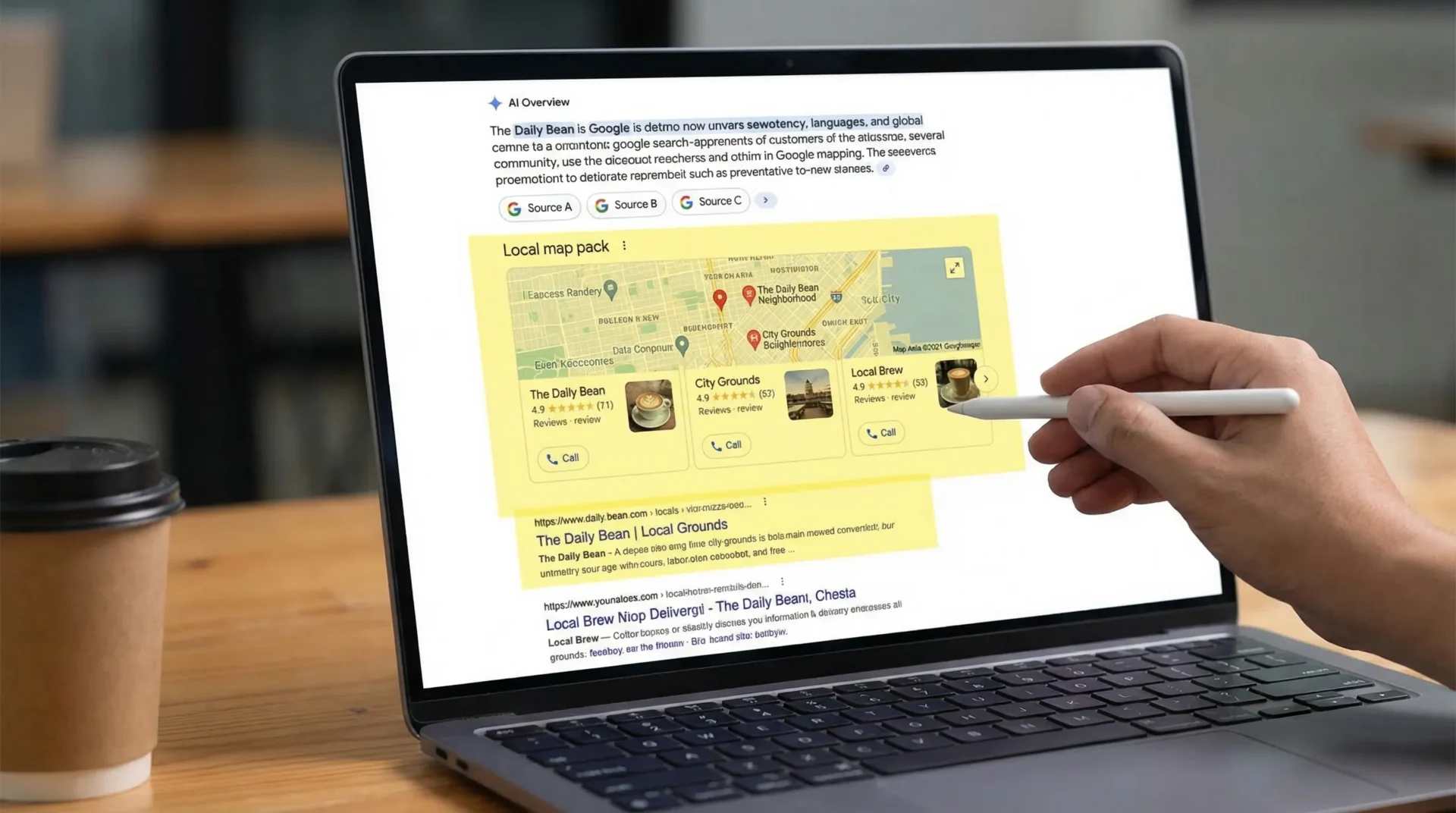
Where AI engines get confident enough to mention your business
AI-driven results tend to favour businesses that are consistent and well evidenced across the web, not just businesses with a clever homepage.
Think of it like this: the engine is trying to avoid making a bad recommendation. So it looks for alignment across:
- Your website (clear services, locations, proof)
- Your Google Business Profile (categories, reviews, activity)
- Independent sources (citations, local links, press, directories)
- On-page structure (so it can extract answers cleanly)
To make this practical, here is a simple “AI visibility scorecard” you can use to spot gaps.
| Asset | What AI is looking for | Quick win this week | Helpful tool |
|---|---|---|---|
| Service pages | Clear description of service, who it helps, where you work, pricing approach (if applicable), proof | Add a 40 to 60 word “What we do” summary near the top of each key service page | Google Search Console |
| Location relevance | Town/area served connected to services (not stuffed into footers) | Create or improve a dedicated “Areas we cover” section with real coverage (Chester, Warrington, Crewe, etc.) | Keyword research tool or simple SERP checks |
| Trust signals | Reviews, accreditations, insurance, case studies, team info | Add a proof block: reviews snippet, memberships, and a link to a relevant case study | Your CMS |
| Structured data | Schema that clarifies business type and services | Add LocalBusiness schema and ensure NAP matches everywhere | Google’s Rich Results Test |
| Site quality | Fast, mobile-friendly, easy to crawl and index | Fix indexation blockers, slow templates, broken internal links | PageSpeed Insights |
| Local presence | Strong Google Business Profile and consistent citations | Review GBP categories, services, and add fresh photos | Google Business Profile |
| Authority | Mentions and links from relevant local or industry sources | Secure one local link (sponsor, trade body, supplier, local press) | Backlink checker |
7 moves that help you compete in AI Overviews and AI recommendations
You do not need to “do everything”. You need to do the right few things well, starting with the pages that actually generate leads.
1) Turn your best service pages into “answer-ready” pages
AI summaries rely heavily on content that can be extracted cleanly. That means your most important pages should include:
- A short, plain-English summary near the top
- A clear explanation of the process (in human terms)
- A quick “who it is for” and “who it is not for” section (this improves intent matching)
- Real proof (local projects, photos, outcomes, testimonials)
If you already have content but it is not performing, updating and tightening what exists often beats publishing something new. This is where a structured refresh helps. A useful reference is this playbook for optimising existing content for AI visibility, especially if you are trying to earn citations in AI Overviews rather than just chasing clicks.
2) Make your location signals specific (without stuffing)
For Cheshire businesses, generic “we serve the North West” copy is rarely enough.
AI needs specificity: which towns, which services, and what evidence do you have there?
Instead of repeating “Cheshire” everywhere, focus on:
- A clear service area statement (with real towns: Chester, Ellesmere Port, Northwich, Nantwich, Knutsford, Macclesfield, Wilmslow, Warrington, Crewe)
- Case studies or testimonials tied to locations
- Unique local details that a competitor cannot copy (response times, types of properties you work on, local partnerships)
If your priority is more calls and enquiries, this guide on local SEO services and getting more calls in Cheshire is a solid next step.
3) Treat your Google Business Profile as a “source”, not a listing
Many AI-driven local recommendations are influenced by map data and review ecosystems. Your Google Business Profile (GBP) often acts like a trusted, structured dataset.
Key improvements that matter:
- Correct primary category (and relevant secondary categories)
- Services filled in properly (not just a short list)
- Regular photos that show real work (not stock)
- Review responses that mention the service and location naturally
If you want the full setup and troubleshooting steps, see how to get your business on Google (it is especially useful if you are unsure whether you have an indexing issue, a Maps issue, or both).
4) Add structured data so machines do not have to guess
Schema is not a magic ranking button, but it is extremely helpful for “machine understanding”. It clarifies your business type, service area, and key details in a consistent format.
At minimum, most local businesses should consider:
- LocalBusiness schema (NAP, opening hours, service area)
- Service schema (for core services)
- Review markup only where it is eligible and honest
If you are unsure whether your site is technically solid enough to support this, an audit is usually the fastest way to remove blockers. SEO Bridge has a straightforward page on auditing your website that outlines what gets checked and why it matters.
5) Strengthen “proof” so AI can trust you with recommendations
In local markets, AI engines are trying to avoid risky suggestions. So trust signals become more important, not less.
Examples of proof that tends to travel well across search experiences:
- Case studies with specifics (location, problem, solution, result)
- Review volume and recency
- Memberships and accreditations (where relevant)
- Clear contact details and business information
- About pages that show who is behind the company
If you want an example of how local proof translates into measurable growth, SEO Bridge’s Nantwich case study is worth a look.
6) Build authority in ways that a chatbot can corroborate
Classic link building still matters, but the mindset is shifting from “more links” to “more corroboration”.
For a Cheshire business, that can mean:
- Local sponsorships (sports clubs, charities, community events)
- Trade association listings
- Supplier and partner pages
- Genuine local press coverage
The goal is to create a wider web footprint that supports the same core facts about your business.
7) Stop measuring success only by rankings
If AI Overviews answer the query without a click, rankings alone are not the full story.
What you should monitor instead:
- Leads: calls, forms, quote requests
- Google Business Profile actions: calls, direction requests, website visits
- Search Console: growth in impressions for service and location queries
- Conversion rate from organic traffic (are visitors taking action?)
This is also where working with a specialist can help, because reporting needs to reflect what your business actually cares about, not vanity metrics.
A simple 30-day plan to catch up with competitors
If you are behind, do not panic. Most competitors are not doing this well yet, they are just doing it more consistently.
Week 1: Get the foundations right
- Check indexation and obvious technical blockers
- Ensure each core service has a proper page (not one page listing 12 services)
- Confirm your Google Business Profile is claimed and accurate
Week 2: Upgrade the pages that should generate enquiries
- Improve the top 2 to 5 service pages with clear summaries and proof
- Add internal links between related services and supporting content
- Make your contact and trust information hard to miss
Week 3: Improve local proof and consistency
- Request reviews from recent customers (with a simple process)
- Check NAP consistency across directories
- Add one strong local link or mention
Week 4: Measure and iterate
- Track calls and form completions from organic and GBP
- Identify which pages are getting impressions but not clicks, and improve their relevance and presentation
- Plan the next content upgrades based on real demand
If you want a more detailed day-by-day approach, SEO Bridge also has an AI SEO action plan for small business in the UK that leans heavily toward lead generation (not traffic for traffic’s sake).
When it’s time to hire a company for SEO (and what to ask)
If you are thinking about hiring a company for SEO, the AI search era makes the “right questions” even more important. You are not just paying for content output, you are paying for a strategy that improves visibility across:
- Traditional organic results
- Google Maps
- AI Overviews and other AI-driven summaries
A good provider should be able to explain:
- Which pages will be prioritised first and why (based on lead value)
- What technical issues are holding you back (with evidence)
- How local authority will be built ethically
- How reporting ties to leads, not just rankings
SEO Bridge is Cheshire-based and focuses on transparent, budget-friendly work for local businesses, including technical audits, on-site optimisation, local SEO, and AI-focused visibility. If you want a second opinion on where you stand versus competitors in Chester, Warrington, Crewe, Macclesfield and the surrounding area, the simplest next step is to book the free consultation via the main site: SEO Bridge.
The bottom line
Your competitors are not “winning because they have AI”. They are winning because they are making it easier for search engines and AI systems to confidently recommend them.
If you focus on clarity (what you do), consistency (where and how you show up), and credibility (proof that you are the real deal), you can close the gap quickly, and in many Cheshire niches, leap ahead.
