If you’re a practice owner or practice manager, you already know the hard part is not “being a great dentist”, it’s being the dentist people can actually find when they search.
In 2026, that matters more than ever. With NHS list closures and long waits still pushing patients to look privately for the first time, search demand for treatments like Invisalign, implants and cosmetic dentistry is growing, and the practices that show up in Google Maps and the top results are the ones getting the calls.
This guide breaks down how to get more dental patients using SEO, what “dentist marketing UK” looks like when it’s done properly, and how to get my dental practice on Google (both Maps and organic results), so your website brings in enquiries while you focus on patients.
How do patients find a dentist online today?
Most patient journeys start in one of these places:
- Google Maps results (often the first thing shown on mobile)
- Local organic results (“dentist in Chester”, “Invisalign Wilmslow”, “emergency dentist near me”)
- Treatment-specific searches (“dental implants cost”, “composite bonding before and after”)
- “NHS vs private” searches (patients trying to understand availability, pricing, waiting times)
That means SEO for dental practices is less about chasing generic traffic and more about showing up for high-intent searches in your area.
Match the page to the search (this is where most practices lose)
A common reason a dental practice website is not showing on Google is that the site has one “Treatments” page trying to rank for everything. Google struggles to understand what you actually offer, and where.
Use this mapping as a practical starting point:
| What the patient searches | What they’re really trying to do | Page you should have | What good looks like |
|---|---|---|---|
| “dentist in Northwich” | Find a nearby practice they can trust | Homepage or location landing page | Clear services, reviews, directions, booking CTA |
| “Invisalign Chester” | Compare providers and costs | Invisalign page (plus location cues) | Candid outcomes, suitability, process, finance options, FAQs |
| “private dentist Warrington” | Check availability and pricing | Private dentistry page | Clear private offering, what’s included, why choose you |
| “why is my dental practice not on Google maps” | Fix visibility fast | GBP support / troubleshooting | Verified profile, correct categories, consistent NAP |
| “emergency dentist Crewe” | Immediate help | Emergency dentist page | Hours, triage steps, call button, location relevance |
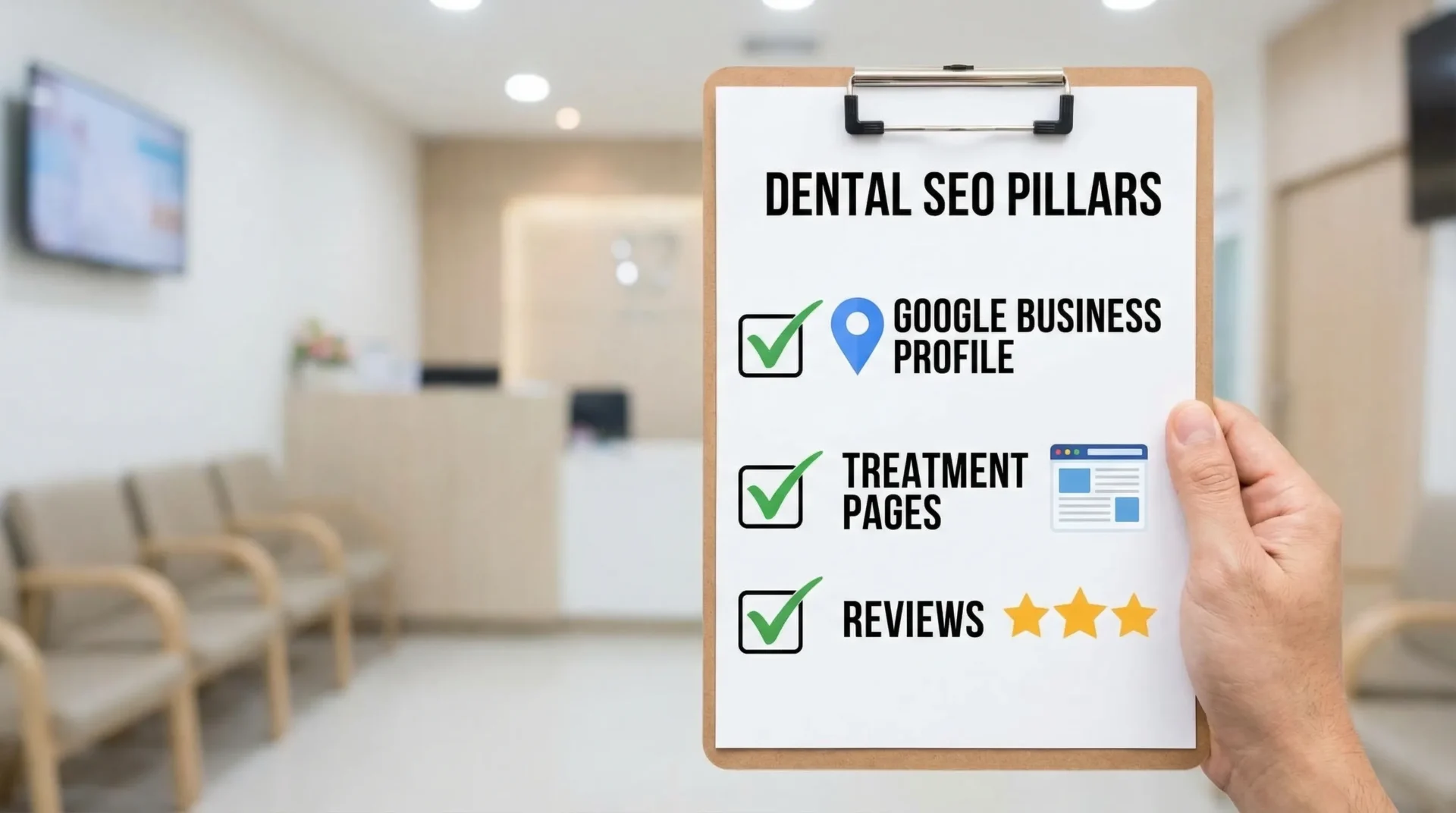
“Get my dental practice on Google”: the 3 visibility layers that matter
When someone says “get my dental practice on Google”, they usually mean one (or all) of these:
- Google Maps visibility (Google Business Profile)
- Organic rankings for local searches
- Trust signals that make people choose you once they land on your listing or site
If any one layer is weak, your competitors take the enquiry.
Layer 1: Google Business Profile (GBP), your biggest lever for local patients
For local SEO for dentists, your Google Business Profile is often the main driver of calls.
Start with the basics, then optimise like a marketer.
| GBP element | What to check | Why it impacts patient enquiries |
|---|---|---|
| Primary category | Use the most accurate primary category (typically “Dentist” or specific type where appropriate) | Category relevance affects Maps rankings |
| Services | Add core services (Invisalign, implants, cosmetic, emergency) | Helps you appear for treatment searches |
| Photos | Real practice photos, team, exterior signage | Builds trust and improves engagement |
| Reviews | Consistent review velocity and professional responses | Strong conversion factor (and local relevance) |
| Opening hours | Accurate, including bank holidays | Prevents bad experiences and negative reviews |
| Location signals | Correct pin, address format, service area only if applicable | Avoids confusion and suppressed visibility |
Google’s own guidance is worth following closely, especially around eligibility and representing your business accurately. See Google Business Profile guidelines.
Layer 2: Your website being crawlable, indexable, and locally relevant
If your site can’t be properly crawled or indexed, you will struggle to rank, even with great content.
If you suspect a technical issue, SEO Bridge has a practical breakdown of common causes in Why Your Website Isn’t Showing Up on Google (And How to Fix It).
Layer 3: Trust and conversion, the difference between traffic and patients
In healthcare, trust is the product. For dentists, this is amplified by:
- Price sensitivity (especially for private treatments)
- Fear and anxiety
- Aesthetic outcomes (Invisalign, veneers, bonding)
- Choice overload (patients compare several practices)
So SEO for dentists is not just rankings. It’s getting the click, then converting it into a call or booking.
Why your dental practice is not showing on Google Maps (and how to fix it)
The query “why is my dental practice not on Google maps” is more common than you’d think. In most cases, it’s one of these problems:
- Your GBP is unverified or has verification issues
- Your address or pin is inconsistent (sometimes caused by suite numbers or formatting changes)
- You chose the wrong primary category
- You have duplicates (old practitioners, old locations)
- You moved location and didn’t handle updates cleanly
- You have weak prominence signals (few reviews, limited citations, minimal local authority)
If you need a broader “get found” checklist that includes Maps plus organic results, this SEO Bridge guide is a useful companion: How To Get My Business On Google.
Local SEO for dentists: what to build on your website (so Google understands you)
If you want to grow a dental practice online, you need pages that mirror how patients search.
1) Create (or improve) your treatment pages for high-value ROI
For marketing for private dentists UK, treatment pages are where ROI happens because they align with commercial intent.
Prioritise pages for:
- Invisalign
- Dental implants
- Veneers
- Composite bonding
- Teeth whitening
- Emergency appointments
Each page should answer what patients actually ask:
- Who is it for (and who it’s not for)?
- What’s involved, step-by-step?
- Typical timelines
- Pricing approach (even ranges or “from” guidance can help, if accurate)
- Aftercare and risks (written carefully, professionally)
- Clear next step (consultation booking, call, assessment form)
2) Add location relevance without spam
You do not need to plaster “Chester dentist” in every sentence.
Instead:
- Put your full address in the footer
- Embed a map on your contact page
- Use consistent name, address and phone number (NAP)
- Mention nearby areas naturally where it’s true (for example, “serving patients from Chester, Ellesmere Port and Wrexham”)
If your practice is in Cheshire, also think about practical catchment searches from surrounding counties where patients may travel for private treatments, such as parts of Greater Manchester, Merseyside, Staffordshire and North Wales.
3) Build one strong “Private dentistry” page (especially right now)
With NHS access issues still affecting patient choices, many people search “private dentist near me” because they assume it’s their only option.
A good private dentistry page should:
- Explain what “private” means at your practice (availability, appointment length, treatment options)
- Set expectations on pricing without being vague
- Include clear next steps for new patients
This is one of the simplest ways to get more private dental patients online, because it aligns directly with what people are searching today.
Dentist marketing UK: the on-page SEO details that move rankings
On-page SEO is where many dental sites underperform because the basics are missing or duplicated across pages.
Here’s what tends to make the biggest difference:
Page titles that reflect real searches
Bad: “Services | Smile Clinic”
Better: “Invisalign in Wilmslow | Clear Aligners Consultation”
Headings that help both Google and skimmers
Use one clear H1 per page, then structured H2 sections.
Internal links that guide patients to book
Treatment pages should link to:
- Fees or finance info (if you have it)
- Before and after galleries (if compliant and permissioned)
- The booking/contact page
If you want a broader framework that ties SEO to leads rather than vanity traffic, SEO Bridge lays it out in SEO Services: The 5 Building Blocks That Drive Leads.
Content that drives enquiries: answer what patients ask (then earn the click)
If you’re asking “how do patients find a dentist online?”, a big part of the answer is: they search their symptoms, fears, and desired outcomes.
Good content topics are not fluffy blog posts. They are practical pages that reduce uncertainty.
Examples that tend to convert well:
- “Invisalign vs fixed braces: what’s better for adults?”
- “How long do dental implants last?”
- “Is composite bonding worth it?”
- “I’m nervous about the dentist: what to expect at your first appointment”
This approach supports SEO for dental practices and also makes your practice feel human.
Add E-E-A-T signals (especially important in healthcare)
Dental websites sit in a high-trust category. Strengthen credibility with:
- Clinician bios with qualifications and GDC numbers
- Clear practice policies (complaints, cancellations, finance where relevant)
- Evidence-led explanations (avoid exaggerated claims)
- References where appropriate
As a general reminder for UK clinics, keep marketing compliant with the standards that apply to dental professionals and advertising.
How to attract more Invisalign enquiries online (without racing to the bottom on price)
If Invisalign is a key growth driver, avoid making your page a price-only pitch. Patients are often choosing based on confidence and outcomes.
A high-converting Invisalign page usually includes:
- A clear suitability section (who it’s ideal for)
- Your consultation process
- What happens if attachments or refinements are needed
- Retainer guidance
- Realistic timelines
- Transparent next step (assessment booking)
Also consider supporting content that addresses comparison searches, because these are common in private dentistry:
- Invisalign vs Spark
- Invisalign cost factors
- Invisalign on finance
Reviews and reputation: the fastest trust builder for local SEO
In competitive areas like Chester, Warrington, Wilmslow, Knutsford, Northwich, Crewe and Nantwich, reviews can be the deciding factor even when rankings are similar.
Practical review improvements (without being pushy):
- Ask at the right moment (after a successful appointment, not at reception rush)
- Make it easy (QR code, follow-up email, simple instructions)
- Respond professionally, including to negative reviews (no patient-specific details)
Reviews help Maps visibility and conversion rate, which is why they’re a core part of local SEO for dentists.
Local authority: citations, local links, and real-world connections
To Google, a practice that is referenced consistently across the web looks more established.
Focus on:
- Core citations (major UK directories and dental-specific platforms where appropriate)
- Local sponsorships (sports clubs, community initiatives)
- Partnerships with complementary services
A practical example of complementary care is creating a patient resources page that signposts related support beyond dentistry, such as a reputable speech and language therapy centre for patients who may benefit from wider communication or therapy services.
The goal is not linking for the sake of it, it’s demonstrating real-world relevance and trust.
If you’re not being found in AI search, it’s usually the same fundamentals
More patients are now discovering providers via AI-driven results (Google AI features, and conversational tools). These systems still rely heavily on the same inputs:
- Clear service definitions
- Strong local entity signals (practice name, address, reviews, citations)
- Structured, answer-ready content
If you want to understand what’s changing and how to adapt, SEO Bridge covers the practical steps in AEO and GEO: The Next Step in SEO.
Measure what matters: patients, not just positions
To know whether your SEO is working, track patient-led outcomes.
| Metric | What it tells you | How to track it |
|---|---|---|
| Calls from GBP | Maps performance | GBP insights plus call tracking if used |
| Contact form enquiries | Website conversion | Form tracking in analytics |
| Direction requests | Local intent | GBP insights |
| Booked consultations | Business impact | Practice management system or CRM notes |
| Treatment mix | ROI by service line | Tag leads by Invisalign, implants, emergency, NHS/private |
Rankings are useful, but they’re not the KPI your accountant cares about.
A realistic 30-day plan for a busy dental team
If you’re time-poor (most practices are), you don’t need 100 tasks. You need the right 10.
Week 1: Fix findability
Audit:
- GBP accuracy (categories, services, hours)
- Your contact page and NAP consistency
- Whether key pages are indexed
If you want a structured, professional check without guessing, start here: Shall We Audit Your Website?
Week 2: Build your “money pages”
Prioritise the pages that drive private ROI:
- Invisalign
- Implants
- Cosmetic (veneers, bonding)
- Emergency
Week 3: Improve trust signals
Add or improve:
- Clinician bios
- Reviews strategy
- Case studies/testimonials (where compliant)
Week 4: Strengthen local authority
- Build citations
- Earn 1 to 3 genuine local links (community, partnerships)
- Publish one genuinely useful article that answers a high-intent patient question
When to DIY vs when to bring in help
If you’re thinking, “I could do this, but I won’t have time”, that’s normal. Practice owners and managers should not have to become SEO experts.
A good SEO partner will:
- Translate “traffic” into patient enquiries
- Prioritise what moves the needle for your practice (private vs NHS, high-value treatments)
- Keep everything transparent and measurable
SEO Bridge is Cheshire-based and works with local businesses on lead-focused SEO. If you want to talk through quick wins for your area (Cheshire and surrounding counties) and your treatment priorities, you can start with a no-obligation consultation via the main site: SEO Bridge.