
Search is evolving fast, but not in the way the loudest headlines suggest. Despite constant claims that SEO is finished, the reality is far more practical and far less dramatic.
What is changing is how people interact with search. Users increasingly expect direct answers rather than a list of links. AI powered search experiences now summarise, explain, and combine information instantly. As a result, new terms like AEO and GEO have entered the conversation, often framed as replacements for traditional SEO.
They are not replacements. They are outcomes.
Understanding that difference is what separates long term visibility from short lived tactics.
SEO Still Forms the Foundation
SEO remains the core discipline behind search visibility. It focuses on making content discoverable, understandable, and useful. Technical performance, content quality, relevance, authority, and user experience still matter because they influence how systems evaluate trust.
Even in AI driven environments, search engines need reliable sources. They still crawl pages, assess structure, interpret meaning, and measure credibility signals across the web. None of that disappears simply because the interface looks different.
SEO has not stopped working. It has expanded in scope.
What AEO Is Really About
Answer Engine Optimisation is best understood as a shift in output rather than a new practice. Instead of optimising purely for rankings, the focus moves toward being selected as the answer.
This requires content that is clear, specific, and unambiguous. Pages that directly address questions perform better than those that circle around a topic. Well structured sections, concise explanations, and logical progression make it easier for systems to extract meaning.
AEO does not require abandoning SEO principles. It rewards strong fundamentals executed with clarity and intent.
If a human can quickly understand your content and trust it, an answer engine can too.
Where GEO Fits In
Generative Engine Optimisation focuses on inclusion within AI generated responses. These systems do not just pull from one page. They synthesise information from multiple trusted sources and rely heavily on authority signals.
This means visibility depends on more than a single well optimised article. Brand presence, consistency, topical relevance, and external validation all play a role.
If your business is not recognised as a credible source within its niche, it is unlikely to appear in generative outputs. This is not a new rule. Authority has always mattered. AI simply applies it at a higher standard.
GEO highlights the importance of reputation and ecosystem visibility rather than page level tricks.
The Problem With Treating SEO AEO and GEO as Separate Disciplines
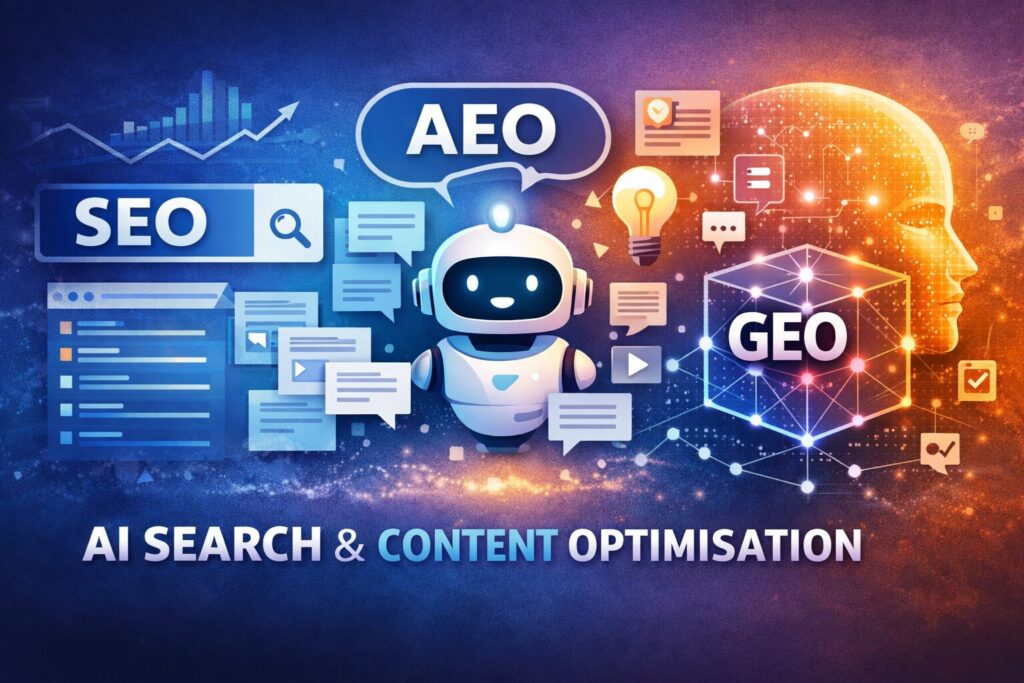
Much of the confusion comes from framing these concepts as entirely different strategies. In practice, they are deeply connected.
SEO focuses on discoverability
AEO focuses on answer suitability
GEO focuses on authority and inclusion
All three rely on the same inputs. High quality content, strong structure, semantic clarity, and genuine expertise.
Splitting them into separate silos risks missing the bigger picture. Optimisation today is not about chasing labels. It is about making content that works across multiple discovery environments.
What Actually Works in Modern Search
Instead of focusing on acronyms, businesses should prioritise principles that consistently deliver visibility.
Clarity matters more than volume. Content should answer real questions directly.
Structure matters more than clever wording. Clear headings and logical flow improve understanding.
Authority matters more than optimisation tricks. Trust is earned over time and across platforms.
Consistency matters more than trends. Repeated signals reinforce credibility.
These principles apply whether content appears in a traditional search result, an AI overview, or a conversational interface.
Why This Matters for Businesses Now
AI powered search reduces friction for users. It also raises the bar for content creators. Only information that is useful, reliable, and well presented earns visibility.
For businesses, this means shortcuts are less effective. Thin content, vague messaging, and surface level optimisation are filtered out faster than ever.
The upside is that strong brands with genuine expertise have more opportunity to stand out. When optimisation aligns with usefulness, everyone wins.
The Real Takeaway
SEO, AEO, and GEO are not competing ideas. They describe how the same work shows up in different places.
If your content is clear, authoritative, and structured with intent, it will perform across modern search experiences. The interface may change. The principles do not.
That is what actually matters in the age of AI search.
