
Most small business SEO advice falls into two unhelpful camps:
- “Just write loads of blogs” (with no plan for leads)
- “Do everything” (which is impossible when you are running the business)
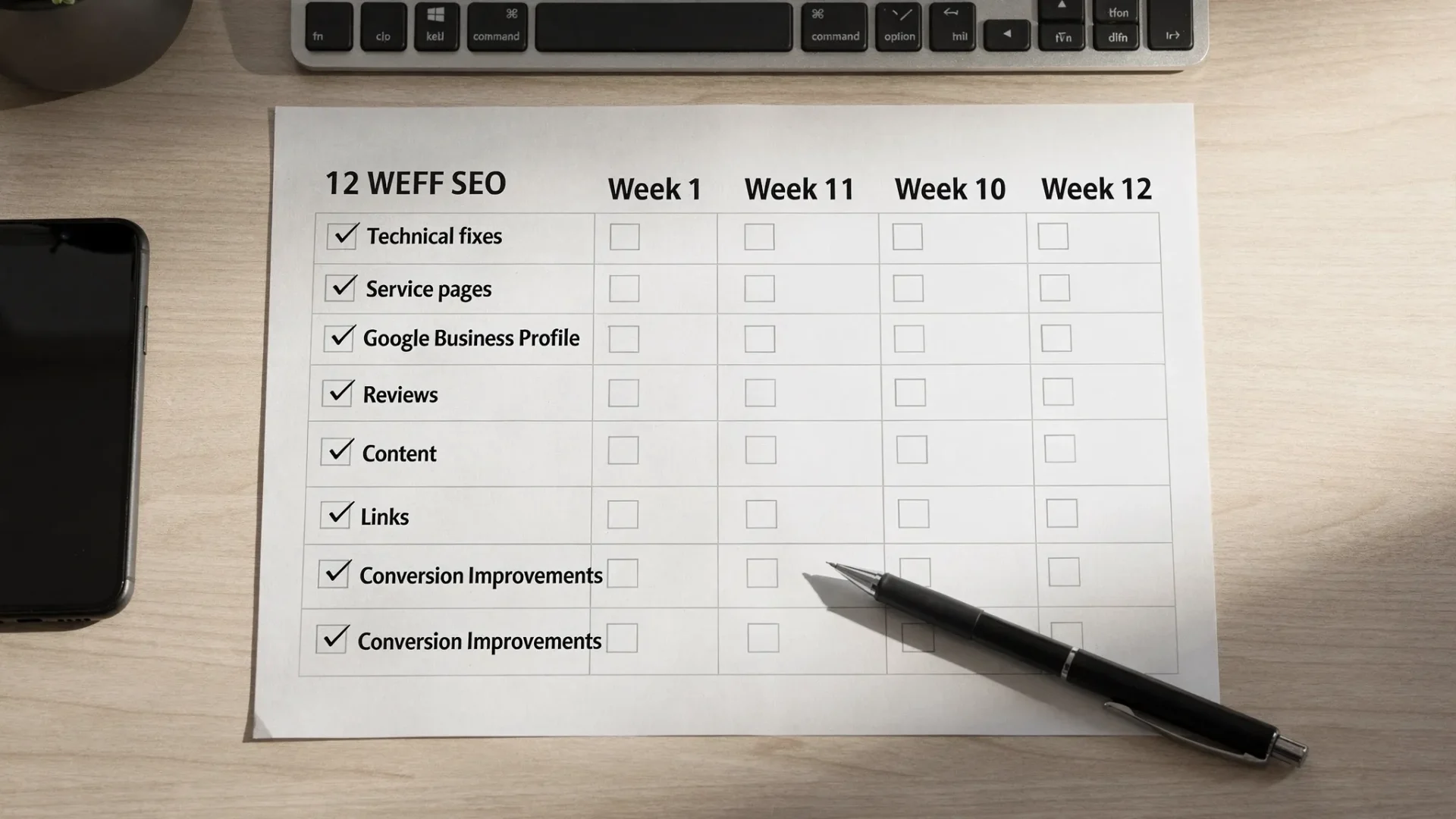
This 12-week plan is what I use to get small business websites moving in the right direction, without fluff, without shortcuts, and without promising magic results.
It works whether you are a trades business in Crewe, a service business in Chester, or an ecom brand selling nationwide, because it focuses on the stuff that actually drives visibility and enquiries: solid foundations, clear pages, local trust, helpful content, and real authority.
Before you start: pick an outcome (not a ranking)
If you only track rankings, you will make bad decisions. Small business SEO should be tied to outcomes like:
- More calls
- More quote requests
- More bookings
- Better quality leads (fewer time-wasters)
Write down your top 2 services and your top 2 locations (or your top 2 product categories if you are ecommerce). That becomes your focus for the next 12 weeks.
Set up tracking in week 0 (it takes 30 minutes)
You need a basic measurement setup before you change anything:
- Google Search Console to see what you already show up for, indexing issues, and clicks
- GA4 (or another analytics tool) to see what visitors do
- A simple lead log (spreadsheet is fine) to note where enquiries came from
If you rely on “I think we got more calls”, you will never be sure what worked.
Here is a sensible baseline for most small businesses:
| What to track | Why it matters | What good looks like in 12 weeks |
|---|---|---|
| Organic enquiries (calls, forms, bookings) | The only metric that pays the bills | Upward trend, even if small |
| Clicks and impressions (Search Console) | Early indicator before leads jump | More impressions on your core services |
| Page-level traffic | Shows which pages drive results | Service and location pages start pulling weight |
| Google Business Profile actions (calls, website clicks) | Local intent is high intent | More actions, not just views |
| Conversion rate (roughly) | Fixes the “traffic but no leads” problem | A small increase can beat big traffic gains |
The 12-week SEO plan (overview)
This is the whole plan in one glance. Then we will break each phase down.
| Week | Focus | Main deliverable |
|---|---|---|
| 1 | Indexing and technical basics | Search Console clean-up and crawlable site |
| 2 | Speed, mobile and UX quick wins | Faster pages, fewer obvious blockers |
| 3 | Keyword and page mapping | Clear target for each key service |
| 4 | On-page improvements | Stronger titles, headings, internal links |
| 5 | Google Business Profile | Proper setup, services, photos, trust |
| 6 | Citations and reviews | Consistent NAP and a review system |
| 7 | Content plan for leads | 4 to 6 topics tied to real enquiries |
| 8 | Publish content that AI can quote | Answer-first pages with FAQs and proof |
| 9 | Local links and partnerships | A shortlist of real link opportunities |
| 10 | Authority content and PR-lite | Case studies, testimonials, mentions |
| 11 | Conversion improvements | Better calls to action and trust signals |
| 12 | Review, refine, repeat | What to double down on next quarter |
Weeks 1 to 2: Get the foundations right (so Google can actually trust the site)
This phase is boring, but it prevents months of wasted effort.
Week 1: Fix indexability and obvious technical issues
Start with Search Console.
Check:
- Pages are indexed (and the right pages)
- Sitemap is submitted
- No accidental noindex tags on key pages
- No duplicate versions of the site (http vs https, www vs non-www)
If your website is new, it is normal to have low visibility at first. What is not normal is making Google guess which version of your site is the “main” one.
If you are on WordPress, make sure your SEO plugin is generating a sitemap and that your core pages are set to index.
Week 2: Improve speed and mobile usability (the small wins first)
Use PageSpeed Insights and focus on the easiest fixes:
- Compress oversized images (especially home page banners)
- Remove unused plugins (WordPress sites get heavy quickly)
- Fix obvious layout issues on mobile (menus, buttons, forms)
Do not chase a perfect score. For most small businesses, “fast enough, usable on mobile, no major errors” is the target.
If you already have a post on UX and SEO, this week is where you apply it properly across the site (navigation, clarity, mobile-first layout, and page speed).
Weeks 3 to 4: Build pages that match what customers actually search
This is where most small business sites fall down. They have one vague “Services” page and expect it to rank for everything.
Week 3: Map keywords to pages (one page, one job)
Keep it simple:
- Pick 5 to 10 money phrases (for example, “boiler repair Nantwich”, “accountant for small business Chester”, “wedding photographer Cheshire”)
- Decide which page should rank for each phrase
- If the page does not exist, add it to your plan
You are aiming for clarity.
If you serve multiple towns, avoid making 20 thin location pages. Instead, build a small set of strong pages around where you genuinely compete (Chester, Crewe, Nantwich, Northwich, and so on) and make them useful.
Week 4: On-page SEO that is not spammy
For each priority page (start with your top 5), tighten:
- Title tag: service + location + a reason to click (no waffle)
- H1: should match the page topic
- First 100 words: say who you help, where, and what you do
- Internal links: link from your home page and relevant blogs to the service page
- FAQ block: 3 to 6 real questions customers ask you
If you want to support AI search as well as Google’s traditional results, structure matters. Clear headings, plain English answers, and specific details make it easier for “answer engines” to pull the right information.
If you are unsure how to write this without sounding robotic, write like you speak to customers on the phone.
Weeks 5 to 6: Local SEO that drives calls (Google Business Profile, reviews, citations)
If you are a local business, your Google Business Profile (GBP) can be your best lead source. In Cheshire towns especially, the map results can be brutally competitive, but they are also where high-intent searches happen.
Week 5: Get your Google Business Profile into good shape
Key fixes I see all the time:
- Wrong primary category
- Services missing or too vague
- No real photos
- No proper description of what makes you different
- No regular activity (posts, updates, Q&A)
Also check that your website link, phone number, and service area are correct.
Week 6: Build consistency (citations) and start a review system
Two things matter here:
- NAP consistency (Name, Address, Phone) across key directories
- A review habit that feels natural
For reviews, do not overcomplicate it. Pick one moment in your process where you ask every happy customer. Consistency beats the “please leave us a review” panic once every six months.
If you work in a trust-based niche (law, finance, medical, high-end services), respond to reviews professionally. It is a trust signal for both people and platforms.
Weeks 7 to 8: Content that brings in leads (and helps with AI visibility)
Blogging is not dead, but “random blogging” is.
This phase is about publishing content that answers real questions your customers ask before they buy.
Week 7: Choose 4 to 6 topics that are tied to sales
Good small business topics usually fall into these buckets:
- Pricing and costs (“How much does X cost in the UK?”)
- Comparisons (“X vs Y, which is better for…?”)
- Process (“What happens when you book…?”)
- Problems (“Why is my… doing this?”)
- Local intent (“Best way to… in Cheshire”, where relevant)
A useful benchmark is: if the post ranks, could it realistically lead to an enquiry?
Week 8: Publish “answer-first” content that AI can quote
AI-driven results (Google AI Overviews, ChatGPT-style search, Perplexity, and others) tend to reward content that is:
- Clear and structured
- Specific and factual
- Supported by proof (experience, examples, reviews, credentials)
A good example of this style, outside of typical local SEO, is businesses that publish genuinely helpful guides and showcase real work. For instance, an elopement filmmaker might attract global search demand by publishing destination guides, planning resources, and strong portfolio proof, like Stories by DJ’s elopement filmmaking and planning approach. You do not need to be in weddings to learn from that, the point is: build content that helps someone make a decision.
Weeks 9 to 10: Build authority and links (without doing anything dodgy)
Links still matter, but most small businesses either ignore them or buy rubbish.
This is where you earn a handful of relevant links that actually make sense.
Week 9: Local links and partnerships
Look for opportunities that are real-world relationships:
- Suppliers and trade partners (ask to be listed)
- Local business associations
- Sponsorships you would do anyway (local sports clubs, events)
- Guest articles on local publications (if you can add value)
If you are in Cheshire, local links can be easier than you think because business networks are tight. A single good local mention can be more valuable than 50 random directory links.
Week 10: Add proof content (the most underused “link bait”)
Create one of the following:
- A proper case study (problem, approach, outcome)
- A before-and-after page (with what changed and why)
- A “how we work” page that answers objections clearly
This improves conversions and it gives you something worth referencing when you do outreach.
Weeks 11 to 12: Turn visibility into enquiries (and lock in the gains)
If you are getting some traffic but not enough leads, it is rarely “because you need more backlinks”. It is often because the website does not make it easy to take the next step.
Week 11: Conversion fixes on your priority pages
Review your top service pages and check:
- Is the phone number obvious on mobile?
- Is there a clear call to action above the fold?
- Do you show trust (reviews, certifications, case studies, guarantees you can genuinely stand behind)?
- Are forms short and usable?
Also check your contact page. You would be amazed how many small business sites make it hard to enquire.
Week 12: Review results and set the next 90 days
In Search Console, look for:
- Queries where impressions rose but clicks did not (often a title or meta description issue)
- Pages that started showing for relevant searches (double down)
- Pages that get traffic but no engagement (content mismatch, weak CTAs, wrong intent)
SEO is a loop. The 12-week plan gives you a foundation and momentum, then you repeat what works.
What you can realistically expect after 12 weeks
No honest SEO person guarantees rankings. What I typically expect from a well-run 12-week push is:
- A cleaner technical base (so future work actually sticks)
- Better visibility for service and location pages
- More relevant impressions and early clicks
- Stronger local signals (GBP actions, reviews)
- A clearer sense of what content and pages lead to enquiries
In most cases, the bigger lead gains land after this initial phase, because trust and authority take time to build.
If you want help: keep it affordable and focused
If you are time-poor, you do not need a massive retainer to get started. You need the right priorities and someone to implement them properly.
If you are looking for a straightforward option, here is our guide to affordable SEO for small businesses in the UK, including what to expect and what to avoid.
Frequently Asked Questions
Do I need to blog every week for SEO to work? No. You need the right pages and content that matches what customers search. For many small businesses, strong service pages and a handful of high-intent articles beat constant blogging.
When should a small business focus on local SEO vs national SEO? If most of your work comes from a defined area (for example, Cheshire towns), start local. If you sell products nationwide or serve clients remotely, build category or service pages around national intent as well.
Is Google Business Profile really that important? If you serve customers locally, yes. GBP is often the fastest path to calls because it shows up at the exact moment someone searches “near me” or “in [town]”.
What is the biggest SEO mistake small businesses make? Being vague. One general “Services” page, no proof, no location signals, and no focus. Clarity usually wins.
Can AI content hurt my rankings? It can, if it is thin, generic, or published at scale without human review. AI is best used to support drafts and speed up production, with real expertise and editing layered on top.
What should I do if I only have 2 hours a week? Spend it on the highest impact items: Google Business Profile, reviews, improving your top service page, and one genuinely helpful piece of content per month.
Want a second pair of eyes on your 12-week plan?
I’m Matt, founder of SEO Bridge in Nantwich. If you want, I can take a quick look at your site and tell you what I would prioritise first (and what I would ignore for now).
Get in touch for a free SEO consultation via SEO Bridge and I will point you in the right direction, whether you DIY it or want hands-on help.
