
If you’ve just claimed your Google Business Profile, tweaked a few pages on your site, and you’re waiting for the phone to start ringing, you’re not alone.
The honest answer to “How long does local SEO take to work?” is: usually a few months to see meaningful movement, and 6 to 12 months to build a proper, defensible position.
That’s not me being vague, it’s just how local search works. Google needs time to crawl changes, test your business in the results, and build trust based on real-world signals (reviews, consistency, links, and how people engage with your listing).
First, what does “local SEO working” actually mean?
Different business owners mean different things by “working”, and if we don’t define it, it’s easy to feel like nothing’s happening.
Local SEO is “working” when you see progress in one (or ideally all) of these areas:
- Google Maps visibility (you appear more often for “near me” and town-based searches)
- Local organic rankings (your service pages show up in the standard results)
- More enquiries (calls, forms, bookings, quote requests)
- Better quality leads (less time-wasters, more people ready to buy)
Rankings are only part of it. I’d rather see a Nantwich trades business get 10 extra quote requests a month from the right searches than “rank number one” for something that never converts.
Typical local SEO timelines (what most small businesses can expect)
Every site and every area is different, but here’s a realistic timeline I use when setting expectations with clients.
| Timeframe | What you can realistically see | What it depends on |
|---|---|---|
| 1 to 2 weeks | Technical fixes processed, Google starts re-crawling pages | Whether your site is crawlable, indexable, and not held back by obvious issues |
| 3 to 6 weeks | Early movement in impressions, a few keyword shifts, Google Business Profile activity rising | How competitive your area is, and whether your GBP and service pages are properly set up |
| 2 to 3 months | Clearer ranking trend, more map appearances, first consistent lead uplift (for many businesses) | Review velocity, location relevance, on-page quality, local links/citations |
| 4 to 6 months | Stronger map pack performance, more stable rankings, better conversion rates from search | Consistency of work, competition, site authority and content depth |
| 6 to 12 months | Proper momentum, wider keyword coverage, stronger brand trust locally | Ongoing content, link earning, reputation building, and keeping the site technically sound |
A useful reference point: Google’s own documentation notes that SEO changes can take time to be reflected because crawling, indexing, and ranking are not instant processes. (See Google Search Central for a plain-English overview of how search works.)
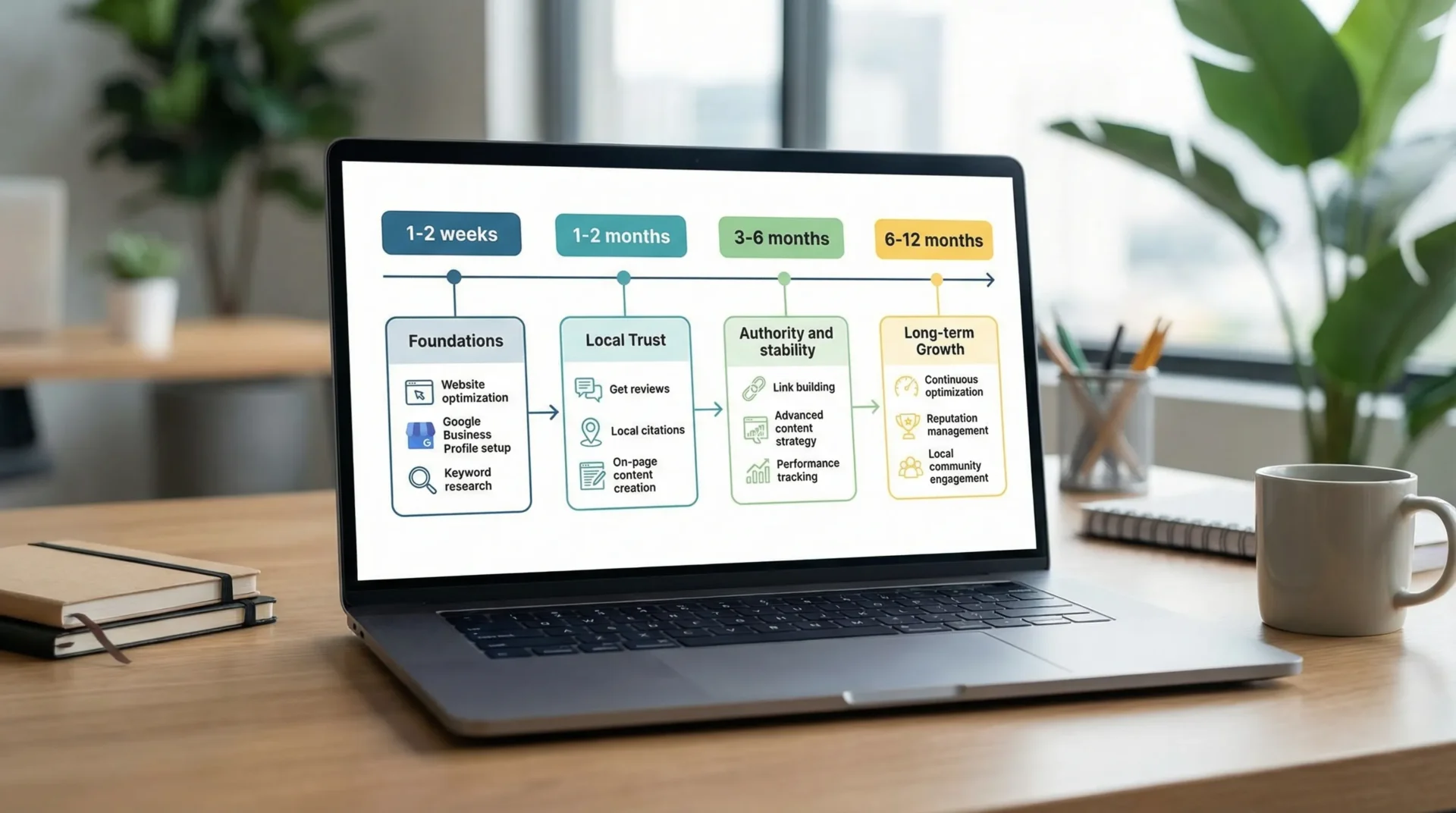
Why local SEO can feel slow (even when you’re doing it right)
Local SEO is part website SEO, part Google Business Profile optimisation, and part reputation building. Some of those signals move quickly, and some take time.
1) Google needs to crawl and re-evaluate your site
Even if you make perfect improvements today, Google still has to:
- Crawl the pages
- Understand what changed
- Decide how those changes affect relevance and quality
- Test your pages against competitors
If your website is new, thin, or messy technically, this stage alone can delay progress.
2) Trust is earned through proof, not claims
You can write “Best electrician in Crewe” on your homepage all day long. Google cares more about proof:
- Consistent business details across the web
- Reviews (quantity, quality, and recency)
- Links and mentions from other local sites
- Evidence you really offer the service in the areas you say you do
3) Your local competition matters more than you think
Local SEO isn’t “you vs Google”. It’s you vs the other businesses already winning.
In some Cheshire towns, you might be competing with a handful of decent websites. In others, you’re up against companies that have:
- Hundreds of reviews
- Multiple location pages
- Years of link building
- Strong local brand recognition
That changes the timeline.
What speeds local SEO up (and what wastes time)
When local SEO drags on, it’s usually because effort is going into the wrong places.
Quick wins (often within the first month)
These are the bits that commonly move the needle early:
- Google Business Profile cleanup: correct categories, services, description, service areas, photos, and regular posts
- Fixing obvious on-site problems: broken pages, slow load times, poor mobile usability, missing titles/headings
- Sorting your core pages: one strong page per service (and clear coverage of your main town/patch)
If you’re in Cheshire, this is where a focused local strategy tends to outperform generic “SEO tips”. Your pages need to match how people actually search in places like Chester, Crewe, Nantwich, Northwich, Sandbach, and the surrounding villages.
Slow burns (but they create stability)
These are the longer-term activities that make results stick:
- Earning decent local links (not spam)
- Building out helpful, service-led content
- Improving conversion rate (turning visitors into enquiries)
- Review generation processes that keep your reputation fresh
Common time-wasters
In my experience, these are the things that make business owners feel busy but don’t build lasting local visibility:
- Chasing “vanity keywords” that don’t bring leads
- Paying for hundreds of dodgy directory links
- Publishing lots of thin AI articles with no real expertise
- Constantly changing direction every two weeks
If you do use AI to help with content, it needs human input and real business knowledge. We cover this properly in our AI SEO blog content service (and what “good” looks like versus content that just fills space).
A simple 90-day plan (what I’d prioritise first)
If you’re trying to work out whether you’re on the right track, here’s a sensible order of operations.
Days 1 to 30: get the foundations right
This is where most businesses see early signs of life, especially in Google Business Profile insights.
Focus on:
- Technical health (indexing, speed, mobile, basics)
- Correct service pages (clear, specific, locally relevant)
- Google Business Profile completeness and consistency
- Tracking (so you can measure calls and forms properly)
On the tracking point, one overlooked issue is form testing and lead routing. If you (or your developer) are QA testing multiple forms, automations, or signup flows, a tool like Mailhook’s programmable temp inboxes can make it easier to confirm emails arrive correctly without using your real inboxes.
Days 31 to 60: build relevance and local proof
Now you’re trying to show Google (and customers) that you’re a legitimate, trusted local option.
This usually means:
- Improving internal linking between related services and locations
- Adding FAQs and structured sections where they genuinely help users
- Starting review generation (and replying properly)
- Cleaning up inconsistent citations and business info online
Days 61 to 90: start building authority
This is where many small businesses start to see more stable movement.
Think:
- A small number of quality local links (partners, suppliers, local press, industry bodies)
- Case studies and proof pages
- More helpful content that answers the questions customers actually ask
How you can tell it’s working (before rankings fully catch up)
Rankings can lag behind reality. Here are the earlier indicators I look for:
- Google Search Console impressions rising for town and service-based searches
- More keyword variety (you show up for more searches, even if not top yet)
- Google Business Profile actions increasing: calls, direction requests, website clicks
- Better engagement on key pages: longer time on page, more people reaching contact pages
- Lead quality improving: fewer “Do you cover my area?” calls, more specific enquiries
If you’re only looking at one keyword in one town, you’ll miss the bigger picture.
What about AI search, AEO, and GEO? Does that change the timeline?
It changes the playing field, but the fundamentals still apply.
In 2026, plenty of customers are getting suggestions from AI tools and AI features in search results. To show up there, you need content that’s easy to extract and trust.
That’s where AEO (Answer Engine Optimisation) and GEO (Generative Engine Optimisation) come in, and why we offer dedicated AI, AEO and GEO services.
In practical terms, it usually means:
- Clear service definitions (what you do, who it’s for, where you do it)
- Strong “proof” (reviews, credentials, case studies, policies)
- Structured layouts (headings, short sections, summary blocks)
- Consistent entity signals (business name, address, phone, service areas)
The good news is that work that helps AI visibility usually helps local SEO too, because it forces clarity.
Why some businesses see results faster than others (a quick checklist)
Here’s a straight comparison of what typically speeds things up versus what slows things down.
| Faster progress usually comes from | Slower progress usually comes from |
|---|---|
| An established domain with some existing authority | A brand new site with no history |
| A properly optimised Google Business Profile | A GBP that’s incomplete or incorrectly categorised |
| Clear service pages targeting real searches | One generic homepage trying to rank for everything |
| Consistent reviews coming in each month | No reviews, or a big gap since the last ones |
| A focused service area | Trying to target 20 towns without substance |
| A site that converts (calls, forms, trust signals) | Traffic that leaks because the site is unclear or slow |
Should you DIY local SEO, or bring in help?
DIY is doable if you’ve got time, patience, and you’re happy learning the basics.
Most business owners I speak to are time-poor, and they’d rather spend their time running the business. That’s where having a one-person specialist who actually does the work (not a sales team) can be a better fit.
If you want an idea of what ongoing help looks like, you can view our SEO packages and the types of businesses we support on our who we work with page.
The bottom line: local SEO is a process, but it shouldn’t feel like a mystery
In most cases, you should expect early signs within 4 to 8 weeks, and more meaningful lead-driven results over 3 to 6 months, assuming the fundamentals are done properly and the competition isn’t extreme.
If you’re unsure whether your local SEO is actually moving in the right direction (or whether you’re wasting time on the wrong tasks), I’m happy to take a look.
If you’d like a straight-talking, no-pressure review, get in touch with me (Matt) at SEO Bridge and request a free SEO analysis. I’ll tell you what I’d prioritise first and what kind of timeline is realistic for your area and industry.
