
Search has changed a lot in the last few years, but the reason most small businesses care about SEO is still the same: you want the right local people to find you, trust you, and contact you.
If you’ve ever typed “plumber near me”, “accountant in Chester”, or “best kitchen fitter Cheshire” and clicked one of the top results, you’ve used SEO in action.
This guide explains SEO (Search Engine Optimisation) in plain English for 2026, including what’s new with AI-driven results and what to focus on if you want more leads in Cheshire and nearby counties.
SEO, what is SEO (in one simple definition)?
SEO is the process of improving your website and online presence so you show up more often, and more prominently, when people search for what you sell.
That includes traditional Google results, Google Maps, and increasingly, AI-powered answers (like Google’s AI Overviews and other “answer engines”).
A useful way to think about it:
- Search engines are matchmakers. They try to match a searcher with the most helpful, trustworthy result.
- SEO is how you help the search engine understand your business, and how you prove you’re a good match.
How SEO actually works (crawling, indexing, ranking)
Search can feel mysterious, but the mechanics are straightforward.
Crawling
Google and other search engines use automated programs (often called “bots” or “crawlers”) to discover pages on the web.
Indexing
If a page is accessible and meets certain requirements, it can be added to the search engine’s index (its huge database of pages).
Ranking
When someone searches, Google chooses which indexed pages to show and in what order. Ranking decisions consider many factors, but they generally boil down to:
- Relevance: does your page match what the person asked?
- Quality and helpfulness: does it actually answer the question well?
- Trust and authority: is the business and content credible?
- User experience: is the page fast, mobile-friendly, and easy to use?
Google’s own documentation is worth skimming if you want the official view: Google Search Essentials.
What’s different about SEO in 2026?
If you last looked at SEO years ago, a few shifts matter for local businesses.
1) Search results are “busier”, so visibility is more than ranking #1
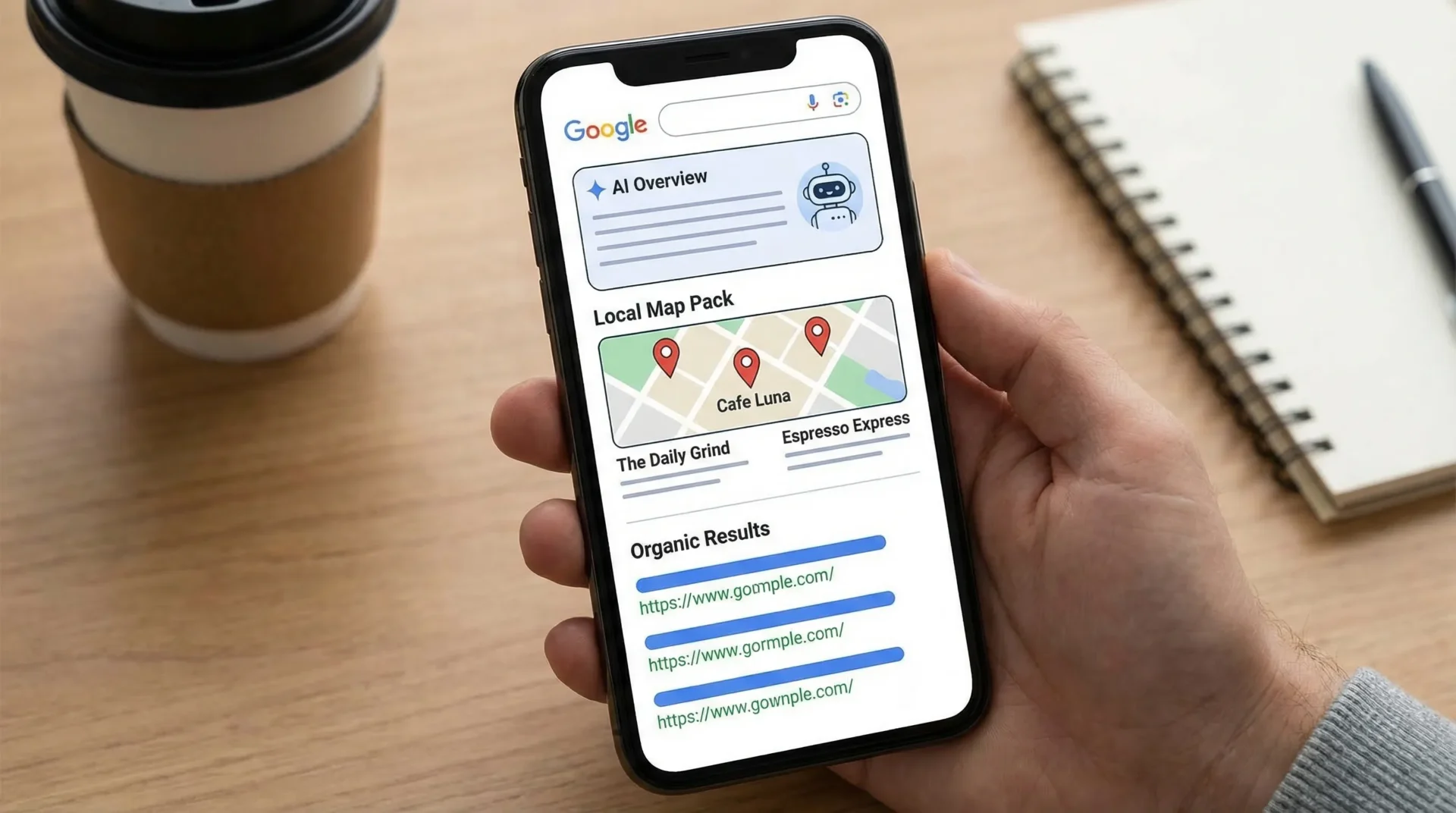
A modern results page might include:
- A map pack (Google Maps listings)
- An AI Overview (a summarised answer)
- People Also Ask boxes
- Service ads or shopping elements
- “Organic” website results
So the goal is not just “rank my homepage”. It’s:
- Own the map pack for your service area
- Be the best result for high-intent searches
- Be easy for AI systems to cite and summarise
2) AI search rewards clarity, structure, and credibility
AI-driven search experiences pull from sources that are easy to interpret and trust. That means:
- Clear page structure (headings, scannable sections)
- Specific answers (not waffle)
- Real-world proof (reviews, case studies, credentials)
- Consistent business details across the web
3) “Just blogging” is not a strategy anymore
Content still matters, but in 2026, volume alone rarely wins. The winners publish:
- Pages that match real customer intent (quotes, bookings, emergency call-outs, comparisons)
- Local proof (projects in Chester, Crewe, Macclesfield, etc.)
- Helpful service information (pricing approach, process, timelines, what to expect)
The 5 parts of SEO that matter most for small businesses
You’ll hear lots of jargon, but most SEO work fits into these buckets.
1) Local SEO (Maps, reviews, service area signals)
For Cheshire businesses, local SEO is often the quickest path to leads because it targets people who are ready to buy.
Local SEO includes:
- Your Google Business Profile (GBP)
- Reviews and review responses
- Accurate business info (name, address, phone)
- Location/service pages on your website
- Local links and citations (relevant directories and local organisations)
If your priority is “get my business on Google”, GBP is the starting point. Google’s own setup guidance is here: Create a Business Profile.
2) On-page SEO (helping each page make sense)
On-page SEO is about making it obvious, to both humans and search engines, what a page is about.
Key elements:
- Page titles that match real searches
- Headings that make the page easy to skim
- Copy that answers the question better than competitors
- Internal links that guide visitors (and crawlers) to related pages
- Images with descriptive alt text
If you serve multiple towns, this is where you can naturally reflect that, for example:
- “Boiler repair in Chester and Ellesmere Port”
- “Commercial cleaning across Warrington and Greater Manchester”
Only do this when it’s true. Overstating locations can backfire.
3) Technical SEO (so your site can be crawled, indexed, and trusted)
Technical SEO is less glamorous, but it’s often where easy wins hide, especially on newer or DIY-built sites.
Common foundations:
- Your site is indexable (no accidental “noindex” tags)
- Pages load quickly on mobile
- HTTPS is enabled
- Clear navigation and clean URLs
- Broken links and redirect issues are fixed
A practical place to start is Google Search Console, which tells you whether Google can index your pages and what issues it finds.
4) Content that earns clicks and converts (not just “SEO content”)
In 2026, “content” is not just blogs. It includes:
- Service pages
- Location pages (when relevant)
- Case studies
- FAQs embedded inside service pages (without needing a big FAQ section)
- Comparison pages (“X vs Y”, “best option for…”) when appropriate
The best content for leads is usually bottom-of-funnel content that helps someone decide:
- What’s included
- Who it’s for
- What it costs (even ranges or “how pricing works”)
- How fast you can start
- Why you are a safe choice
5) Authority (links, mentions, and real-world proof)
Google still needs ways to judge who’s credible.
Authority signals can include:
- Relevant backlinks (local press, suppliers, partners, trade associations)
- Mentions of your business across the web
- Strong reviews and reputation signals
- Consistent branding and clear ownership details
For many local firms, this can be as simple as building relationships in the area and making sure those relationships are visible online.
“Getting my business on Google”: what to prioritise first
If your main goal is local lead generation in Cheshire, focus on the parts that directly influence visibility and conversion.
Here’s a realistic priority order.
Step 1: Make sure Google can find and trust your basics
- Set up Search Console and submit your sitemap (your web platform can usually generate this)
- Ensure your site is secure (HTTPS)
- Make your contact details easy to find on every page
Step 2: Build a strong Google Business Profile
A high-performing GBP usually has:
- Correct categories (primary and secondary)
- A clear description of services and service area
- Products/services filled in (where relevant)
- Regular photos (your work, team, vehicles, premises)
- Consistent opening hours
- A review plan (and real responses)
Step 3: Create one great page per core service (then expand)
Instead of launching ten thin pages, build one excellent “money page” for each core service.
A strong service page typically includes:
- What the service includes
- Who it’s for (and who it’s not for)
- Service area (Cheshire towns you genuinely cover)
- Proof (reviews, accreditations, photos, case studies)
- Clear call to action (call, form, book)
Step 4: Add local proof that competitors cannot copy
Local proof is a major differentiator.
Examples:
- “Recent project in Knutsford” case study
- Before/after photos from a job in Northwich
- A short write-up of work completed for a business in Wilmslow
This is also the type of information AI systems often find useful because it’s specific and verifiable.
A simple 30-day SEO starter plan (built for local leads)
If you want structure without overwhelm, use this as a first month roadmap.
| Week | Focus | What “done” looks like |
|---|---|---|
| Week 1 | Tracking and access | Search Console set up, Analytics (or equivalent) installed, you can see impressions, clicks, and indexing status |
| Week 2 | Google Business Profile | Categories correct, services added, photos uploaded, review request process in place |
| Week 3 | Core pages | Homepage and 1 to 3 service pages improved (clear titles, headings, strong CTAs, real proof) |
| Week 4 | Technical and speed | Major issues fixed, mobile experience checked, key pages tested in PageSpeed Insights |
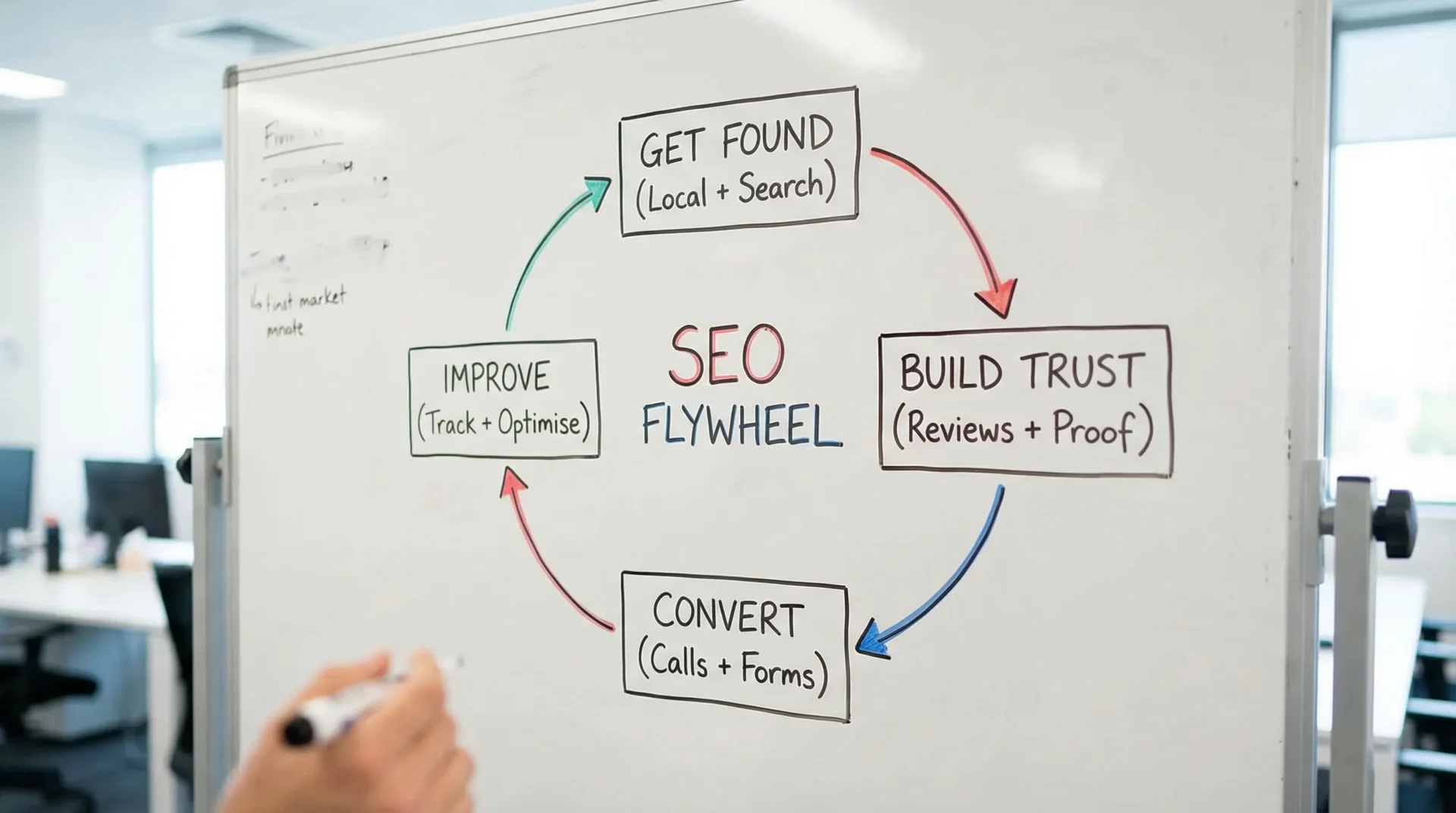
After 30 days, you should have a cleaner foundation and better local visibility signals. From there, SEO becomes an ongoing loop: improve pages, earn trust, measure results, repeat.
How long does SEO take to work?
For local businesses, you can sometimes see movement in weeks, especially in Google Business Profile visibility, but it depends on:
- How competitive your niche is (for example, “electrician Chester” is tougher than a niche B2B service)
- Whether your website has technical issues
- How strong your competitors’ map listings and reviews are
- How much credible local proof you can add
The most reliable way to think about it:
- SEO is compounding: small improvements stack up.
- The goal is not traffic for its own sake: it’s enquiries from the right people.
What SEO is not (and what to watch out for)
A few misconceptions still cause wasted spend.
SEO is not a one-time task
Competitors keep improving, search results keep changing, and your own services change. SEO needs maintenance.
SEO is not “add keywords and you’re done”
Keyword stuffing is outdated. Modern search systems care more about intent, clarity, and usefulness.
SEO is not only about Google
Yes, Google dominates, but discovery now includes:
- Google Maps
- Apple Maps (especially for iPhone users)
- AI tools that summarise and recommend businesses
A good SEO approach strengthens your whole digital footprint, not just one ranking.
SEO is not a guarantee
No reputable agency can honestly guarantee a #1 ranking, because search engines are not under anyone’s direct control. What you can do is follow best practice, track outcomes, and make steady gains.
Cheshire-specific SEO: what often makes the difference
If you’re trying to generate more leads in Cheshire and surrounding counties (Merseyside, Greater Manchester, Staffordshire, Lancashire, Derbyshire, Shropshire), a few patterns come up repeatedly.
Map pack performance is often the lead engine
Many service businesses get a significant share of calls from Maps. That means reviews, proximity, categories, and on-profile activity can matter just as much as the website.
“Service area” needs to be believable
A page that claims you serve 40 towns can look generic. It’s usually better to:
- Focus on your true core areas (for example, Chester, Ellesmere Port, Frodsham)
- Add supporting evidence (jobs completed, testimonials, photos)
- Expand gradually as you build authority
Conversion matters more than you think
Getting more visibility is only half the job. Your site needs to turn visits into enquiries.
Quick conversion checks:
- Is your phone number tappable on mobile?
- Do you show reviews or trust badges where decisions are made?
- Is there a clear next step on every key page?
When it makes sense to hire help (and what to ask)
DIY SEO is possible for many new businesses, but hiring help is worth considering if:
- You need leads quickly and competition is strong
- Your site has technical issues you cannot diagnose
- You’re investing in a new website and want SEO baked in
- You want consistent reporting and accountability
If you do speak to an agency, focus the conversation on outcomes and process, not buzzwords. This guide can help you evaluate options: How to choose the right SEO marketing agency in 2026.
Want a practical next step?
If you’re based in Cheshire (or nearby) and you want to know what’s realistically stopping you from showing up on Google and Maps, a focused audit usually reveals the fastest wins.
- For a broader step-by-step on local visibility, read: How to get your business on Google
- If calls are your priority, this is the most relevant guide: Local SEO services, how to get more calls in Cheshire
- If you want a second opinion on your site’s SEO foundations, you can request a free SEO consultation with SEO Bridge
SEO in 2026 is less about tricks, and more about being the clearest, most trustworthy answer for the searches that matter. Do the basics well, add real local proof, and keep improving based on what the data tells you.
