
The Complete Guide to Local SEO for UK Small Businesses (2026) | SEO Bridge
The Complete Guide — Updated April 2026

Local SEO for UK Small Businesses: Everything You Actually Need to Know

No jargon. No fluff. A straight-talking guide to getting your business found by local customers on Google — written for business owners, not SEO specialists. If you want more calls, more enquiries and more customers finding you rather than your competitors, this is where to start.

Written by Matt Warren, SEO Bridge 10+ years hands-on experience 5,500+ words 15 min read
Local SEO guide for UK small businesses — SEO Bridge
What local SEO actually is Google Business Profile Reviews and citations Technical SEO basics Full checklist included
In this guide

The Complete Guide to Local SEO

Here is the situation most small business owners find themselves in. You have a website. It looks decent. You have been trading for years and your existing customers love you. But when someone in your town types your service into Google, your business does not appear anywhere near the top.

Meanwhile a competitor with a worse service and a more basic website is sitting in the top three results and picking up all the new customers you are not even getting a chance to speak to.

That is not bad luck. That is a local SEO gap — and this guide explains exactly how to close it. We will keep it practical and plain throughout. If a term sounds like jargon, we will explain it before we use it.

Section 1

What Is Local SEO?

Local SEO stands for local search engine optimisation. In plain English, it is the work you do to make your business appear when someone nearby searches for what you offer.

When someone in Nantwich searches for “plumber near me”, Google does not just look for websites with the word “plumber” on them. It looks for plumbers that appear trustworthy, relevant and local. Local SEO is the process of making your business look like the obvious answer to that question.

There are three places a local business can appear in Google search results:

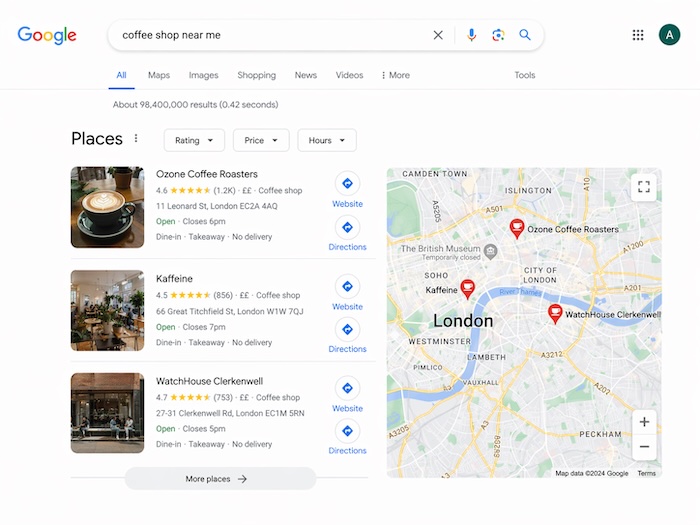
  • The map pack — the box with a map and three business listings near the top of the page. This is often the most valuable position because it appears before the organic results and includes a click-to-call button.
  • Organic results — the standard blue link results below the map pack. These come from your website rather than your Google Business Profile.
  • Google Maps directly — when someone opens Google Maps and searches for a type of business nearby.

Local SEO covers all three. It is not just about your website. It is about your entire online presence — your Google Business Profile, your reviews, how consistently your business details appear across the internet, and how well your website backs up what you do.

The key difference from regular SEO

Regular SEO focuses on ranking for broad national searches. Local SEO focuses on being found by people in a specific area who are ready to spend money. For most small businesses, local SEO is the higher-value priority.

Google Business Profile map pack results

The map pack appears before organic results and captures the majority of clicks for local searches.

46%
Of all Google searches have local intent
76%
Of local searches lead to a visit within 24 hours
28%
Of local searches result in a purchase
Section 2

Why Local SEO Matters for Small Businesses

The numbers above tell one part of the story. Nearly half of all Google searches have local intent. Three quarters of people who do a local search visit a business within 24 hours. That is not research traffic. That is buying traffic.

But there is a more specific reason local SEO matters for small businesses in particular. You are not trying to compete with national companies for national search terms. You are trying to be the most visible option in your town. That is a winnable game — if you understand what Google is looking for.

Consider two businesses. A plumber in Crewe who has never thought about local SEO and a plumber in Crewe who has spent a few hours getting the basics right. The second plumber will almost always appear higher in Google Maps and local results. Not because of a magic trick. Because Google has more confidence in them. That confidence gap is what local SEO closes.

For most local businesses, Google Maps is effectively your website. A customer searching on their phone often calls directly from the map pack result without ever visiting your website. That makes your Google Business Profile one of your most important marketing assets — and we cover it in detail in section 4.

How Google decides who to show

Google publishes its own local ranking factors. There are three. This is not SEO speculation — it is straight from Google itself.

Relevance

Does your listing match the search?

A plumber with services clearly listed and a website that talks specifically about plumbing in their area is more relevant than one whose website just says “welcome to our services page.”

Distance

How close are you?

You cannot move your business for SEO purposes, but you can make your coverage area very clear. If you cover multiple towns, say so explicitly on your website and Google Business Profile.

Prominence

How trusted are you?

Driven by your reviews, directory listings, website authority and backlinks. A business with 80 genuine five-star reviews appears more prominent than one with three reviews from 2019.

Worth knowing

Two of the three factors Google uses — relevance and prominence — are directly within your control. Distance is the only one you cannot change. That means most of your local search position is determined by how well you have set things up.

Section 4

Google Business Profile — Your Most Important Local SEO Tool

Your Google Business Profile (GBP) is the listing that appears in Google Maps and the map pack. It is completely free. It is also the single most impactful thing you can set up for local search visibility — and most businesses barely scratch the surface of what it can do.

Getting the six basics right

1

Claim and verify your listing

Go to Google Business Profile and claim your business. Unverified listings have very limited visibility. Verification usually takes a few days via postcard, phone or video.

2

Choose the right primary category

Your primary category is one of the strongest local ranking signals. Be specific. “Plumber” beats “Contractor”. “Italian Restaurant” beats “Restaurant”. Add secondary categories for other services you offer.

3

Write a proper business description

You have 750 characters. Use them. Describe what you do, who you help and where you cover. Include the names of your main towns naturally — do not keyword-stuff it.

4

List every service you offer

Google has a dedicated services section. Fill it in specifically. If you are a builder who does extensions, loft conversions and new builds, list all three — not just “building services.”

5

Add real photos and keep adding them

Listings with photos get significantly more clicks. Add photos of your premises, team, work and products — then keep adding monthly. Google rewards active profiles.

6

Post regular updates

Google Posts let you publish updates and offers directly on your profile. Posting at least twice a month signals an active, engaged business to Google.

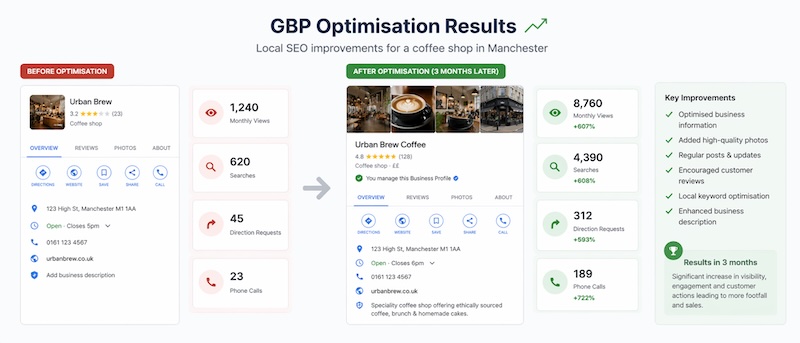
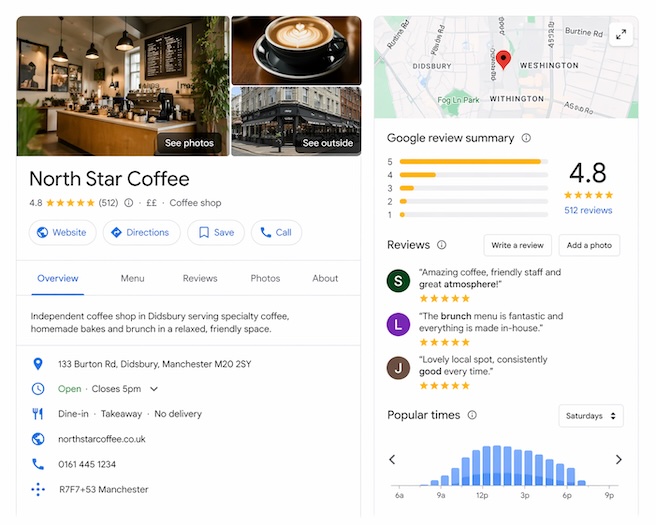
Google Business Profile Optimised Scre

A fully completed profile with services, regular photos and Google Posts consistently outranks neglected listings.

One thing to avoid

Do not add extra keywords to your business name. If your business is “Dave’s Plumbing”, your GBP name should be “Dave’s Plumbing” — not “Dave’s Plumbing Best Emergency Plumber Cheshire 24 Hours.” Google suspends listings for this. Your GBP name must match your actual trading name.

GBP suspension?

If your profile has been suspended, do not just keep resubmitting. Diagnose the reason first, fix it, then submit a properly documented reinstatement request. We cover GBP suspension recovery as a standalone service — find out more here.

Sections 5, 6 & 7

Your Website, Your Reviews & Your Citations

Three things that work together. Your website backs up your Google Business Profile. Your reviews build the trust that makes customers choose you. Your citations tell Google your business details are consistent and real.

📄

Your website and local SEO

Your GBP gets you seen in Google Maps. Your website gets you chosen once someone clicks through. Google cross-checks the two — if your GBP says kitchen fitter in Chester but your website never mentions kitchens or Chester, Google gets confused. Each main service needs its own page. Each town you cover should appear clearly on relevant pages. Phone number visible without scrolling. Every page should have a unique, descriptive title.

View our onsite optimisation service →

Reviews and reputation

Reviews are one of Google’s most important local ranking signals — and the first thing a potential customer reads. Ask at the right moment (straight after a job). Send a direct link to your Google review form. Reply to every review, good and bad. Never buy fake reviews — Google detects them, suspends listings for them, and they are illegal under UK consumer protection law. A business with consistent, recent, genuine reviews beats everyone else almost every time.

How we help with review strategy →
🔗

Citations and NAP consistency

A citation is any online mention of your business name, address and phone number. The more reputable places you appear, the more prominent Google considers you. But consistency is just as important as quantity — your name, address and phone number must be identical everywhere. One format, used without exception. Start with Google Business Profile, then Bing Places, Yell.com, Thomson Local, Facebook and your industry directories. Check and fix any discrepancies on existing listings.

View our link building service →
Section 8

Content That Attracts Local Customers

Content does not mean writing blog posts for the sake of it. It means creating pages and articles that answer the questions your ideal customers are actually asking when they search Google.

Think about what someone in your area would type into Google when they need your service. Not just “plumber Nantwich” — but also “how much does a boiler service cost in Cheshire”, “do I need a plumber for a dripping tap”, or “emergency plumber Chester open Sunday.” Each of those is a potential page. Each one brings in a customer who is thinking about spending money in your service area.

The most important thing to understand is that Google wants specific pages for specific intent. A single “Services” page with eight bullet points will not rank for any of them. You need dedicated pages for the services and locations that matter to your business. This is one of the biggest gaps we see on audits — businesses with brilliant services but nothing on their website that matches what customers actually search for.

What this looks like in practice

A plumber in Nantwich who also covers Crewe and Sandbach should have a page for boiler repair, a page for emergency callouts, a page for bathroom fitting — and ideally a location page for each main town. Not thin, duplicated pages with the town name swapped out, but pages with genuinely local content. See our guide to onsite optimisation for more on how to structure these.

The content types that work best

Content type
What it achieves
Service pages
e.g. Boiler Repair Nantwich
Ranks for specific service searches in your area. Converts visitors into enquiries directly.
Location pages
e.g. Electrician in Crewe
Ranks for searches in each town you serve. Only works with genuinely different content per location.
FAQ articles
e.g. How much does a loft conversion cost?
Captures early-stage research searches and builds trust before the customer is ready to call.
Case studies
e.g. Kitchen extension in Sandbach
Real proof that beats marketing copy. Ranks for project-based searches and builds instant credibility.
How-to guides
e.g. How to find a reliable plumber
Builds authority and trust. Also increasingly shows up in AI-generated answers (more on this below).
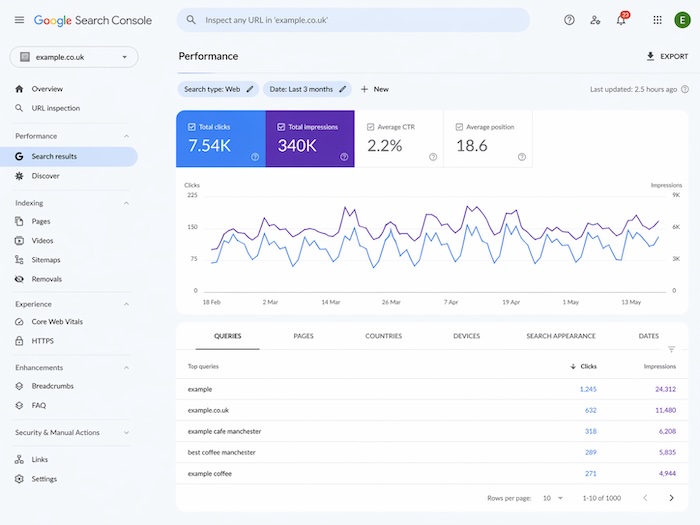
Google Search Console Screenshot

Google Search Console is free and shows you exactly which searches bring people to your site, which pages have problems, and what Google cannot access.

Start here for free

Google Search Console is the free tool that shows you exactly which searches your site appears for, which pages are getting clicks, and any technical problems Google has found. If you do not have it set up, that is your very first action. It takes about ten minutes and gives you more useful information than most paid SEO tools.

Section 9

Technical SEO Basics — What You Cannot Ignore

Technical SEO sounds intimidating. Most of it is not. There are a handful of things that matter enormously for a small business website, and they are all fixable without a complete rebuild.

Mobile-friendliness

Over 60% of local searches happen on a mobile phone. If your website is hard to use on a phone — small text, buttons too close together, content that requires horizontal scrolling — you will lose the visitor before they contact you. Google also gives mobile-friendly sites preferential treatment. Test your site on your own phone right now.

Site speed

Page speed is a confirmed Google ranking factor. Research consistently shows that people leave a website if it takes more than 3 seconds to load on mobile. The most common causes are uncompressed images, too many plugins (particularly on WordPress) and cheap shared hosting. Most are fixable without changing your theme or switching host.

HTTPS — the padlock

Your website should load with a padlock symbol in the browser bar. If it shows “not secure”, visitors will leave immediately and Google will rank you lower. Ask your web host to install an SSL certificate — most provide them free of charge.

Clear, unique page titles

Every page should have a unique title that describes what it is about. A page called “Home” tells Google nothing. A page called “Emergency Plumber Nantwich — Dave’s Plumbing, 24/7” tells Google exactly what it is about and who should click on it.

Schema markup

Schema is a small piece of code that helps Google understand your business details — address, phone, opening hours, services and reviews. Most SEO plugins (like Yoast or RankMath on WordPress) handle the basics automatically. It is worth checking your key business information is properly marked up. Our WordPress SEO service covers schema implementation in detail for WordPress sites specifically.

Section 12

DIY or Hire an Agency?

A lot of the basics of local SEO can be done by a business owner with some time and willingness to learn. The question is whether your time is better spent on those things or on running your business — and whether the more technical elements are things you can handle.

Task
DIY difficulty
Impact if done well
Where to get help
Google Business Profile setup Easy Very high GBP optimisation service
Getting reviews consistently Easy Very high Local SEO service
NAP consistency across directories Easy but time-consuming Medium Local SEO service
Improving page titles and descriptions Easy on most platforms High Onsite optimisation
Writing better service page content Medium High Onsite optimisation
Site speed improvements Difficult without technical knowledge Medium to high Technical SEO / WordPress SEO
Schema markup Difficult without technical knowledge Medium Technical SEO service
Link building Time-consuming and requires strategy High Link building service
Keyword research Medium High — foundation of everything Keyword research service
What to look for in an agency

A good SEO agency should be able to show you exactly what they will do each month, explain how it relates to your rankings, and report in plain English. If someone cannot explain what they are doing in terms you understand, that is a red flag. Look for evidence of work done — case studies, specific examples, a clear change log each month. If all you get is “rankings improved”, you are paying for theatre. Our case studies show real results in plain numbers.

Section 13

Your Local SEO Checklist

Use this as your starting point. If you can tick everything on this list, you are ahead of the majority of small businesses in the UK. If several items are missing, those are your quick wins.

Google Business Profile
  • Profile claimed and verified
  • Business name matches your actual trading name exactly — no keyword stuffing
  • Primary category is as specific as possible
  • Secondary categories added for all relevant services
  • Business description written and near the 750 character limit
  • All services listed with descriptions
  • Opening hours accurate and updated for bank holidays
  • At least 10 photos added including team, premises and work
  • Google Posts published at least twice a month
  • Every review responded to
Reviews and citations
  • Active strategy for consistently asking customers for Google reviews
  • Business listed on Yell, Bing Places, Facebook Business and Thomson Local
  • Business name, address and phone number identical on all listings
  • Listed on relevant trade or industry directories
  • No duplicate GBP listings exist for your business
Website
  • Each main service has its own dedicated page
  • Each town you serve is mentioned clearly on relevant pages
  • Phone number is visible on every page without scrolling
  • Every page has a unique, descriptive title tag
  • Site loads quickly on mobile — test with Google PageSpeed Insights
  • Site is HTTPS with a padlock in the browser bar
  • Google Search Console set up and showing no critical errors
  • Business name, address and phone number appear on the website
  • No pages with thin content that says almost nothing useful
Content
  • Homepage clearly states what you do and where you are based
  • Service pages describe what you offer specifically, not generically
  • At least one piece of content answering a common customer question
  • Content uses natural language, not keyword-stuffed copy
results graphic showing before and after example

Consistent local SEO work over 6 to 12 months produces compounding results — the businesses that start earliest hold the strongest positions.

The honest summary

The Businesses That Win Are the Ones That Just Get It Done

Local SEO is not magic. It is not complicated. It is a series of practical steps that tell Google clearly and confidently who you are, what you do, where you do it, and why you can be trusted.

The businesses that get the best results are not the ones with the biggest budgets or the flashiest websites. They are the ones that get the fundamentals right and stick at it. Reviews keep coming in. The Google Business Profile stays active. The website gets improved a bit at a time. That compound effect over 12 months makes a genuine, measurable difference to how many new customers find you.

If you have read this guide and are not sure where to start, start with your Google Business Profile. It is free, it is the most visible part of your local SEO presence, and the gap between a properly set-up profile and a neglected one is enormous. Fix that first. Everything else can follow.

And if you want someone to tell you honestly what is holding your specific business back — not a generic list but a real look at your site, your rankings and your competitors — that is exactly what our one-off SEO audit is designed to do.

Want a free local SEO review?

We will check your current Google rankings, review your Google Business Profile, look at your website and give you a straight-talking picture of what you are missing. Done by Matt Warren, not a tool. Free, no obligation.

Get Your Free SEO Review

Or schedule a call at a time that suits you.

No obligation — completely free

Ready to Get More Local Customers from Google?

Get a free, no-obligation SEO review from Matt Warren. A real look at your website and rankings by a real person — not an automated report — with honest recommendations on exactly where to start.

We respond quickly — or schedule a call at a time that suits you.

Matt Warren, founder of SEO Bridge
Written by Matt Warren — Founder, SEO Bridge

Matt has been doing SEO since 2007, starting with his own business Warble Entertainment which he built and sold in 2018. He now runs SEO Bridge from Nantwich, Cheshire, helping small businesses across the UK get found on Google. Every client deals with Matt directly — no account managers, no offshore teams, no jargon.